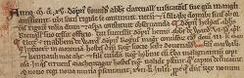
Fearchar mac an t-Sagairt, who became the first Earl of Ross in the reign of Alexander II, emerges suddenly in the historical record in the early thirteenth century as a powerful regional leader whose origins remain obscure. Contemporary sources record little more than his epithet, mac an t-Sagairt (“son of the priest”), leaving the background of the Ross earldom open to later interpretation. Among the most influential attempts to explain these origins was that of William Reeves, whose 1862 study of the cult of St Maelrubha proposed that Fearchar belonged to a hereditary family of lay abbots at Applecross bearing the surname O’Beolan. Reeves based this reconstruction largely on a group of later Gaelic and local traditions referring to a figure known as the “Red Priest,” which he identified as a single historical individual, Patrick the Red of the fifteenth century. This article argues that Reeves’s interpretation rests upon a conflation of distinct traditions. When the references to the “Red Priest” in the Red Book of Clanranald, the Sleat History, the Old Statistical Account, and Lochcarron tradition are examined individually, they do not support the identification proposed by Reeves and may in some cases refer instead to the Applecross saint Maelrubha. Once these traditions are disentangled, the evidentiary foundation for the supposed Applecross origins of the earls of Ross largely disappears.
Fearchar mac an t-Sagairt, who became Earl of Ross in the reign of Alexander II, emerges suddenly in the historical record in the early thirteenth century as a powerful regional leader whose origins remain obscure. Contemporary sources record little more than his epithet, mac an t-Sagairt (“son of the priest”), leaving the background of the Ross earldom open to later interpretation. Among the most influential attempts to explain these origins was that of William Reeves, whose 1859 study of the cult of St Maelrubha proposed that Fearchar belonged to a hereditary family of lay abbots at Applecross bearing the surname O’Beolan. This was not a story that had come down through the ages or that was discovered by reviewing ancient documents. The bulk of Reeves's paper is a carful study of the names, places and traditions still associated with Maelrubha. The difficulty arises in the portion of the paper—typically cited for its implications for the origins of the earldom of Ross—where Reeves turns from Maelrubha to the later “Abbots and Ministers” of Applecross and advances the argument linking Fearchar mac an t-Sagairt, Earl of Ross, to Applecross and to an alleged O’Beóllain kindred. Reeves, in a footnote, thanks his “learned and ingenious friend, W. F. Skene, Esq.” for the first suggestions regarding the O'Beollans. The present article therefore does not treat Reeves’s claim as a settled conclusion but as a testable reconstruction: it reviews each source Reeves cites (and each substantive statement he builds upon), identifies where he misreads, conflates, or overextends the evidence, and then reconstructs—so far as the surviving contemporary record permits—the account that the earliest documents actually support. '''Mention new Y-DNA evidence.'''
The present article therefore does not treat Reeves’s claim as a settled conclusion but as a testable reconstruction: it reviews each source Reeves cites (and each substantive statement he builds upon), identifies where he misreads, conflates, or overextends the evidence, and then reconstructs—so far as the surviving contemporary record permits—the account that the earliest documents actually support.
== William Reeves and Applecross ==
As a Bishop of the Church of Ireland, Reeves's primary interest was the life and veneration of the Irish Saint Maelrubha. Reeves begins his paper by saying, "Next to St Columcille, there is no ecclesiastic of the ancient Scottish Church whose commemorations are more numerous in the West of Scotland than St Maelrubha, or whose history is marked with greater exactness in the main particulars of his life." Maelrubha was a missionary and it is recorded in the Irish annals that in 671 he left Ireland for Scotland, or what was called, at the time of the annals, Alba, and, in 673, founded the church of Aporcrosan. This is the place that is, today, known as Applecross. It appears, however, that during Reeves's lifetime, the Irish Church was not aware of the location of this church of Aporcrosan and the parish of Applecross was not aware of its original connection to this venerated saint of Ireland.
-----
In 1849, Reeves submitted a letter to the Irish Ecclesiastical Journal saying,
This was not a story that had come down through the ages or that was discovered by reviewing ancient documents. This was a theory that came to Reeves during his research into the work of Maelrubha.
:"Dear Sir,—There is a parish in Scotland with the early history of which the statistical writers of that country seem to have been hitherto unacquainted ; and there is a saint in the Irish calendar, the scene of whose devotions has not been previously ascertained by any Irish topographer. The parish is Applecross, and the saint is Maolrubha."
[[William Reeves (bishop)|William Reeves]] presented this paper to the [[Society of Antiquaries of Scotland]] in June of 1859.{{sfn|Reeves|1862|p=[https://archive.org/details/proceedingssoci19unkngoog/page/245/mode/1up 245]}} Here we find the first overt claim of a connection between {{Fearchar}}, Earl of Ross, and the monastery founded by [[Máel Ruba|Maelrubha]] at [[St. Maelrubha's monastery at Aporcrosan|Applecross]].
This was a brief, 2-page letter that offered snippets of Maelrubha's life, his genealogy, his festival, and the clues that connect him to Applecross. It contained no details about the church of Aporcrosan itself or the lives of its inhabitants. There was no mention made in this letter of lay abbots of Applecross or the earls of Ross.
Reeves weaves the questionable tale that, early on, a family named O'Beollan were hereditary farmers of these abbey-lands. He connects these O'Beollans back to the Irish family Ó Beólláin who were hereditary farmers of the abbey-lands of St Columba's church of Drumcliff. In this tale, these O'Beollans were of the ‘same stock’ as Maelrubha and the first Earl of Ross, Mac-an-tsagairt, “son of the priest”, was of this O'Beollan family. He then finds in several sources a Red Priest, or Sagart Ruadh, who he believes to be the last of this line of hereditary farmers of these abbey-lands of Applecross.
A decade later, Reeves followed this letter up with the paper that was presented by the Society of Antiquaries of Scotland on the 14th of June 1859. This was a much more in-depth exploration of Maelrubha, his genealogy, his festival, and the clues that connect him to Applecross and, in fact, many places in Scotland. It included a chapter titled "Local Commemorations" that detailed the ways in which Maelrubha's influence can still be found in the place names, traditions, and celebrations of 21 parishes across Scotland.
Reeves himself was both an antiquarian and Bishop of the Church of Ireland. His primary interest was the life of the Irish Saint [[Máel Ruba|Maelrubha]] and the churches he founded.{{sfn|Moore|1896|loc=[https://en.wikipedia.org/wiki/s:Dictionary_of_National_Biography,_1885-1900/Reeves,_William_(1815-1892) William Reeves]}} This paper was an expansion of an earlier paper that focused on his search for the location of the monastery originally called by the name <span class="insular" style="text-weight:bold;">porcrosn</span> or <span class="insular" style="text-weight:bold;">puor crosn</span> founded in Scotland by Maelrubha.
The Applecross Parish entry specifically contains an additional section titled "Abbots and Ministers". It is here that Reeves explores what he had come to believe was the legacy of Maelrubha's original church of Aporcrosan and its connection to the earls of Ross. This is a small section in a much larger paper. Reeves had clearly gone to great effort to detail the specifics of the life and influence of the saint Maelrubha. In contrast, however, this section on the abbots and ministers of Applecross appears to be a theory pieced to together loosely at the suggestion of others, most notably, Scottish historian Wlliam F. Skene. We know of his contribution because Reeves himself credits him in a footnote, saying, “for the first suggestions regarding the O'Beollans, I am indebted to my learned and ingenious friend, W. F. Skene, Esq.”
The [[Source:Irish Ecclesiastical (Ancient Irish Missionaries)|original paper]] made no mention of an O'Beollan family, a Red Priest, or the Earls of Ross. These names all appear in a section of the subsequent paper titled ''[[#Abbots and Ministers|Abbots and Ministers]]''. It's small part of a much larger paper that concentrates on the life and ancestry of Maelrubha and identifiable locations of his missionary works on the west coast of Scotland. Again, as a Bishop of the Church of Ireland, his primary interest was the life and works of the Irish Saint Maelrubha. He goes so far as to say in the earlier paper that, “it must prove gratifying to every lover of his country to find another missionary treading in the steps of St. Columba.” Maelrubha, not the Earls of Ross, were the primary focus of his research.
== Reeves's Construction of the Evidence ==
Reeves begins the "Abbots and Ministers" section with what is known about Applecross from the Irish annals. There are a total of 11 entries found in three different annals referring to 4 events; Maelrubha’s founding of a church of Aporcrosan, his death, the death of his successor, and the death of a later abbot recorded variously in 797 and 801. Reeves himself points out that, “this is the last reference to the place in the Irish Annals, and, it may be said, in all existing records.” There is no mention again until the presentation of Mr. Alexander MacCloid to the bishop of Ross to grant him the collation over two chaplaincies lying below the parish church of Abilcros. This was in 1515.
The monastery of Aporcrosan, or Applecross, is lost to history. There are no records in existence. What we know of it comes from 4 events mentioned in Irish annals, the last being in the year 801. There is no mention of even the place of Aporcrosan or Applecross found in records for over 700 years. It appears then as the name of a parish church.
Reeves then states, however, that, “There exists, indeed, a vivid tradition of an individual styled the Red Priest of Applecross, who is said to have conveyed to his daughter the rich estates with which this church was endowed.”
== Reeves’s Construction of the Applecross Lineage ==
As we know from Reeves's letter of 1849, he was familiar with the ''Old Statistical Account'' published in 1792. He included a quote from the Applecross Parish entry in that letter, saying, “Close by the parish church, are the remains of an old religious house, where the standard and soles of crucifixes are still to be seen. It was richly endowed with landed property, which tradition relates to have been conveyed, by the last Popish missionary, in the place known by the designation of the Red Priest of Applecross, to his daughter.”
As an antiquarian and Bishop of the Church of Ireland, Reeves's primary interest was the life of the Irish Saint [[Máel Ruba|Maelrubha]] and the churches he founded.{{sfn|Moore|1896|loc=[https://en.wikipedia.org/wiki/s:Dictionary_of_National_Biography,_1885-1900/Reeves,_William_(1815-1892) William Reeves]}}
Reeves then included in his subsequent paper two very different versions of the “story of the Red Priest, as now current in the neighbourhood,” as conveyed to him by “his venerated friend the minister of Lochcarron”. Both of these legends tell the story of how the lands of Applecross came to be in the hands of the Mackenzies. In both versions, the lands were originally in possession of the Red Priest, who is supposed to have been a MacDonald. The version first presented by Reeves explains that they Mackenzies acquired these lands from the Red Priest through marriage to his daughter. Here, Reeves found the details of “the last Popish missionary, in the place known by the designation of the Red Priest of Applecross”, who conveyed the church lands to his daughter.
This section discussing the abbots and ministers of Applecross appears to be a story he just pieced together from details he encountered in his attempt to locate the remains of the original monastery at Applecross and work being doing concurrently by Scottish historian [[William Forbes Skene|William F. Skene]]. As a member of the [[Society of Antiquaries of Scotland]], Reeves would have had opportunity to interact with the likes of William Skene and, in fact, in a footnote, Reeves does credit Skene for several suggestions.
Reeves now turns from the tradition of the Red Priest to the Obeolan suggestion provided to him by his friend, William F. Skene. It comes from the section of a manuscript written in the late 17th century by the Macdonalds and pertaining to Alexander Macdonald, Lord of the Isles and Earl of Ross. Alexander was the son of Donald of the Isles and Mary Leslie, granddaughter of William, 5th Earl of Ross. The earldom of Ross had been inherited by William's daughter Euphemia after his death in 1372.{{sfn|Adam|1991|p=[https://archive.org/details/calendaroffearnt0000unse/page/85/mode/1up 85]}} It followed her line until it Robert Stewart, the Duke of Albany, persuaded her granddaughter to resign it to his son, the Earl of Buchan. Donald Macdonald, Lord of the Isles, then claimed the earldom on behalf of his wife, Euphemia's daughter, Mary Leslie. This conflict was decided at the Battle of Harlaw in 1411 with Mary Leslie becoming Countess of Ross and Donald Macdonald, Earl of Ross, by right of his wife.
Reeves’s study of St Maelrubha and Applecross remains, in many respects, a careful piece of nineteenth-century scholarship, grounded in wide reading and a genuine concern to reconstruct the saint’s cult and historical footprint in Scotland. The difficulty arises in the portion of the paper—typically cited for its implications for the origins of the earldom of Ross—where Reeves turns from Maelrubha to the later “Abbots and Ministers” of Applecross and advances the argument linking Fearchar mac an t-Sagairt, first Earl of Ross, to Applecross and to an alleged O’Beóllain kindred. In contrast to the more source-driven portions of the article, this section is methodologically uneven: it relies heavily on late traditions and secondary suggestions (including material associated with William F. Skene and local ministerial correspondence), and it proceeds by conflating disparate references—most notably those to a “Red Priest”—into a single historical individual. references—most notably those to a “Red Priest”—into a single historical individual.
Reeves quoted a small portion of Alexander's entry in his paper, saying, “this surname Obeolan was the surname of the Earls of Ross, till Farquhar, born in Ross, was created earl by King Alexander, and so carried the name of Ross since, as best answering the English tongue. This Obeolan had his descent from the ancient tribe of the Menapii; of this tribe is also St Rice or Rufus.” As Reeves explained in the paper, Rice and Rufus are two of the endless variety of ways in which Maelrubha's name is presented. So, here, Reeves found a connection between Maelrubha and the earls of Ross.
As an antiquarian and a member of the [[Society of Antiquaries of Scotland]], he had the opportunity to interact with the likes of William Skene.
Reeves included a second extract from a different manuscript, written again by the Macdonalds, at the turn of the 18th century . Also from the section pertaining to Alexander Macdonald, Lord of the Isles and Earl of Ross, the excerpt reads, “Alister [Alexander] had other children, the offspring of the daughter of Gillapatrick Roe [Patrick the Red], son of Rury, son of the Green Abbot, son of the Earl of Ross, whose surname was ''of the Rosses''.” With the addition of this manuscript, Reeves had a genealogical connection from Patrick the Red back to an earl of Ross.
Reeves then makes the statement that, “The Red Priest was Gilla Patrick O'Beollan, whose daughter was married or handfasted to Alexander, Lord of the Isles of Lochalsh, and was mother of Celestine de Insulis, in whose charter of 1467 these lands are included.” By equating the Red Priest and Patrick the Red, Reeves could claim a lineage from a "Red Priest of Applecross" back to the earls of Ross.
{{Tree chart/start|align=center|summary=Earl of Ross from MacVurrich's Gaelic manuscript}}
Again, as an antiquarian and a Bishop of the Church of Ireland, Reeves was familiar with its early history. He was aware of the Irish family Ó Beolláin that was known to have been herenachs of St. Columba's church of Drumcliff, near Sligo. In medieval Ireland, a ''herenach'' was a hereditary ecclesiastical official responsible for managing church lands, collecting parish revenues, and supporting the clergy. Reeves explained that the mother of Maelrubha, Subtan, was the sister of Comgall. It was thought that Comgall may have been a disciple of St. Columba. So, in this way, Reeves made a connection between Maelrubha's church of Aporcrosan, St. Columba's church of Drumcliff, and the Irish family Ó Beolláin. He made the assumption that the O'Beollan family of Patrick the Red was the same as the Ó Beolláin family of St. Columba's church. He then assumed that the tradition of herenach had followed the family from Ireland to Applecross.
Reeves begins with what is known about Applecross from the Irish annals. There are a total of 11 entries found in three different annals referring to 4 events; Maelrubha’s founding of a church of Apor Crosán, his death, the death of his successor, and the death of a later abbot in 797 or 801. Reeves himself points out that this is the last reference to the place in the Irish Annals. There is no mention again until the presentation of Mr. Alexander MacCloid to the bishop of Ross to grant him the collation over two chaplaincies lying below the parish church of Abilcros. This was in 1515.
The monastery of Apor Crosán, or Applecross, is lost to history. There are no records in existence. What we know of it comes from 4 events mentioned in Irish annals, the last being in the year 801. There is no mention of even the place of Apor Crosán or Applecross found in records for over 700 years. It appears then as the name of a parish church.
Reeves constructs his connection from the earls back to Applecross through several late 18th-century and 19th-century documents. He credits noted Scottish historian William F. Skene for the first suggestions regarding the O'Beollans. Skene also shared with him a passage from The Red Book of Clanranald, which Reeves refers to as MacVurrich's Gaelic manuscript. It says, “Alexander had other children, viz., Hugh, by a daughter of Gilpatrick Roy, son of Rory, son of the Green Abbot, son of the Earl of Ross, whose surname was of the Rosses.”
In this passage he finds Gilpatrick Roy, or Patrick the Red, connected genealogically to the earls of Ross.
This Alexander is included in another Macdonald manuscript, the Sleat History, which Reeves calls the legendary history of the MacDonalds. From this, he gets the statement, “Alexander his son succeeded to his father's estate, and was proclaimed Earl of Ross and Lord of the Isles after the accustomed manner, a man born to much trouble all his lifetime. First, he took to him the concubine, daughter to Patrick Obeolan, surnamed the Red, who was a very, beautiful woman. This surname Obeolan was the surnames of the Earls of Ross, till Farquar, born in Ross, was created earl by King Alexander, and so carried the name of Ross since, as best answering the English tongue. This Obeolan had its descent of the ancient tribe of the Manapii; of this tribe is also St Rice or Rufus. Patrick was an abbot, and had Carlebay in the Lewis, and the church lands in that country, with 18 merks lands in Lochbroom.”
From these two manuscripts, then, he constructs the lineage of a Patrick the Red, descended from the earls of Ross whose surname was Obeolan. He also finds a connection to St Rice or Rufus. He explains in great detail in his article that these are references to Maelrubha.
He knows, from previous research, that there is a passage in the Old Statistical Account of 1792 that says, “Close by the parish church, are the remains of an old religious house, where the standard and soles of crucifixes are still to be seen. It was richly endowed with landed property, which tradition relates to have been conveyed, by the last Popish missionary, in the place known by the designation of the Red Priest of Applecross, to his daughter.”
He summed this up by saying,
::“It would seem that the office of ''herenach'', or hereditary farmer of abbey-lands, which was originally, both in Ireland and Scotland, of a clerico-secular character, was, in the case of this church [Applecross], early vested in the family of O'Beollan. They were of Irish extraction, and of the same stock as St Maelrubha, the founder, although their exact descent is forgotten. In the present instance, as in the richly-endowed churches of Dull and Glendochart in Scotland, and of Armagh and Bangor in Ireland, the secular functions of the herenach in process of time gained upon the clerical; and the transmission of the estates, which was originally by election in the founder's kin at large, became limited in direct succession, marriage on the part of the tenants being both allowed and practised. In this manner the church-lands of Applecross became an heirloom in one family, which family, namely O'Beollain, furnished the recipient of the first-created earldom of Ross.”
He sees in this passage a connection between the Red Priest of Applecross and Patrick the Red of the Macdonald histories.
He also has a legend given to him by his “venerated friend the minister of Lochcarron”. It tells the dramatic story of how the lands of Applecross came to be in the hands of the Mackenzies of Coul through the daughter of the Red Priest, who is supposed to have been a MacDonald.
Reeves considers this legend to be the tradition, mention in the Old Statistical Account, that the landed property in the place known by the designation of the Red Priest of Applecross was conveyed by the last Popish missionary to his daughter.
So, Reeves had in front of him,
* Patrick the Red, son of Rory, son of the Green Abbot, son of the Earl of Ross
* Patrick Obeolan, surnamed the Red, an abbot, whose surname Obeolan was the surname of the Earls of Ross and had its descent of the ancient tribe of the tribe of Maelrubha
* The tradition that a Popish missionary, in the place known by the designation of the Red Priest of Applecross, conveyed the property to his daughter
* The legend from a local mister of how the lands of Applecross came to be in the hands of the Mackenzies through the daughter of a Red Priest, who is supposed to have been a MacDonald
He equated Patrick the Red of the Macdonald genealogies with the Red Priest of legend, saying, “The Red Priest was Gilla Patrick O'Beollan, whose daughter was married or handfasted to Alexander, Lord of the Isles of Lochalsh, and was mother of Celestine de Insulis, in whose charter of 1467 these lands are included.”
He then uses this surname O'Beollan to make the connection from Alba, or Scotland, back to the Irish family Ó Beolláin. This Ó Beolláin family is known to have been herenachs of St Columba's church of Drumcliff, near Sligo. Reeves explains that Subtan, sister of Comgall, was mother of Maolrubha. Comgall may have been a disciple of St. Columba. So, Reeves finds this potential connection from Applecross, through Maelrubha, back to Columba and uses it to postulate the connection between an O'Beollan family of Applecross and the Ó Beolláin family of Drumcliff. Further, solidifying his belief that the line of the earls of Ross could be traced back to the Ó Beolláin family of Ireland. And he extends this tradition of Ó Beolláin herenachs of St Columba's church of Drumcliff to O'Beollan herenachs of Maelrubha’s church of Applecross.
From these four sources, all produced over 800 years after the last mention of Apor Crosán in the Irish Annals, Reeves weaves his tale, saying,
There exists, indeed, a vivid tradition of an individual styled the Red Priest of Applecross, who is said to have conveyed to his daughter the rich estates with which this church was endowed, and which, down to his time, had been enjoyed by his predecessors in office.
::It would seem that the office of herenach, or hereditary farmer of abbey-lands, which was originally, both in Ireland and Scotland, of a clerico-secular character, was, in the case of this church, early vested in the family of O'Beollan. They were of Irish extraction, and of the same stock as St Maelrubha, the founder, although their exact descent is forgotten. In the present instance, as in the richly-endowed churches of Dull and Glendochart in Scotland, and of Armagh and Bangor in Ireland, the secular functions of the herenach in process of time gained upon the clerical; and the transmission of the estates, which was originally by election in the founder's kin at large, became limited in direct succession, marriage on the part of the tenants being both allowed and practised. In this manner the church-lands of Applecross became an heirloom in one family, which family, namely O'Beollain, furnished the recipient of the first-created earldom of Ross.
-----
Skene was the source of the excerpt from the Red Book of Clanranald, written circa 1700, that includes the genealogy “Patrick the Red, son of Rury, son of the Green Abbot, son of the Earl of Ross”. This excerpt comes from a passage dedicated to Alexander Macdonald, a descendant of {{Fearchar}} who became both Lord of the Isles and Earl of Ross. It states that Alexander had a son by a daughter of this Patrick the Red.
Reeves also mentions the legendary history of the MacDonalds, written in the late 17th century, but not published until 1847. It also includes a section dedicated to Alexander Macdonald, Lord of the Isles and Earl of Ross. It states that, “First, he took to him the concubine, daughter to Patrick Obeolan, surnamed the Red, who was a very, beautiful woman. This surname Obeolan was the surnames of the Earls of Ross, till Farquar, born in Ross, was created earl by King Alexander, and so carried the name of Ross since, as best answering the English tongue. This Obeolan had its descent of the ancient tribe of the Manapii; of this tribe is also St Rice or Rufus.”</span>{{sfn|Reeves|1862|pp=[https://archive.org/details/proceedingssoci19unkngoog/page/275/mode/1up 275-276]}} Rufus being another name for Maelrubha.
Reeves thanks Skene for what he calls “the first suggestions regarding the O'Beollans”. He is not specific about the details of this suggestion, but we do know that Skene's ''[[The Highlanders of Scotland]]'', first published in 1836, states that, “the oldest authorities concur in asserting the patronymic or Gaelic name of the earls of Ross to be O'Beolan, or descendants of Beolan.” Skene does not name these ‘oldest authorities’, but it's possible that he considered this “legendary history of the MacDonalds” one of those authorities. No other evidence is found to corroborate this connection.
We know that Reeves had access to the ''Statistical Accounts of Scotland''. He mentions them in the opening paragraph of his original article and cites them again in this article. From the [[Applecross Parish, Ross-shire|Applecross Parish]] entry published in the ''[[Source:Old Statistical Account (Applecross)|Statistical Account]]'' of 1792, he finds mention of a Red Priest of Applecross. This entry states that the parish church was richly endowed with landed property which was conveyed by the last Popish missionary to his daughter.{{sfn|McQueen|1792|p=[https://archive.org/details/b21365799_003/page/379/mode/1up 379]}}
The last piece of the puzzle is the story told to Reeves by his friend the minister of Lochcarron. The story of the Sagart Ruadh, or Red Priest, who had a daughter. Legend has it that it was through her that Mackenzies of Coul came to hold the lands of Applecross.
Reeves, therefore, had this legend of a Red Priest whose daughter had the lands of Applecross. He finds in these two Macdonalds manuscripts the concubine of Alexander, the daughter of Patrick the Red, or Patrick Obeolan, surnamed the Red. The Macdonald history states that the surname Obeolan was the surnames of the Earls of Ross and connects Patrick Obeolan to the tribe of Rufus, or Maelrubha. The Book of Clanranald provided a genealogy actually connecting Patrick the Red to an unnamed son of the Earl of Ross.
In this way, Reeves drew a tenuous connection between the Fearchar, Earl of Ross, and the lands of Applecross. He then took it one step further by drawing a connection even further back to the [[Irish Ó Beólláin]] family who were herenachs of St Columba's church of Drumcliff.
Reeves begins by saying,
::<span class="booktext">“There exists, indeed, a vivid tradition of an individual styled the ''Red Priest of Applecross'', who is said to have conveyed to his daughter the rich estates with which this church was endowed, and which, down to his time, had been enjoyed by his predecessors in office.”</span>{{sfn|Reeves|1862|p=[https://archive.org/details/proceedingssoci19unkngoog/page/275/mode/1up 275]}}
Of these predecessors, he says specifically,
::<span class="booktext">“It would seem that the office of herenach, or hereditary farmer of abbey-lands, which was originally, both in Ireland and Scotland, of a clerico-secular character, was, in the case of this church, early vested in the family of O'Beollan. They were of Irish extraction, and of the same stock as St Maelrubha, the founder, although their exact descent is forgotten.”</span>{{sfn|Reeves|1862|p=[https://archive.org/details/proceedingssoci19unkngoog/page/275/mode/1up 275]}}
And,
::<span class="booktext">“... In this manner the church-lands of Applecross became an heirloom in one family, which family, namely O'Beollain, furnished the recipient of the first-created earldom of Ross.”</span>{{sfn|Reeves|1862|p=[https://archive.org/details/proceedingssoci19unkngoog/page/275/mode/1up 275]}}
He gives us his source for these connections when he says,
::<span class="booktext">“The legendary history of the MacDonalds, published by the Iona Club, states that “this surname Obeolan was the surname of the Earls of Ross, till Farquhar, born in Ross, was created earl by King Alexander, and so carried the name of Ross since, as best answering the English tongue. This Obeolan had his descent from the ancient tribe of the Menapii; of this tribe is also St Rice or Rufus.””</span>{{sfn|Reeves|1862|pp=[https://archive.org/details/proceedingssoci19unkngoog/page/275/mode/1up 275-276]}}
Reeves did not originally set out to investigate the Earls of Ross. He was curious, instead, to know the location of the church of Apor Crosán founded by Maelrubha in 673.
His initial letter was well-received and, ten years later, Reeves presented this, much expanded, paper to the [[Society of Antiquaries of Scotland]]. It includes, in the section dedicated to Applecross Parish, a subsection called “[[#Abbots and Ministers|Abbots and Ministers]]”. It is here that he presents what he calls “a vivid tradition of an individual styled the Red Priest of Applecross”. Fortunately, he also provides us with all of the facts and stories that led him to the conclusion that the “office of hereditary farmer of abbey-lands was, in the case of this church, early vested in the family of O'Beollan.” And that “the church-lands of Applecross became an heirloom in one family, which family, namely O'Beollain, furnished the recipient of the first-created earldom of Ross.”
As expected, Reeves focused the bulk of his research on Maelrubha. He presents in the first half of the paper the story of Maelrubha and his ancestry along with a detailed explanation of the confusion between St. Maelrubha of Applecross and St. Ruffus of the Roman Martyrology. The second half of the paper is dedicated to the ways in which St. Maelrubha was commemorated in each of the parishes. Applecross is the only parish in which he includes an ''Abbots and Ministers'' section. It appears to be an attempt to simply round out the contents of the paper as a whole and provide an additional bit of historical context. And, unlike the well-researched majority of the paper, it appears to be just a quick side note based on information obtained from other people.
Reeves begins by saying,
::“<span class="booktext">There exists, indeed, a vivid tradition of an individual styled the ''Red Priest of Applecross'', who is said to have conveyed to his daughter the rich estates with which this church was endowed, and which, down to his time, had been enjoyed by his predecessors in office.”{{sfn|Reeves|1862|p=[https://archive.org/details/proceedingssoci19unkngoog/page/275/mode/1up 275]}}
== The Evidence ==
=== The Irish Annals ===
=== The Irish Annals ===
Everything that is known of Maelrubha's monastery at Applecross comes from entries found in three Irish Annals; the Annals of the Four Masters, the Annals of Tigernach, and the Annals of Ulster.
Everything that is known of Maelrubha's monastery at Applecross comes from entries found in three Irish annals; the Annals of the Four Masters, the Annals of Tigernach, and the Annals of Ulster.
They cover Maelrubha's initial voyage to Scotland and the founding of the church beginning in 671. They end with the reporting of the death of Mac Oige of Aporcrosan in 801. There are no records in existence that were kept by the monestary itself.
They cover Maelrubha's initial voyage to Scotland and the founding of the church of Aporcrosan beginning in 671. They end with the reporting of the death of Mac Oige of Aporcrosan in 801. There are no records in existence that were kept by the monastery itself.
* 671 - Maelrubha, Abbot of Beannchair, went to Alba, and founded the church of Aporcrosan.<ref name="Masters M671.2" />
* 671 - Maelrubha, Abbot of Beannchair, went to Alba, and founded the church of Aporcrosan.<ref name="Masters M671.2" />
Line 122:
Line 70:
* 801 - Mac Oige of Aporcrosan, abbot of Bennchor, Muiredach son of Óchobor, abbot of Cluain Ferta Brénainn, Coscrach grandson of Fraech, abbot of Lugmad, Clemens of Tír dá Glas—all ended their lives happily and in peace.
* 801 - Mac Oige of Aporcrosan, abbot of Bennchor, Muiredach son of Óchobor, abbot of Cluain Ferta Brénainn, Coscrach grandson of Fraech, abbot of Lugmad, Clemens of Tír dá Glas—all ended their lives happily and in peace.
=== The Macdonald Manuscripts ===
Reeves points out that this last entry, the death of Mac Oige of Aporcrosan, abbot of Bangor, is evidence of a continued connection between Maelrubha's church at Aporcrosan and Comgall's church at Bangor in Ireland. This is the only actual evidence linking Applecross to any of the churches in Ireland. The connection between Applecross and St Columba's church of Drumcliff was made by Reeves based solely on the similarities of the Irish name Ó Beolláin and the name Obeolan as presented in the Macdonald manuscript.
{| class=wikitable
! Sleat History
! Book of Clanranald
|-
| The legendary history of the MacDonalds, published by the Iona Club
| MacVurrich's Gaelic manuscript
|-
| between 1660 and 1688
| circa 1700
|-
| style="vertical-align:top;" | Alexander his son succeeded to his father's estate, and was proclaimed Earl of Ross and Lord of the Isles after the accustomed manner, a man born to much trouble all his lifetime. First, he took to him the concubine, daughter to Patrick Obeolan, surnamed the Red, who was a very, beautiful woman. This surname Obeolan was the surnames of the Earls of Ross, till Farquar, born in Ross, was created earl by King Alexander, and so carried the name of Ross since, as best answering the English tongue. This Obeolan had its descent of the ancient tribe of the Manapii; of this tribe is also St Rice or Rufus. Patrick was an abbot, and had Carlebay in the Lewis, and the church lands in that country, with 18 merks lands in Lochbroom.
| style="vertical-align:top;" | Alexander had other children, viz., Hugh, by a daughter of Gilpatrick Roy, son of Rory, son of the Green Abbot, son of the Earl of Ross, whose surname was of the Rosses. He had for patrimony the third part of Lewis, and other lands upon the mainland. It is he that was killed in the parts of Garioch when along with Mac Donald, viz., Donald of Isla. For there were four that went out of the army before any part of the main force went with them, viz., Norman Macleod and Torquill his brother, Lochluinn mac Gillemhaoil and Gilpatrick mac Rory. Gilpatrick mac Rory and Lochluinn mac Gillemhaoil were killed, but Norman and Torquill escaped safe from the pursuit.
|}
==== Book of Clanranald, MacVurrich's Gaelic manuscript ====
From ‘MacVurrich's Gaelic manuscript’, we have,
::<span class="booktext">“Alexander had other children, viz., Hugh, by a daughter of Gilpatrick Roy, son of Rory, son of the Green Abbot, son of the Earl of Ross, whose surname was of the Rosses. He had for patrimony the third part of Lewis, and other lands upon the mainland. It is he that was killed in the parts of Garioch when along with Mac Donald, viz., Donald of Isla. For there were four that went out of the army before any part of the main force went with them, viz., Norman Macleod and Torquill his brother, Lochluinn mac Gillemhaoil and Gilpatrick mac Rory. Gilpatrick mac Rory and Lochluinn mac Gillemhaoil were killed, but Norman and Torquill escaped safe from the pursuit.”</span>{{sfn|Cameron|Macbain|Kennedy|1894|p=[https://research.ucc.ie/celt/document/T402566#pb.213 213]}}
MacMhuirich is also speaking here of Alexander Macdonald, Earl of Ross and Lord of the Isles, Gilpatrick Roy being the same man as Patrick Obeolan, surnamed the Red.
Reeves's entire theory hinges on this passage from a manuscript written in the 17th century and another brief passage from what he calls ‘MacVurrich's Gaelic manuscript’, written just a few decades later.
Reeves translated the second passage to read,
::<span class="booktext">“Alister had other children, the offspring of the daughter of Gillapatrick Roe, son of Rury, son of the Green Abbot, son of the Earl of Ross, whose surname was ''of the Rosses''.”</span>{{sfn|Reeves|1862|pp=[https://archive.org/details/proceedingssoci19unkngoog/page/276/mode/1up 276-277]}}
Here Reeves finds mention of what he considered a ''Red Priest'', here actually called Gillapatrick Roe, or Patrick the Red. In a footnote, Reeves says of this passage, “For this extract, as well as for the first suggestions regarding the O'Beollans, I am indebted to my learned and ingenious friend, [[William Forbes Skene|W. F. Skene, Esq.]]”
==== Sleat History, the legendary history of the MacDonalds ====
William Skene was one of the founders of the [[Iona Club]]. When they published this ‘Fragment of a Manuscript History of the Macdonalds’ in 1847, he furnished the endnotes. We know that Skene was also familiar with this ‘MacVurrich's Gaelic manuscript’ because Reeves thanks him for the extract. It's entirely possible that it was Skene who first imagined a connection between the Earls of Ross and Applecross. He may have simply mentioned these sources to Reeves when he learned of his research into Maelrubha.
It's interesting, though, that Skene did not caution Reeve regarding the contents of this manuscript.
Skene himself says in the endnotes,
::<span class="booktext">“The genealogical accounts of the various families contained in these MSS. is, however, frequently full of errors, principally intentional, and arising from the prejudices and active partizanship of the Sennachy, who being always devoted to one particular family, shared his patron's animosity against the Clans with whom he was at feud, and his jealousy of the other families of his own Clan, between whom there existed a rivalry. The Sennachy seldom scrupled to subserve his patron's jealousies, by perverting the history of their families, and this he, in general, accomplished either by actually perverting the genealogy, or by an extensive bastardising of the heads of the family, probably proceeding upon a principle not unknown to the present day, that a fact, however notoriously false, if perseveringly asserted for a certain length of time, will at length be received as true.”</span>{{sfn|Iona Club|1847|p=[https://archive.org/details/collectaneadere00skengoog/page/n345/mode/1up 325]}}
This manuscript, often called the [[Sleat History]], or Macdonald manuscript, was written by a [[Scottish Highlands|Highland]] [[seanchaí]] sometime during the reigns of [[Charles II of England|Charles II]] and [[James II of England]], so between 1660 and 1688.{{NLS|Adv.MS.73.1.12}} It contains a history and genealogy of the Macdonalds, including those who were [[Macdonald Earls of Ross|Earls of Ross]].
Reeves quotes from this manuscript one the passage that says,
::“<span class="booktext">This surname Obeolan was the surnames of the Earls of Ross, till Farquar, born in Ross, was created earl by King Alexander, and so carried the name of Ross since, as best answering the English tongue. This Obeolan had its descent of the ancient tribe of the Manapii; of this tribe is also St Rice or Rufus.”<ref name="Collectanea p. 304" />
In these two sentences, Reeves finds a connection between the surname Obeolan, {{Fearchar}}, first Earl of Ross of his line, and ‘St Rice or Rufus’, who he equates with Maelrubha.
Reeves chooses to include very short quotes from each of these manuscripts, but, if we we look at the larger context, from the Macdonald manuscript, thought to have been written first, we have,
::“<span class="booktext">Alexander his son succeeded to his father's estate, and was proclaimed [[Earl of Ross]] and [[Lord of the Isles]] after the accustomed manner, a man born to much trouble all his lifetime. First, he took to him the concubine, daughter to [[Patrick the Red, abbot|Patrick Obeolan, surnamed the Red]], who was a very, beautiful woman. This surname Obeolan was the surnames of the [[Mac an t-Sagairt Earls of Ross|Earls of Ross]], till [[Fearchar, Earl of Ross|Farquar]], born in Ross, was created earl by King Alexander, and so carried the name of Ross since, as best answering the English tongue. This Obeolan had its descent of the ancient tribe of the Manapii; of this tribe is also St Rice or Rufus. Patrick was an abbot, and had Carlebay in the Lewis, and the church lands in that country, with 18 merks lands in Lochbroom.”</span><ref name="Collectanea p. 304" />
The seanchaí is speaking here of [[Alexander Macdonald, Earl of Ross, Lord of the Isles (-1449)|Alexander Macdonald, Earl of Ross and Lord of the Isles]] who died in 1449.
=== Manapii ===
We also see here mention of the [[Manapii]], as it is spelled in the original publishing of the Macdonald manuscript by the Iona Club. The name of the tribe in Reeves's paper, as it is printed by the [[Society of Antiquaries of Scotland]], is spelled [[Menapii]]. The Menapii were a [[w:Belgae|Belgic]] tribe from mainland Europe. The Manapii were an Irish tribe thought, potentially, to be descended from the Menapii.
It is from this statement that Reeves gets the idea that “the family of O'Beollan were of Irish extraction and of the same stock as St Maelrubha.”
Again, we have to ask ourselves, though, what is the basis for this claim that this Obeolan had its descent of the ancient tribe of the Manapii?
[[Ronald and Máire Black|Ronald Black]], in his in-depth analysis of the [[1467 manuscript]], says, “In a vague and stuttering way, Hugh MacDonald is pointing us towards Applecross, though once again Applecross is not mentioned.”{{sfn|Black Nov 2019|pp=[https://www.1467manuscript.co.uk/GreenAbbottBlack%20BLACKforWEB.pdf#page=2 2]}}
Was there a benefit to the Macdonalds to be connected to Applecross?
Early in the 15th century, the title ‘Countess of Ross’ was inherited by [[Euphemia Leslie, Countess of Ross (-aft1424)|Euphemia]], daughter of [[Alexander Leslie, Earl of Ross (-1402)|Alexander Leslie, Earl of Ross]], grandson of William, 5th Earl of Ross, and [[Isabel Steward, wife of Alexander de Lesley, Earl of Ross|Lady Isabel Stewart]], granddaughter of [[Robert II of Scotland]].
Euphemia became the ward of her grandfather [[Robert Stewart, Duke of Albany]], who persuaded her to resign the earldom to his son, [[John Stewart, Earl of Buchan]]. This action was then challenged by [[Donald Macdonald, Earl of Ross and Lord of the Isles (1378-1423)|Donald Macdonald, Lord of the Isles]], who claimed the earldom on behalf of his wife [[Mary Leslie, Countess of Ross (-c1435)|Mary Leslie]], Euphemia's aunt. This conflict was decided at the [[Battle of Harlaw]] in 1411 with Mary Leslie becoming Countess of Ross and Donald Macdonald, Earl of Ross, by right of his wife.
The Macdonalds held the title until it was surrendered back to the crown circa 1493. The title was vacant until May of 1565, when, as a preliminary to his marriage to [[Mary, Queen of Scots]], daughter of Stuart king [[James V of Scotland]], [[Henry Stuart, Lord Darnley]], was made a knight, Lord of Ardmanoch and Earl of Ross. Their son [[James VI and I|James, King of England, Ireland & Scotland]], was also earl of Ross, as was his son [[Charles I of England]].
Was there motive, at this point, then, for these families, the Rosses and the Macdonalds, to assert their relationship with the original earls? Why is it that no mention of a surname is found before the early 17th century?
Rev. Scott has a similar take, saying,
::<span class="booktext">“Dr. Reeves identified Sagart Ruadh with a certain Gilla-Patrick the Red, a reputed ancestor of certain Ross-shire lairds. These Ross-shire lairds, however, claimed descent not only from Gilla-Patrick the Red, but from Maolrubha or Sagart Ruadh himself. This claim we can quite understand and explain when we remember that those who made it held Maolrubha's lands of Applecross, to which they had to profess some sort of title.”</span>{{sfn|Scott|1909|p=[https://archive.org/details/scottishhistoric06edinuoft/page/261/mode/1up 261]}}
He says of these ‘Ross-shire lairds’,
::<span class="booktext">“I understand that two of the families concerned did not thank Dr. Reeves for his laboured attempt to identify the Sagart Ruadh with Gilla-Patrick the Red. If Dr. Reeves had been correct the origin of these families would have been put about 500 years later than is reputed.”</span>{{sfn|Scott|1909|p=[https://archive.org/details/scottishhistoric06edinuoft/page/261/mode/1up 261]}}
He goes on to say,
::<span class="booktext">“A Sutherland family also claimed descent from Maolrubha. While the Ross-shire lairds claim through a daughter, the Sutherland laird claimed through a son. Needless to add, the Sutherland laird also held land belonging to a church of Maolrubha.”</span>{{sfn|Scott|1909|p=[https://archive.org/details/scottishhistoric06edinuoft/page/261/mode/1up 261]}}
As we will see, this Gilla-Patrick the Red also comes from this, and another, Macdonald manuscript.
Do we have reason, then, to question claims made by the Macdonalds, and maybe even the Sutherlands, regarding the surname of the Earls and any ancestry that connects to them or to Maelrubha?
Even if we could prove that they were both descendants of this tribe, the connection is in no way an indication of a familial or [[patrilineal]] relationship between Maelrubha and Patrick Obeolan. The Manapii were first mentioned by Greek geographer Ptolemy in the 2nd century AD. In the 500 years between Ptolemy and Maelrubha there could be many, many descendants of this tribe. And in the 700 years between Maelrubha and Patrick the Red, there could be many, many more descendants of this tribe.
We see that Reeves seems to have interpreted this passage from the Macdonald manuscript as, “This Obeolan had its descent of the ancient Irish tribe; of this tribe is also Maelrubha.” And from this, he found a connection to Applecross, gleaning from it, somehow, confirmation that the surname of the Earls of Ross was once Obeolan and that they could trace their lineage back to Applecross.
=== A Common Kirk ===
Reeves himself states that this entry of 801 is, “the last reference to the place in the Irish Annals, and, it may be said, in all existing records, until it makes its appearance as “ane commoun kirk of the bischoprik of Ros.”” This passage is found in a document dated 4 August 1575. It is the presentation of Murdoch Johnnestoun to the parsonage and vicarage of Apilcroce, a common kirk of the bishopric of Ross, to be examined and admitted as a minister.
=== Patrick the Red and the Macdonalds ===
We do have, however, record of earlier documents pertaining to the parish church of Abilcros or the chapel of Saint Mulrubi in Apilcors. The majority of these are also Presentations of ministers, the earliest dated 23 November 1515. Reeves included most of these documents in the section he titled Appendix. It's not clear why there was no mention made of them in the larger discussion.
These manuscripts, both apparently commissioned by the Macdonalds, contain genealogies of Macdonald branches, including the branch that once held the title of [[Earl of Ross]]. Both were also written during a time that the title of Earl of Ross was vacant, [[Charles I of England]] being that last to hold it. Both attempt to draw a connection from the Macdonalds back to the ancient Earls of Ross, which may be to their benefit if they were attempting to reclaim that title.
* 23 November 1515 - At Edinburgh, By the presentation of Mr. Alexander Maccloid, directed to the bishop of Ross, to grant him the collation of Mr. Alexander over two chaplaincies lying and founded below the '''parish church of Abilcros''' under the diocese of Ross, when they happen to be vacant by the death or incapacity of Mr. Murdac and Mr. Cristini, the chaplains and now possessors of the same,— to the presentation of the king by his right of patronage and ordinary contribution to the said bishop, with full rights, etc. By Signature [etc., as above]. Sol. as above.<ref name="Reg Sec Sig vol. 1 p. 409" />
* 28 May 1539 - At Sanctandrois, Presentation of D. Johannis Donaldsoun-over the chaplaincy of the '''chapel of Saint Mulrubi in Apilcors''', under the diocese of Ross, now vacant by the death of the late D. Alexander McClode, etc. By Signature.<ref name="Reg Sec Sig vol. 2 p. 450" />
* 20 March 1540 - At Stirling, Presentation of D. John Donaldsoun-over the chaplaincy of the '''chapel of Saint Malrube in Apilcroce''', under the diocese of Ross, now vacant by the death of the late Mr. Christopher Johnesoun, the last owner of the same, regarding the presentation of the Lord King and the collation of the Bishop of Ross, etc. By Signature.<ref name="Reg Sec Sig vol. 2 p. 514" />
* 29 March 1540 - At Stirling, ane lettre maid to M. Johne Cameroun and Schir Johne Donaldsoun, chaplains, thare airis and assignais ane or ma,—of the gift of all gudis movable and unmovable quhilkis pertenit sumtyme to Schir Christe Johnesone, chaplane, and now pertenyng to oure soverane lord be resoun of eschete, throw being of the said Schir Christe borne bastard and deit bastard, etc. Per Signaturam.<ref name="Reg Sec Sig vol. 2 p. 515" />
* 29 November 1540 - At Edinburgh, the Presentation of M. John Camroun - over the '''chaplaincy of St. Malrubius in Apilcroce''', under the diocese of Ross, when the same happened to be vacant by the resignation or dismissal of Mr. John Donaldsoun, the last chaplain and possessor of the same, regarding the presentation of the lord the king and the collation of the bishop of Ross, etc. By Signature.<ref name="Reg Sec Sig vol. 2 p. 555" />
* 14 February 1542 - At Falkland, the presentation of Mr. Murdoci Johnesoun, junior, chaplain, over half the '''chaplaincy of Apilcroce''' in the diocese of Ross, when the same happened to be vacant by the resignation, cession, or dismissal of Mr. Murdoci Johnesoun, senior, to the presentation of the lord the king and the collation of the bishop of Ross, etc. By Signature.<ref name="Reg Sec Sig vol. 2 p. 681" />
* 7 September 1548 - At Edinburg, The presentation of Murquhardi Johnestoune the younger over the '''chaplaincy of St. Mulrubi the martyr of Abilcors''' founded in the parish church of Ross below the same diocese now vacant or when the same happens to be vacant by the resignation or dismissal of Mr. Murquhard Johnestoune the senior now chaplain and owner of the same to the presentation of the Queen in the vacant seat of Ross and the ordinary contribution of the vicars general looking at the same etc.<ref name="Proceedings vol. 3 p. 283" />
* 28 May 1549 - At Edinburgh, The presentation of Mr. John Donaldsoune over the '''chaplaincy of St. Malrwbij the martyr in Abilcors''' below the diocese of Ross now vacant or when it happens to be vacant by the resignation or resignation of master John Camroune now the chaplain and owner of the same to the presentation of the Queen with full right of patronage and the ordinary collation of the Vicar General of Ross in the vacant seat of the same, etc.<ref name="Proceedings vol. 3 p. 284" />
* 17 October 1561 - At Edinburgh, Presentation of Mr. William Monro chaplain over the '''chaplaincy of Apilcroce''' below the refuge lie Girth of the same and the diocese of Ross now vacant by the death of the late Mr. John Donaldson the last chaplain and possessor of the same to the presentation of the Lord Queen in full right of patronage and with regard to the ordinary collation of the Bishop of Ross, etc.<ref name="Proceedings vol. 3 p. 284" />
* between 1561 and 1566 - The united value of the '''chaplainries of Saint Monanis (in Kiltearn) and Apilcorce''', held by Sir William Stewart vicar of Dingwall, was stated by him at 36 marks.<ref name="Origines Paroch vol. 2 p. 404" />
* 4 August 1575 - Dalkeith. Presentation of Murdoch Johnnestoun to the '''parsonage and vicarage of Apilcroce, a common kirk of the bishopric of Ross''', in the sheriffdom of Inverness; directing the bishop or commissioner of Ross to examine the said Murdoch and admit him if found qualified to serve as a minister.<ref name="Reg Sec Sig vol. 7 p. 39" />
Neither of these manuscripts mention Applecross specifically. The Macdonald manuscript does, however, say that, “This Obeolan had its descent of the ancient tribe of the Manapii; of this tribe is also St Rice or Rufus.”
Looking at the timeline revealed by these documents, we have record of Maelrubha leaving Ireland in 671 and establishing his church of Aporcrosan in 673. Maelrubha's death in 721. The death of his successor sometime between 732 and 737. And the death of Mac Oige of Aporcrosan, who was actually abbot of Bangor, in 797 or 801. Then there is a gap of 700 years before there is mention again of this church of Aporcrosan. Between 1515 and 1566, we have evidence of the chapel of Saint Mulrubi in Apilcors, indicating that the lands had become holdings of the Catholic Church. Then we see, during the time of the Scottish Reformation, the transition into the parsonage and vicarage of Apilcroce, a common kirk of the bishopric of Ross. The last holder of a Catholic chaplaincy that we have on record was Sir William Stewart, vicar of Dingwall. There is no mention here of a Red Priest or Patrick the Red.
Reeves originally claims that the O'Beollan family held the office of herenach, or hereditary farmer of abbey-lands. '''Herenachs are typically associated with Ireland?''' If this were the case, we may not expect to see them named in records associated with land held by the church. We see in the local legends, though, the tradition that the Red Priest was a Macdonald who had possession of the lands and that possession of them went, through his daughter, to the Mackenzies. If this were the case, we would expect to see the Macdonald priest named in documents.
What Reeves neglects to include in his quoting of the Macdonald seanchaí is the statement that,
=== Local Tradition ===
::<span class="booktext">“Patrick was an abbot, and had Carlebay in the Lewis, and the church lands in that country, with 18 merks lands in Lochbroom.”</span>
Reeves says of these legends,
:“There exists, indeed, a vivid tradition of an individual styled the Red Priest of Applecross, who is said to have conveyed to his daughter the rich estates with which this church was endowed, and which, down to his time, had been enjoyed by his predecessors in office.”
MacVurrich's repeats this by saying,
The idea of this vivid tradition of a Red Priest of Applecross comes from the combination of the Applecross Parish entry in the Statistical Account of 1792 and the local legends conveyed to Reeves by the minister of Lochcarron. This Statistical Account was the first attempt to make a record of the natural resources, economic and social activities of Scotland. In order to collect the information, queries were sent to the misters of each of the 938 parishes. The minster of the parish of Applecross at the time was the Rev. John McQueen. In his section on Antiquities, McQueen wrote,
::<span class="booktext">“He had for patrimony the third part of Lewis, and other lands upon the mainland.”</span>
=== Green Abbot ===
We also see in the MacVurrich's ''Red Book'' the pedigree that led Reeves back to an Earl of Ross, ‘Gilpatrick Roy, son of Rory, son of the Green Abbot, son of the Earl of Ross’.
We have, in the [[1467 manuscript]], a pedigree for a Green Abbot. In his in-depth analysis of this pedigree, [[Ronald and Máire Black|Ronald Black]] concludes that the Green Abbot’s kindred were the Morrisons of Ness, that their origins were at Aberuthven in Strathearn.{{sfn|Black Nov 2019|p=[https://www.1467manuscript.co.uk/GreenAbbottBlack%20BLACKforWEB.pdf#page=24 24]}}
[[map]]
He also concludes that Patrick the Red, or Gilpatrick Roy, was probably abbot of Bragar, on the west coast of Lewis, seven miles from Carloway, or Carlebay.{{sfn|Black Nov 2019|pp=[https://www.1467manuscript.co.uk/GreenAbbottBlack%20BLACKforWEB.pdf#page=16 16-23]}}
Black says of the Earl of Ross connection,
::<span class="booktext">“It may be that the fall of the Nicolsons meant the rise of the Green Abbot, for MacMhuirich tells us that Patrick was ‘son of Ruairi, son of the Green Abbot, son of the earl of Ross’ and that ‘his pedigree was from the men of Ross’, while MacDonald gives Patrick’s surname as Obeolan, which was also, he says, the surname of the earls of Ross. It is difficult to know what to make of this, but if MacDonald’s account came first (which appears to be the case) he seems to be saying that Patrick and the earl shared a common surname, and MacMhuirich deduces from this, quite wrongly, that the Green Abbot was a son of the earl of Ross. There is no Beollán in our pedigree, and the Green Abbot was certainly not a son of the earl of Ross, so all that we can say is that by Patrick’s time a myth appears to have grown up in Lewis that the Green Abbot and the old earls of Ross were of the same stock.”</span>{{sfn|Black Nov 2019|p=[https://www.1467manuscript.co.uk/GreenAbbottBlack%20BLACKforWEB.pdf#page=22 22]}}
=== Old Statistical Account ===
In 1849, he wrote a [[Source:Irish Ecclesiastical (Ancient Irish Missionaries)|letter to the Irish Ecclesiastical Journal]] that begins, “Dear Sir, There is a parish in Scotland with the early history of which the statistical writers of that country seem to have been hitherto unacquainted.” He then presents his conclusion that the remains of an old religious house near the parish church in Applecross were those of Máel Ruba's monastery.{{sfn|Reeves|1849|pp=[https://books.google.com/books?id=_OpHAQAAMAAJ&pg=PA299 299-300]}}
Rev. John McQueen of [[Applecross Parish, Ross-shire|Applecross Parish]] was one of these these “statistical writers”. In his entry for Applecross published in the ''[[Source:Old Statistical Account (Applecross)|Statistical Account]]'' of 1792, McQueen wrote,
::“<span class="junicodelatin">Close by the parish church, are the remains of an old religious house, where the standard and soles of crucifixes are still to be seen. It was richly endowed with landed property, which tradition relates to have been conveyed, by the last Popish missionary, in the place known by the designation of the ''Red Priest of Applecross'', to his daughter.</span>”{{sfn|McQueen|1792|p=[https://archive.org/details/b21365799_003/page/379/mode/1up 379]}}
::“<span class="junicodelatin">Close by the parish church, are the remains of an old religious house, where the standard and soles of crucifixes are still to be seen. It was richly endowed with landed property, which tradition relates to have been conveyed, by the last Popish missionary, in the place known by the designation of the ''Red Priest of Applecross'', to his daughter.</span>”{{sfn|McQueen|1792|p=[https://archive.org/details/b21365799_003/page/379/mode/1up 379]}}
It was these ‘remains of an old religious house’ in Applecross Parish that Reeves determined to be the site of Maelrubha's monastery. It is this ''Red Priest of Applecross'' .
It is these remains of an old religious house that Reeves identified as Maelrubha's church of Aporcrosan. Reeves takes his statement that “an individual styled the Red Priest of Applecross is said to have conveyed to his daughter the rich estates with which this church was endowed” almost word-for-word from this entry. If we look closely at what McQueen actually wrote, though, it can be read differently. McQueen says that “the last Popish missionary, in the place known by the designation of the ''Red Priest of Applecross''”, conveyed the landed property to his daughter. McQueen does not say that the ''Red Priest of Applecross'' conveyed the lands to his daughter. He says that the last missionary “in the place known by the designation of the ''Red Priest of Applecross''”. These are not the same statement. What McQueen is saying is that the place was named after the Red Priest of Applecross, not that the last missionary was the Red Priest of Applecross.
==== The Red Priest ====
Reeves interpretation of this evidence was criticized as early as 1909 by the Rev. Archibald Scott. Rev. Scott was, himself, a Scot, the minister of Kildonan and a member of the Scottish History Society. ''The Scottish Historical Review'' published an article by Scott in April of 1909 titled "Saint Maolrubha". This was Scott's own exploration of the life of this saint. He begins by saying, “S. Maolrubha or Sagart Ruadh (both names mean the ''Red Priest'') stands out in history as one of the most interesting of the missionaries to the Picts of Alba (Scotland).”
=== Minister of Lochcarron ===
He then says, “Both the name and the history of Maolrubha have been greatly confused by historical writers. Either among a non-Pictish branch of the Celts, or owing to popular fancy, the name Sagart Ruadh came to run concurrently with the Pictish name Maolrubha.”
He says specifically, “The two names misled some of the Roman Catholic writers, and even so great an authority as Dr. Reeves, into supposing that Maolrubha and Sagart Ruadh were different persons.” And, “Dr. Reeves, at the outset of his inquiries, prevented himself from recognising that ‘Sagart Ruadh’ is the later Gaelic-speaking people's variant of the Saint's name, by interpreting ‘Maolrubha’ as either ‘Servant of Patience’ or ‘Servant of the Promontory.’ ‘Maolrubha’ means, The Tonsured-one with the Red-hair, or with the Ruddy complexion.”
=== Irish family Ó Beólláin ===
Scott is pointing directly to Reeves's interpretation of the entry in the ''Old Statistical Account''. McQueen wrote, “conveyed, by the last Popish missionary, in the place known by the designation of the ''Red Priest of Applecross'', to his daughter.” Reeves read, “an individual styled the Red Priest of Applecross, who is said to have conveyed to his daughter the rich estates with which this church was endowed.”
Scott is saying that the ''Red Priest of Applecross'' was Maelrubha himself. So, when McQueen said “in the place known by the designation of the ''Red Priest of Applecross''”, he was referring to the lands of Maelrubha's monastery. And, indeed, we see from the Presentations of the 16th century that the place was referred to as the chapel of Saint Malrube in Apilcroce.
=== The “Red Priest” in the Clanranald Tradition ===
=== The Sleat History and the Red Priest ===
=== The Old Statistical Account and Local Tradition ===
=== Lochcarron Tradition and the Problem of Conflation ===
He says,
::<span class="booktext">“The Red Priest was Gilla Patrick O'Beollan, whose daughter was married or handfasted to Alexander, Lord of the Isles of Lochalsh, and was mother of Celestine de Insulis, in whose charter of 1467 these lands are included.”</span>
=== Archibald Scott’s Critique ===
Of this, [[Archibald B. Scott, B.D.|Rev. Archibald Scott]] says, “Dr. Reeves was unintentionally misled by information supplied by Dr. Skene. He was also further misled by some folk-gossip collected and supplied to him by the minister of Lochcarron.”{{sfn|Scott|1909|p=[https://archive.org/details/scottishhistoric06edinuoft/page/261/mode/1up 261]}}
=== The Historical Record for Fearchar mac an t-Sagairt ===
=== The Question of O’Beóllain ===
As an antiquarian and Bishop of the Church of Ireland, Reeves was also in a position to be familiar with the [[Irish Ó Beólláin]] family who were herenachs of St Columba's church of Drumcliff, near Sligo.<ref>{{cite web | last=Woulfe | first=Patrick | title=Ó Beólláin | website=Irish Names and Surnames | date=1923 | url=https://www.libraryireland.com/names/ob/o-beollain.php | access-date=9 Nov 2023}}</ref> In fact, he cites several times his paper on St. Columba and mentions that St Comgall, an associate, or possibly disciple, of Columba, was closely related to Maelrubha through his mother.{{sfn|Archer|1887|loc=[https://en.wikipedia.org/wiki/s:Dictionary_of_National_Biography,_1885-1900/Comgall Comgall]}}
Farquar, or Fearchar, was the first earl of the family of earls who later adopted the surname Ross. As Reeves points out, he appears in an entry recorded in the [[Chronicle of Melrose]] in 1215, referred to only as Mac-an-tsagairt.<ref name="Early sources vol. 2 p. 404" /> The last of his male to hold the title Earl of Ross was {{William 5th Earl}} who died in 1372.{{sfn|Adam|1991|p=[https://archive.org/details/calendaroffearnt0000unse/page/85/mode/1up 85]}} The title then fell into the female line.
There is no evidence of a surname found in [[Timeline of the Earls of Ross|original documents]] of this time.
A [[Cronicle of the Earlis of Ross|manuscript]] written circa 1615, and found at [[Balnagown Castle]], at that time home of Fearchar descendant [[David Ross, 11th of Balnagown ( -1619)|David Ross, 11th of Balnagown]], states,
::<span class="booktext">“Of this Farq<sup>r</sup> discendit fyve erlis, being Ross of surname, viȝ<sup>t</sup> Farq<sup>r</sup> the first, Williame the second, Williame the third, Hew the fourt, and William the fift;”</span><ref name="Cronicle of the Earlis 1850 p. 2" />
In 1639, [[Sir Robert Gordon, 1st Baronet|Sir Robert Gordon]] published his ''[[Genealogical history of the Earldom of Sutherland]]''. In it he stated,
::<span class="booktext">“the laird of Balnagown his surname should not be Rosse, seing ther wes never any Earle of Rosse of that surname; bot the Earles of Rosse wer first of the surname of Builton,”</span><ref name="Earldom of Sutherland p. 36" />
And then we have, sometime between 1660 and 1688, this Macdonald seanchaí writing,
::<span class="booktext">“This surname Obeolan was the surnames of the Earls of Ross, till Farquar, born in Ross, was created earl by King Alexander, and so carried the name of Ross since, as best answering the English tongue.”</span>
How is it known that “this surname Obeolan was the surnames of the Earls of Ross”? Was this common knowledge that was just never recorded? Is it true, as has been said, that the surname of Builton is the Anglicized version of Obeolan? If this is the case, why is there no other mention of it? And why would the Balnagown manuscript make a point to say that “of this Farq<sup>r</sup> descended five earls, being Ross of surname”?
The Macdonald seanchaí says also,
::<span class="booktext">“This Obeolan had its descent of the ancient tribe of the Manapii; of this tribe is also St Rice or Rufus.”</span>
Reeves goes into great detail in this paper about the confusion between St. Maelrubha and the Roman St. Rufus of Capua. In this instance, though, he seems to equate ‘St. Rufus’ with Maelrubha. He says elsewhere in the paper, “it may be mentioned that an island off Applecross, now called Croulin Beg, was formerly styled ''St Ruphus's Island'', and that in a native authority our saint is called “St Rice or Rufus.” In the case of three or four other churches, the patron St Rufus seems to be none other than our Maelrubha.”
Could the Macdonald manuscript be the “native authority” he is referring to?
=== The Mackenzies ===
=== The Mackenzies ===
=== DNA evidence ===
This Red Priest, or Sagart Ruadh, is named in both versions of the legend conveyed to Reeves by the minister of Lochcarron. The parish of Lochcarron shares a border with Applecross Parish just to the south. The minister of Lochcarron was in a position to have heard the local legends. In both of Lochcarron's versions, the Red Priest is supposed to have been a Macdonald. And in both of the versions, the lands of Applecross end up in the hands of the Mackenzies. It is the first version of the legend that Reeves provides that most closely matches the tradition that McQueen relates. In this version, the daughter of the Red Priest is betrothed to a son of the laird of Coul, but Mackenzie of Gairloch attempted to abduct her. After he was slain, she accepted the proposal of a Macdonald. This “so exasperated the Mackenzies of Coul, that they came, demanded the lady for their chief, and succeeded in scattering the MacDonnells, on whose withdrawal the lady was surrendered to them, and with her the lands of Applecross.” And, as Reeves adds, “Thus, as the story goes, these lands came into the family of Mackenzie, with whom they remained till the other day.”
We do know that the lands of Applecross eventually came to be in the hands of the Mackenzies.
Reeves includes the text of this document in the 'Appendix' section of his paper, dated 22 April 1569.
<blockquote class="booktext">Precept of the Charter of Confirmation on the charter of fief made by Mr. William Stewart, chaplain of Apilcroce, under the diocese of Ross, with the express consent and assent of John, Bishop of Ross, and the Dean and Canons of the cathedral church of Ross, capitularly gathered to Rorio Makkangze and his male heirs, legitimately begotten or to be begotten of his body. to the conveyance of Kenzeoch McKangze of Kintaill and his heirs male to whomever bear the arms and surname of the said Kanzeocht and to their assigns to whomsoever of all and singular lands underwritten, viz. half the lands of Bounadell half the lands of Longoll and Athechork half the lands of Kippeche half the lands of Satrell and Drumloy half the lands of Corlmvir half the lands of Corchirie half the lands of Coulnakill half the lands of Ardestaig half the lands of Scheildaig half the lands of Dybege half the lands of Rischill half the lands of Lestang, lying in the county of Rossense and the sheriffdom of Inuerness to the said lord William as the patrimony and property of the said chaplaincy To be held of the said lord William and his successors at Edenburght on the twenty-second day of the month of April in the year of the Lord, etc., lxix.{{sfn|Reeves|1862|pp=[https://archive.org/details/proceedingssoci19unkngoog/page/284/mode/1up 284-285]}}</blockquote>
Cosmo Innes confirms in the Applecross section of ''Origines Parochiales Scotiae'' that, “in 1569 the same Kenzeoch was heir in remainder to the chapel lands of Apilcroce, then granted by Sir William Stewart the chaplain to Rory Makkangze and his heirs male.”{{sfn|Innes|1854|p=[https://archive.org/details/originesparoc97a02unknuoft/page/393/mode/1up 393]}} He cites the same document, Reg. Sec. Sig., vol. xxxviii. fol. 119.
Here we find again Sir William Stewart, vicar of Dingwall, the last holder of a Catholic chaplaincy of Apilcorce. This is the point at which the lands of Applecross came to be in the possession of the Mackenzies.
The Rorio Makkangze who was granted these lands of Apilcroce in 1569 was [[Roderick Mackenzie, 2nd of Davochmaluag]].{{sfn|Black Nov 2019|p=[https://www.1467manuscript.co.uk/GreenAbbottBlack%20BLACKforWEB.pdf#page=7 7]}} The Kenzeoch McKangze mentioned would've been his 1st cousin, and also his daughter's father-in-law, [[Kenneth 'of the Whittle' Mackenzie, 10th of Kintail ( -1568)|Kenneth Mackenzie, 10th of Kintail]]. This transaction is an example of the diminishing power of the church prior to the [[w:Scottish Reformation Parliament|Scottish Reformation]] which led to the transfer of church property into the hands of powerful nobles.<ref>{{cite web|title=Applecross History|website=Applecross Historical Society and Heritage Centre|url=https://www.applecrossheritage.org.uk/applecross-history-culture|access-date=18 Feb 2024}}</ref>
This places Lochcarron's legend sometime around the year 1569. It does not, however, conform to the narrative of Lochcarron's legend. We see here that Mr. William Stewart was the last Popish missionary in the place known by the designation of the Red Priest of Applecross. He was not a Macdonald.
This first version of the legend involved Mackenzie of Gairloch, who “paid dearly” for attempting to abduct the Red Priest's daughter. It is then the Mackenzies of Coul who demanded the lady for their chief and, with her, the lands of Applecross.
According to historian [[Alexander Mackenzie]], the Mackenzies obtained the Barony of Gairloch in the late 15th century.{{sfn|Mackenzie|1894|p=[https://archive.org/details/historyofmackenz00mack/page/386/mode/1up 386-387]}} About the time of Lochcarron's legend, the lands changed hands several times between the sons of John Glassich Mackenzie. Hector Mackenzie of Gairloch died in 1566. Alexander died a few weeks after he succeeded his brother.{{sfn|Mackenzie|1894|p=[https://archive.org/details/historyofmackenz00mack/page/403/mode/1up 403]}} Mackenzie takes from an old family manuscript that the brothers were killed probably in the same manner as their father and uncles, by the Mackenzies of Kintail.{{sfn|Mackenzie|1894|p=[https://archive.org/details/historyofmackenz00mack/page/401/mode/1up 401]}}
The Mackenzies of Coul, however, were not contemporary with these brothers. Alexander Mackenzie of Applecross and 1st of Coul was the grandson of Roderick Mackenzie, 2nd of Davochmaluag, and Kenneth Mackenzie, 10th of Kintail, the men actually named in the Precept of the Charter of Confirmation of 1569.
[[Alexander Mackenzie (historian)|Alexander Mackenzie]] wrote in the ''[[History of the Mackenzies]]'' that the wife of this Roderick MacKenzie, 2nd of Davochmaluag, was Ann, daughter of Donald Gorm Macdonald, 7th of Sleat.{{sfn|Mackenzie|1894|p=[https://archive.org/details/historyofmackenz00mack/page/595/mode/1up 595]}} He writes in the ''[[History of the Macdonalds]]'', however, that [[Donald Gorm Macdonald, 5th of Sleat ( -1539)|Donald Gorm Macdonald]] was 5th of Sleat{{sfn|Mackenzie|1881|p=[https://archive.org/details/historyofmacdlor00mack/page/164/mode/1up 164]}} and that the 7th of Sleat was [[Donald Gorm Mòr Macdonald, 7th of Sleat (-c1617)|Donald Gorm Mòr Macdonald]]{{sfn|Mackenzie|1881|p=[https://archive.org/details/historyofmacdlor00mack/page/189/mode/1up 189]}} who died without issue.{{sfn|Mackenzie|1881|p=[https://archive.org/details/historyofmacdlor00mack/page/213/mode/1up 213]}} Besides apparently being childless, Donald Gorm Mòr would've lived too late to have been the father of the wife of Roderick Mackenzie. This would suggest, then, that Donald Gorm Macdonald, 5th of Sleat, was the father of Ann, wife of Roderick MacKenzie.
Either way, there may be some truth to Lochcarron's claim that the first Mackenzie to possess the lands of Apilcroce was married to the daughter of a Macdonald. That Macdonald, however, was not the Red Priest, or a priest of any kind, and not the holder of the lands of Applecross. He was, instead, chief of [[Clan Macdonald of Sleat]].
Other than this single detail, though, the legends do not hold up when comparted to what we know from original documents.
And one of the two chaplains of Apilcroce, with consent of the church, transferred to the Mackenzies his half of these lands.
Reeves quoted from the ''Origines Parochiales Scotiae'', “In 1662 John M'Keanzie of Aplecroce was served heir male to his grandfather, Alexander M'Keanzie of Coull, in the lands of Aplecroce.”
=== The Macdonald Manuscripts ===
Reeves made his connection from a supposed Red Priest, “the last of that family who was proprietor of these lands”, to the earls of Ross through entries found in two 17th-century manuscripts. Both of these manuscripts included genealogies of Macdonald branches. The earliest focused on the Macdonalds of Sleat. The second, thought to have been written just a few decades later, was found in the Red Book of Clanranald.
Both of these genealogies included an entry for Alexander Macdonald, Lord of the Isles and Earl of Ross. Alexander inherited the title Lord of the Isles from his father and was Earl of Ross through his mother's line. This is where we find Patrick the Red. Patrick's daughter was the mother of at least one of Alexander's children.
{| class=wikitable
! Sleat History
! Book of Clanranald
|-
| The legendary history of the MacDonalds, published by the Iona Club
| MacVurrich's Gaelic manuscript
|-
| between 1660 and 1688
| circa 1700
|-
| style="vertical-align:top;" | Alexander his son succeeded to his father's estate, and was proclaimed Earl of Ross and Lord of the Isles after the accustomed manner, a man born to much trouble all his lifetime. First, he took to him the concubine, daughter to Patrick Obeolan, surnamed the Red, who was a very, beautiful woman. This surname Obeolan was the surnames of the Earls of Ross, till Farquar, born in Ross, was created earl by King Alexander, and so carried the name of Ross since, as best answering the English tongue. This Obeolan had its descent of the ancient tribe of the Manapii; of this tribe is also St Rice or Rufus. Patrick was an abbot, and had Carlebay in the Lewis, and the church lands in that country, with 18 merks lands in Lochbroom.
| style="vertical-align:top;" | Alexander had other children, viz., Hugh, by a daughter of Gilpatrick Roy, son of Rory, son of the Green Abbot, son of the Earl of Ross, whose surname was of the Rosses. He had for patrimony the third part of Lewis, and other lands upon the mainland. It is he that was killed in the parts of Garioch when along with Mac Donald, viz., Donald of Isla. For there were four that went out of the army before any part of the main force went with them, viz., Norman Macleod and Torquill his brother, Lochluinn mac Gillemhaoil and Gilpatrick mac Rory. Gilpatrick mac Rory and Lochluinn mac Gillemhaoil were killed, but Norman and Torquill escaped safe from the pursuit.
|}
We have, in the Sleat History, Patrick the Red who was both an abbot and of the “same tribe St Rice or Rufus.”
Reeves equated this Patrick the Red with the ''Red Priest of Applecross''. He said specifically, “The Red Priest was Gilla Patrick O'Beollan, whose daughter was married or handfasted to Alexander, Lord of the Isles of Lochalsh, and was mother of Celestine de Insulis, in whose charter of 1467 these lands are included.” There are several problems with this sentence, not including the fact that the ''Red Priest of Applecross'' he was seeking was Maelrubha himself, not a figure of the 15th century. This may stem from the fact that this entire theory came to Reeves as a suggestion from William Skene and not through his own thorough research.
Reeves said in a footnote, “For this extract, as well as for the first suggestions regarding the O'Beollans, I am indebted to my learned and ingenious friend, W. F. Skene, Esq.” The extract he was referring to was the genealogy of Patrick the Red that we find in the Book of Clanranald. It may true that Skene also pointed Reeves in the direction of the Sleat History and this is where he found “the first suggestions regarding the O'Beollans”. In fact, this manuscript appears to be the only document currently in existence that could be evidence that the surname of the earls was Obeolan. We know Skene was familiar with the Sleat History because he in possession of it in 1833.
Reeves may have mentioned to Skene that he was finding mention of a ''Red Priest'' in his Applecross research and Skene recalled the mention of Patrick the Red who was both an abbot and of the same tribe as St Rice or Rufus.
, be he was also the author of the notes published with it by the Iona Club in 1847.
In one of these notes, Skene said of the manuscript,
:“The genealogical accounts of the various families contained in these MSS. is, however, frequently full of errors, principally intentional, and arising from the prejudices and active partizanship of the Sennachy, who being always devoted to one particular family, shared his patron's animosity against the Clans with whom he was at feud, and his jealousy of the other families of his own Clan, between whom there existed a rivalry. The Sennachy seldom scrupled to subserve his patron's jealousies, by perverting the history of their families, and this he, in general, accomplished either by actually perverting the genealogy, or by an extensive bastardising of the heads of the family, probably proceeding upon a principle not unknown to the present day, that a fact, however notoriously false, if perseveringly asserted for a certain length of time, will at length be received as true.<br>The writer of this MS. was a staunch adherent of the Slate [Sleat] family, and therefore his statements, with regard both to the Clans with whom the Clan Donald were at feud, and to the rival branches of that great Clan, must be received with great caution. ”
Both manuscripts suggest a connection from Patrick the Red back to the earls of Ross. The earlier manuscript claimed Patrick Obeolan was surnamed the Red. And that “This surname Obeolan was the surnames of the Earls of Ross, till Farquar, born in Ross, was created earl by King Alexander, and so carried the name of Ross since, as best answering the English tongue. This Obeolan had its descent of the ancient tribe of the Manapii; of this tribe is also St Rice or Rufus.”
It seems that McQueen's passage in the ''Statistical Accounts'' may have been the inspiration for parts of this statement.
::“<span class="booktext">The Red Priest was Gilla Patrick O'Beollan, whose daughter was married or handfasted to Alexander, Lord of the Isles of Lochalsh, and was mother of Celestine de Insulis, in whose charter of 1467 these lands are included.”{{sfn|Reeves|1862|p=[https://archive.org/details/proceedingssoci19unkngoog/page/276/mode/1up 276]}}
In a footnote, Reeves thanks notable Scottish historian [[William Forbes Skene]] “for the first suggestions regarding the O'Beollans”.{{sfn|Reeves|1862|p=[https://archive.org/details/proceedingssoci19unkngoog/page/276/mode/1up 276]}}
Of this, [[Archibald B. Scott, B.D.|Rev. Archibald Scott]] says, “Dr. Reeves was unintentionally misled by information supplied by Dr. Skene. He was also further misled by some folk-gossip collected and supplied to him by the minister of Lochcarron.”{{sfn|Scott|1909|p=[https://archive.org/details/scottishhistoric06edinuoft/page/261/mode/1up 261]}}
According to Rev. Scott, the Saint known as Maolrubha was also known as Sagart Ruadh and both of these names mean the Red Priest.{{sfn|Scott|1909|p=[https://archive.org/details/scottishhistoric06edinuoft/page/260/mode/1up 260]}}<ref name="Pictish Trail">{{cite web | title=The Red Priest’s Stone | website=Highland Pictish Trail | date=13 Oct 2021 | url=https://highlandpictishtrail.co.uk/project/red-priests-stone/ | access-date=11 Nov 2023}}</ref> Rev. Scott says specifically, “Dr. Reeves, at the outset of his inquiries, prevented himself from recognising that ‘Sagart Ruadh’ is the later Gaelic-speaking people's variant of the Saint's name.”{{sfn|Scott|1909|p=[https://archive.org/details/scottishhistoric06edinuoft/page/261/mode/1up 261]}} He also says, “The two names misled some of the Roman Catholic writers, and even so great an authority as Dr. Reeves, into supposing that Maolrubha and Sagart Ruadh were different persons.”{{sfn|Scott|1909|p=[https://archive.org/details/scottishhistoric06edinuoft/page/260/mode/1up 260]}}
And, indeed, we see that, instead of reading McQueen's passage as “the place that was once known to be Maelrubha's monastery”, Reeves assumed the ''Red Priest of Applecross'' to be a separate person, the last of the Popish missionaries (Catholics) who conveyed to his daughter the rich estates with which this church was endowed. He then equated this separate ''Red Priest of Applecross'' with both Gilla Patrick O'Beollan and the Sagart Ruadh, or Red Priest, of Lochcarron's ‘folk-gossip’.
Reeves also thanks William Skene for a passage he shared.
::''Chlann eile ag Alasdair iodhon tutsudion''
::''inghean Ghille Phadrig Ruaidh mic Raighre mic an Aba Uaine''
::''mhic Iarla Rois do na Rosachadh a shloinneadh'':
This passage is found in what Reeves calls ‘MacVurrich's Gaelic manuscript’, or the ''[[Books of Clanranald|Red Book]]''. This is the passage he uses to draw a connection between this particular 'Red Priest' and the Earls of Ross, saying,
::“<span class="booktext">In MacVurrich's Gaelic manuscript he is styled ''Giolapadruig Ruaidh'', son of Rury, son of the Green Abbot, son of the Earl of Ross”{{sfn|Reeves|1862|p=[https://archive.org/details/proceedingssoci19unkngoog/page/276/mode/1up 276]}}
This manuscript was written sometime in the early 18th century, so some 4 centuries after the death of the last {{Mac earls}}. Niall MacMhuirich was a member of the [[w:MacMhuirich bardic family|MacMhuirich bardic family]]. The family was, at first, chiefly employed by the Macdonald [[Lord of the Isles|Lords of the Isles]], but, after the fall of the Lordship of the Isles in the 15th century, came to be in the employ of the chiefs of the MacDonalds of Clanranald. The ''Red Book'' is comprised mainly of an account of the history of [[Clan Donald]].
Reeves's conclusion was that McQueen's ''Red Priest of Applecross'' was the last Popish missionary who conveyed to his daughter the rich estates with which the church was endowed. He also concluded that this Red Priest was Gilla Patrick O'Beollan. We've already seen, though, that Rev. Scott's opinion was that, when McQueen mentioned the ''Red Priest of Applecross'', he was referring to Maelrubha himself. And now we have Ronald Black's opinion that Gilla Patrick Roy, or Patrick the Red, was probably abbot of Bragar, on the west coast of Lewis, seven miles from Carloway, or Carlebay.
If it is the case that ‘''Giolapadruig Ruaidh'', son of Rury, son of the Green Abbot,’ or Patrick the Red, was abbot of Bragar, not abbot of Applecross, and if the Green Abbot’s kindred were the Morrisons of Ness, not the Earls of Ross, why is it that the Macdonald seanchaí called him ‘Patrick Obeolan, surnamed the Red’? And why would he say that, “This surname Obeolan was the surnames of the Earls of Ross, till Farquar, born in Ross, was created earl by King Alexander, and so carried the name of Ross since, as best answering the English tongue. This Obeolan had its descent of the ancient tribe of the Manapii; of this tribe is also St Rice or Rufus.”
Returning to the Macdonald manuscript, we next have the line, “This Obeolan had its descent of the ancient tribe of the Manapii; of this tribe is also St Rice or Rufus.”
Reeves then supplies this ‘vivid tradition’ as conveyed to him by the minister of Lochcarron.
::“<span class="booktext">The Sagart Ruadh, or Red Priest, was married, and had by his wife an only child, a female, who was early betrothed to a son of the laird of Coul. The Priest is supposed to have been a MacDonald. The girl in process of time grew to maturity, when several neighbouring lairds strove to win her affections. Among others, Mackenzie of Gairloch, who attempted abduction, but paid dearly for his desperate experiment. He came by sea with a band of daring men, whom he landed on the shore below the manse; and while he remained with a single companion in the boat, they proceeded under cover of night to execute his orders. It would seem that the Red Priest had previously obtained some secret information of their intentions, and was prepared for their reception. So he invited them into his house, and received them with seeming hospitality; but, in the middle of the entertainment, a body of men who were lying in wait, upon a given signal, rushed in and slew all the guests. From the banquet-room they hastened to the shore, and there finding the laird, with his attendant, they put them, in like manner, to death. All their bodies were buried in Applecross churchyard. After this catastrophe a MacDonald paid his addresses to the damsel, and was accepted, which so exasperated the Mackenzies of Coul, that they came, demanded the lady for their chief, and succeeded in scattering the MacDonnells, on whose withdrawal the lady was surrendered to them, and with her the lands of Applecross.”{{sfn|Reeves|1862|p=[https://archive.org/details/proceedingssoci19unkngoog/page/277/mode/1up 277]}}</blockquote>
Reeves then provides what the calls ‘another version of the story’, also involving a Red Priest who was a MacDonald and the last of the family who was proprietor of these lands.
Reeves believed that this Red Priest of Lochcarron's legend was the ''Red Priest of Applecross'', the end of a long line of predecessors who enjoyed the rich estates with which this church was endowed.
And, as he adds, “Thus, as the story goes, these lands came into the family of Mackenzie, with whom they remained till the other day.”
The remains of an old religious house that Reeves identified as Maelrubha's monastery are found near a bay on the west coast of the Applecross Peninsula. It's a small inlet surrounded by hills. We see, though, from this Precept of 1569, that the lands of Apilcroce were vast, including Bonnadell, Longoll and Achechork, Kippech, Satrell and Drumloy, Cowlmoir, Corchirie, Coulnakill, Ardestang, Scheildag, Dybege, Rischill, and Lestang. As the ''Old Statistical Account'' says, “it was richly endowed with landed property.”
From these few pieces of information then, Reeves has a story of a Red Priest, a MacDonald, in possession of the lands of Applecross. And the daughter of this Red Priest, through whom the lands of Applecross came to be in the possession of the Mackenzies.
We do know that these lands did come to be in the hands of the Mackenzies.
[[Cosmo Nelson Innes (1798-1874)|Cosmo Innes]] states in ''[[Source:Origines parochiales (Applecross)|Origines parochiales]]'' that, “in 1569 the same Kenzeoch was heir in remainder to the chapel lands of Apilcroce, then granted by Sir William Stewart the chaplain to Rory Makkangze and his heirs male.”{{sfn|Innes|1854|p=[https://archive.org/details/originesparoc97a02unknuoft/page/393/mode/1up 393]}} He cites [[Source:Scottish document RSS, vol. xxxviii fol. 119|Reg. Sec. Sig., vol. xxxviii. fol. 119]]. He says later, “In 1569 King James VI. confirmed a grant made by Sir William Stewart chaplain of Apilcroce, with the consent of John bishop of Ross, the dean, and the canons, to Rory Makkangze and his heirs male, with remainder to Kenzeoch M'Kangze of Kintaill and his male heirs whomsoever bearing his arms and surname, of half of the lands of Bonnadell, Longoll and Achechork, Kippech, Satrell and Drumloy, Cowlmoir, Corchirie, Coulnakill, Ardestang, Scheildag, Dybege, Rischill, and Lestang, in the earldom of Ross and sheriffdom of Innernes, which belonged to Sir William as the patrimony of the chaplainry.”<ref name="Origines Paroch vol. 2 p. 404" /> And again cites Reg. Sec. Sig., vol. xxxviii. fol. 119.
Reeves also includes the text of this document in the '[[#appendix|Appendix]]' section of this paper.
<blockquote class="booktext">Precept of the Charter of Confirmation on the charter of fief made by Mr. William Stewart, chaplain of Apilcroce, under the diocese of Ross, with the express consent and assent of John, Bishop of Ross, and the Dean and Canons of the cathedral church of Ross, capitularly gathered to Rorio Makkangze and his male heirs, legitimately begotten or to be begotten of his body. to the conveyance of Kenzeoch McKangze of Kintaill and his heirs male to whomever bear the arms and surname of the said Kanzeocht and to their assigns to whomsoever of all and singular lands underwritten, viz. half the lands of Bounadell half the lands of Longoll and Athechork half the lands of Kippeche half the lands of Satrell and Drumloy half the lands of Corlmvir half the lands of Corchirie half the lands of Coulnakill half the lands of Ardestaig half the lands of Scheildaig half the lands of Dybege half the lands of Rischill half the lands of Lestang, lying in the county of Rossense and the sheriffdom of Inuerness to the said lord William as the patrimony and property of the said chaplaincy To be held of the said lord William and his successors at Edenburght on the twenty-second day of the month of April in the year of the Lord, etc., lxix.{{sfn|Reeves|1862|pp=[https://archive.org/details/proceedingssoci19unkngoog/page/284/mode/1up 284-285]}}</blockquote>
[[File:Apilcroce lands.jpg|thumb|right|244px|The chapel lands of Apilcroce circa 1569.]]
[[File:Apilcroce lands.jpg|thumb|right|244px|The chapel lands of Apilcroce circa 1569.]]
Line 428:
Line 200:
|layers=NLS.osgb1888
|layers=NLS.osgb1888
}}</div>
}}</div>
So, the lands of Applecross, at this point, included Bonnadell, Longoll and Achechork, Kippech, Satrell and Drumloy, Cowlmoir, Corchirie, Coulnakill, Ardestang, Scheildag, Dybege, Rischill, and Lestang. And one of the two chaplains of Applecross, with consent of the church, transferred to the Mackenzies his half of these lands.
The locations of some of these lands are lost to history. From what we do know, we can see that this was a very large area, covering the entire peninsula. This agrees with Reeves's statement, “That in after-times the lands of Applecross, in a radius of six miles from the saint's church, enjoyed the rights of sanctuary and immunity.”{{sfn|Reeves|1862|p=[https://archive.org/details/proceedingssoci19unkngoog/page/267/mode/1up 267]}}
The locations of some of these lands are lost to history. From what we do know, we can see that this was a very large area, covering the entire peninsula. This agrees with Reeves's statement, “That in after-times the lands of Applecross, in a radius of six miles from the saint's church, enjoyed the rights of sanctuary and immunity.”{{sfn|Reeves|1862|p=[https://archive.org/details/proceedingssoci19unkngoog/page/267/mode/1up 267]}}
The Rorio Makkangze who was granted these lands of Applecross in 1569 was [[Roderick Mackenzie, 2nd of Davochmaluag]].{{sfn|Black Nov 2019|p=[https://www.1467manuscript.co.uk/GreenAbbottBlack%20BLACKforWEB.pdf#page=7 7]}} The Kenzeoch McKangze mentioned would've been his 1st cousin, and also his daughter's father-in-law, [[Kenneth 'of the Whittle' Mackenzie, 10th of Kintail ( -1568)|Kenneth Mackenzie, 10th of Kintail]].
=== O'Beollan name ===
Ó Beolláin and O'Beollan have their root in the same Bjolan?
This transaction is an example of the diminishing power of the church prior to the [[w:Scottish Reformation Parliament|Scottish Reformation]] which led to the transfer of church property into the hands of powerful nobles.<ref>{{cite web|title=Applecross History|website=Applecross Historical Society and Heritage Centre|url=https://www.applecrossheritage.org.uk/applecross-history-culture|access-date=18 Feb 2024}}</ref>
This also places Lochcarron's legend sometime around the year 1569. It, however, does not conform to the narrative of Lochcarron's legend. Mr. William Stewart, as far as we know, was not a ''Red Priest of Applecross''. He was also not a MacDonald. In the second version of the story that Reeves includes, the MacRuries were first to obtain the estate, but the papers fell into the hands of the Mackenzies, but that his clearly not the case.
In the first version of the legend, Loccharron mentions Mackenzie of Gairloch, who “paid dearly” for attempting to abduct the Red Priest's daughter. It is then the Mackenzies of Coul who demand the lady for their chief and, with her, the lands of Applecross.
According to historian [[Alexander Mackenzie]], the Mackenzies obtained the Barony of Gairloch in the late 15th century.{{sfn|Mackenzie|1894|p=[https://archive.org/details/historyofmackenz00mack/page/386/mode/1up 386-387]}} About the time of Lochcarron's legend, the lands changed hands several times between the sons of John Glassich Mackenzie. Hector Mackenzie of Gairloch died in 1566. Alexander died a few weeks after he succeeded his brother.{{sfn|Mackenzie|1894|p=[https://archive.org/details/historyofmackenz00mack/page/403/mode/1up 403]}} Mackenzie takes from an old family manuscript that the brothers were killed probably in the same manner as their father and uncles, by the Mackenzies of Kintail.{{sfn|Mackenzie|1894|p=[https://archive.org/details/historyofmackenz00mack/page/401/mode/1up 401]}}
The Mackenzies of Coul, however, were not contemporary with these brothers. Alexander Mackenzie of Applecross and 1st of Coul was the grandson of Roderick Mackenzie, 2nd of Davochmaluag, and Kenneth Mackenzie, 10th of Kintail, the men actually named in the Precept of the Charter of Confirmation of 1569.
{{Mackenzie of Applecross descendant chart|state=expanded}}
[[Alexander Mackenzie (historian)|Alexander Mackenzie]] wrote in the ''[[History of the Mackenzies]]'' that the wife of this Roderick MacKenzie was Ann, daughter of Donald Gorm Macdonald, 7th of Sleat.{{sfn|Mackenzie|1894|p=[https://archive.org/details/historyofmackenz00mack/page/595/mode/1up 595]}} He writes in the ''[[History of the Macdonalds]]'', however, that [[Donald Gorm Macdonald, 5th of Sleat ( -1539)|Donald Gorm Macdonald]] was 5th of Sleat{{sfn|Mackenzie|1881|p=[https://archive.org/details/historyofmacdlor00mack/page/164/mode/1up 164]}} and that the 7th of Sleat was [[Donald Gorm Mòr Macdonald, 7th of Sleat (-c1617)|Donald Gorm Mòr Macdonald]]{{sfn|Mackenzie|1881|p=[https://archive.org/details/historyofmacdlor00mack/page/189/mode/1up 189]}} who died without issue.{{sfn|Mackenzie|1881|p=[https://archive.org/details/historyofmacdlor00mack/page/213/mode/1up 213]}} Besides apparently being childless, Donald Gorm Mòr would've lived too late to have been the father of the wife of Roderick Mackenzie.
Either way, there may be some truth to Lochcarron's claim that the first Mackenzie to possess the lands of Apilcroce was married to the daughter of a Macdonald. This Macdonald, however, was not the Sagart Ruadh, or Red Priest. He was, instead, chief of [[Clan Macdonald of Sleat]].
Regardless, this mention of a Macdonald appears to be the clue that led Reeves to what he calls the “[[Source:Collectanea (Fragment)|legendary history of the MacDonalds]], published by the Iona Club”. Or maybe this was the ‘suggestion regarding the O'Beollans’ that was made by William Skene.
This [[Sleat History|Macdonald manuscript]] was written by a [[Scottish Highlands|Highland]] [[seanchaí|sennachie]] sometime during the reigns of [[Charles II of England|Charles II]] and [[James II of England]], so between 1660 and 1688{{NLS|Adv.MS.73.1.12}}, so a century after the transfer of the lands of Applecross by the church to the Mackenzies. The [[Iona Club]] published a transcription of a 'fragment' of a copy of the document for the first time in 1847, just before Reeves sent his letter to the [[Irish Ecclesiastical Journal (vol. 5)|Irish Ecclesiastical Journal]].
The main focus of this document is a history of the [[Clan Macdonald|Macdonalds]], Lords of the Isles, and their descendant line, the Macdonalds of Sleat. When speaking of [[Alexander Macdonald, Earl of Ross, Lord of the Isles (-1449)|Alexander, Earl of Ross and Lord of the Isles]], it says,
::<span class="booktext">“[[Alexander Macdonald, Earl of Ross, Lord of the Isles (-1449)|Alexander his son]] succeeded to his father's estate, and was proclaimed [[Earl of Ross]] and [[Lord of the Isles]] after the accustomed manner, a man born to much trouble all his lifetime. First, he took to him the concubine, daughter to [[Patrick the Red, abbot|Patrick Obeolan, surnamed the Red]], who was a very, beautiful woman. This surname Obeolan was the surnames of the [[Mac an t-Sagairt Earls of Ross|Earls of Ross]], till [[Fearchar, Earl of Ross|Farquar]], born in Ross, was created earl by King Alexander, and so carried the name of Ross since, as best answering the English tongue. This Obeolan had its descent of the ancient tribe of the Manapii; of this tribe is also St Rice or Rufus. Patrick was an abbot, and had Carlebay in the Lewis, and the church lands in that country, with 18 merks lands in Lochbroom.”</span><ref name="Collectanea p. 304" />
Reeves finds here an abbot named Patrick the Red. The daughter of this Patrick the Red is said here to have been a concubine of [[Alexander Macdonald, Earl of Ross, Lord of the Isles (-1449)|Alexander Macdonald, Earl of Ross and Lord of the Isles]]. This Alexander is known to have died in 1449. This places Patrick the Red in the early 15th century, a century before the transfer of the lands of Applecross by the church to the Mackenzies. Nevertheless, Reeves equates this Patrick the Red with the ''Red Priest of Applecross'' of the ''Statistical Accounts'' and Lochcarron's legend.
He says,
::<span class="booktext">“The Red Priest was Gilla Patrick O'Beollan, whose daughter was married or handfasted to Alexander, Lord of the Isles of Lochalsh, and was mother of Celestine de Insulis, in whose charter of 1467 these lands are included.”</span>
There are several issues with this sentence.
First, according to this manuscript, the only known source to suggest this relationship between Alexander and the daughter of Patrick Obeolan, Alexander was Earl of Ross and Lord of the Isles. Reeves calls him here ‘Alexander, Lord of the Isles of Lochalsh’. Alexander of the Isles of Lochalsh, also called Alexander of the Isles, lord of Lochalsh, was actually the grandson of Alexander, Earl of Ross and Lord of the Isles.{{sfn|Munro|munro|1986|p=[https://digital.nls.uk/scottish-history-society-publications/browse/archive/126625683#?c=0&m=0&s=0&cv=287 194-195]}}{{sfn|Mackenzie|1881|pp=[https://archive.org/details/historyofmacdlor00mack/page/87/mode/1up 87-88]}}
[[File:Alexander-chart,-Acts-of-the-Lords-of-the-Isles.jpg|thumb|center|500px|Family tree of Alexander, Earl of Ross and Lord of the Isles, from ''Acts of the lords of the Isles''.]]
Celestine de Insulis was the son of Alexander, Earl of Ross and Lord of the Isles, and father of Alexander, Lord of the Isles of Lochalsh. Reeves claims that the daughter of Patrick the Red was the mother of Celestine de Insulis. This same manuscript, however, claims that the daughter of Patrick the Red was the mother of Celestine's brother Hugh, 1st of Sleat.
According to MacPhail, Celestine is misplaced by the sennachie and listed as the son of Alexander's son John and MacDuffee of Colonsay's daughter.{{sfn|MacPhail|1914|p=[https://archive.org/details/highlandpapers01macp/page/47/mode/1up 47]}}
In what Reeves calls MacVurrich's Gaelic manuscript, also known as the [[Books of Clanrananld]], we find Celestine, called here Gillespie.
::<span class="booktext">“Gillespie, son of Alexander of Isla, whose mother was daughter of Mac Phee of Lochaber, and Alexander, son of Gillespie, who obtained possession of the earldom of Ross, and Donald, his son, died without issue.”</span>{{sfn|Cameron|Macbain|Kennedy|1894|p=[https://research.ucc.ie/celt/document/T402566#pb.213 213]}}
Skene agrees that Celestine was the son of a daughter of Mac Dubhshithe or Macphee, of Lochaber.
Reeves is the only one to name Celestine as the son of the daughter of Patrick the Red. This appears to be another misinterpretation of the information provided him by Skene. Additionally, there is evidence that suggests that Celestine was also a legitimate son, not the son of an unnamed concubine.{{sfn|Munro|Munro|1986|p=[https://digital.nls.uk/scottish-history-society-publications/browse/archive/126625683#?c=0&m=0&s=0&cv=395 303]}}{{sfn|Gregory|1975|p=[https://archive.org/details/historywesternh03greggoog/page/40/mode/1up 40-41]}}{{sfn|MacPhail|1914|p=[https://archive.org/details/highlandpapers01macp/page/92/mode/1up 92]}}
Unfortunately, unlike all of the other documents referenced in this paper, Reeves does not provide a citation for this Celestine de Insulis charter of 1467 in which “these lands are included”.
We find, dated April 25, 1467, a [[Source:Scottish document NLS, MS. 2131 f.71|charter]] by John, earl of Ross and lord of the Isles, with the consent of his council to his brother Celestine of the Isles of Lochalsh, sheriff of Inverness, of the lands of Strathhalladale in the earldom of Caithness, sheriffdom of Inverness.{{sfn|Munro|Munro|1986|pp=[https://digital.nls.uk/scottish-history-society-publications/browse/archive/126625683#?c=0&m=0&s=0&cv=233&xywh=-512%2C107%2C2707%2C2615 141-142]}}
This is the only charter that has been located pertaining to Celestine de Insulis and dated 1467. This document does not include the lands of Applecross. It is speaking instead of the lands of [[w:Strath Halladale|Strath Halladale]] in Caithness, or Sutherland; Sutherland being on the opposite coast of Scotland.
There are several other charters found involving Celestine.
* February 2, 1463 - Charter by John, earl of Ross and lord of the Isles, with the consent of his council to Celestine his brother and his heirs by Finvola, daughter of Lachlan MacLean of Duart, whom failing to any lawful heirs of Celestine by any other wife, of the lands of Lochbroom, Lochalsh, Lochcarron, Torridon and Kishorn, in the earldom of Ross and sheriffdom of Inverness.<ref name="Acts of the lords of the Isles p. 117" />
* November 8, 1463 - Charter by John, earl of Ross and lord of the Isles, with the consent of his council to Celestine of the Isles his natural brother and his heirs male by Finvola, daughter of Lachlan MacLean of Duart, whom failing to heirs male of Celestine by any other wife, of the lands of Sleat in the lordship of the Isles.{{sfn|Munro|Munro|1986|p=[https://digital.nls.uk/scottish-history-society-publications/browse/archive/126625683#?c=0&m=0&s=0&cv=218 126]}}
* January 10, 1464 - Charter by John, earl of Ross and lord of the Isles, with the consent of his council to Celestine his natural brother and his heirs by Finvola daughter of Lachlan MacLean of Duart, whom failing to the heirs of Celestine by any other wife of the lands of Ferincoskry, namely Creich, Spinningdale, Acharry, Fload, and Pulrossie in the earldom of Sutherland and sheriffdom of Inverness.{{sfn|Munro|Munro|1986|p=[https://digital.nls.uk/scottish-history-society-publications/browse/archive/126625683#?c=0&m=0&s=0&cv=223 130]}}
* November 7, 1464 - Note of a charter by John, earl of Ross, to Celestine of the lands of Glenloy, Strone (?), and Locharkaig.{{sfn|Munro|Munro|1986|p=[https://digital.nls.uk/scottish-history-society-publications/browse/archive/126625683#?c=0&m=0&s=0&cv=230 137]}}
This charter of February 2, 1463, includes the lands of Lochbroom, Lochalsh, Lochcarron, Torridon and Kishorn. Lochalsh and Lochcarron, “and others”, were the lands that Skene claims Alexander, Earl of Ross, obtained from Patrick the Red's daughter. If Reeves got his information from Skene, this must have been the transaction that Skene informed him of.
If we look at the map of parish boundaries [[w:Local Government (Scotland) Act 1889|prior to 1891]], Lochbroom Parish was to the northeast of Applecross Parish, just on the other side of Gairloch Parish. Lochcarron Parish was just to the southeast of Applecross Parish. Lochalsh Parish was just to the south of Applecross Peninsula and Lochcarron Parish. Loch Torridon was between the Applecross Peninsula and Lochbroom Parish and Loch Kishorn was between Applecross Peninsula and Lochcarron Parish. ''[[Source:Origines parochiales (Applecross)|Origines parochiales]]'', published in 1854, says of Applecross, “This parish, chiefly mountainous, lies between the salt-water lochs named Loch Kishorn and Loch Torridon, and includes three districts, Kishorn, Applecross, and Lochs.”{{sfn|Innes|1854|p=[https://archive.org/details/originesparoc97a02unknuoft/page/402/mode/1up 402]}}
It appears that this charter includes the lands surrounding the area that was once Maelrubha's monastery, but not the lands that would be considered Apilcroce. As Reeves states, legend has it that the [[St. Maelrubha's monastery at Aporcrosan#Location|sanctuary of Maelrubha's monastery]] extended 6 miles in all directions.{{sfn|McQueen|1792|p=[https://archive.org/details/b21365799_003/page/369/mode/1up 369]}} The monastery itself was at the mouth of the river Crossan. A 6-mile radius would encompass most of the peninsula. This would include what became the Applecross district. These lands do not appear to be included in the charter.
In fact, in 1546, when Angus Yla, son of Alexander Macdonald 6th of Glengarry,{{sfn|Mackenzie|1881|p=[https://archive.org/details/historyofmacdlor00mack/page/301/mode/1up 301]}} granted the lands of Ernsay to Robert Munro of Fowlis, he was lord of half the lands of Lochalsh, Lochcarron, and Lochbroom, and patron of the chaiplainry of Obsdale.{{NRS|GD176/50}}
Again, the charter of 1569 made by the chaplain of Apilcroce, William Stewart, to Roderick Mackenzie indicates that the lands of Apilcroce were church lands at that point. Not in the possession of the Macdonalds.
Skene may have said it more accurately in his ''[[Celtic Scotland]]'', published several decades later.
::“By the daughter of Giollapadraig, the last of the lay abbots of Applecross, and known to tradition as the Red Priest, with whom he obtained the lands of Lochalsh, Lochcarron, and others, he had a son Hugh, to whom he gave the lands of Sleat in Skye ; and by a daughter of Mac Dubhshithe or Macphee, of Lochaber, he had Celestine or Gilleaspic, to whom he gave the lands of Lochalsh.”{{sfn|Skene|1880|p=[https://archive.org/details/celticscotlandh03sken/page/298/mode/1up 298]}}
Skene is speaking here of the only [[Alexander Macdonald, Earl of Ross, Lord of the Isles (-1449)|Alexander Macdonald]] to be earl of Ross. This is the same Alexander that the Macdonald history says “took to him the concubine, daughter to Patrick Obeolan, surnamed the Red”, Giollapadraig being the Gaelic form of Patrick the Red.
Reeves, however, confuses him with Alexander, Lord of the Isles of Lochalsh. These were two different men. Alexander, Lord of the Isles and Earl of Ross, was the father of Celestine de Insulis. And Celestine was the father of Alexander, Lord of the Isles of Lochalsh, therefore, was the grandson of Alexander, Earl of Ross.
who was of a surname that had its descent from the tribe of St. Rufus.
Reeves goes into great detail in this paper about the confusion between St. Maelrubha and the Roman St. Rufus of Capua. In this instance, though, he equates St. Rufus with Maelrubha. It's interesting that he chose to do so. The name of the tribe in Reeves's paper, as it is printed by the [[Society of Antiquaries of Scotland]], is [[Menapii]]. The name in Macdonald's manuscript, as it is printed by the [[Iona Club]], is [[Manapii]]. The Menapii were a [[w:Belgae|Belgic]] tribe from mainland Europe. The Manapii were an Irish tribe thought, potentially, to be descended from the Menapii. If Reeves understood this word to mean the Irish tribe, we see why he could've associated this St. Rufus with Ireland. But we don't know that he did.
There is also this idea that the Manapii were first mentioned by Greek geographer Ptolemy in the 2nd century AD. In the 500 years between Ptolemy and Maelrubha there could be many, many descendants of this tribe. And in the 700 years between Maelrubha and Patrick the Red, there could be many, many more descendants of this tribe. This connection is in no way an indication of a familial or [[patrilineal]] relationship between Maelrubha and Patrick the Red.
Additionally, there is the question of the basis for the claim that this Obeolan had its descent of the ancient tribe of the Manapii. On whose authority does he have this information? Is there any possible ulterior motive for making this claim? Or the claim that Patrick's name was Obeolan? Or that this surname Obeolan was the surname of the Earls of Ross?
In his first note found at the end of the transcription of the fragment, [[William Forbes Skene|William Skene]] states:
::<span class="booktext">“The genealogical accounts of the various families contained in these MSS. is, however, frequently full of errors, principally intentional, and arising from the prejudices and active partizanship of the Sennachy, who being always devoted to one particular family, shared his patron's animosity against the Clans with whom he was at feud, and his jealousy of the other families of his own Clan, between whom there existed a rivalry. The Sennachy seldom scrupled to subserve his patron's jealousies, by perverting the history of their families, and this he, in general, accomplished either by actually perverting the genealogy, or by an extensive bastardising of the heads of the family, probably proceeding upon a principle not unknown to the present day, that a fact, however notoriously false, if perseveringly asserted for a certain length of time, will at length be received as true.”</span>{{sfn|Iona Club|1847|p=[https://archive.org/details/collectaneadere00skengoog/page/n345/mode/1up 325]}}
He points out that the writer of this particular manuscript was a staunch adherent of the Sleat family. According to this manuscript, Hugh, the 1st of the Sleat family, “who was called Austin, or, as others say, Augustine,” was the son that Patrick the Red's daughter bore to Alexander, Lord of the Isles and Earl of Ross.{{sfn|Iona Club|1847|p=[https://archive.org/details/collectaneadere00skengoog/page/305/mode/1up 305]}} The use here of Austin for Uisdean or Hugh is one of many instances in which classical names are utilized to represent Gaelic names of a somewhat similar sound.{{sfn|MacPhail|1914|p=[https://archive.org/details/highlandpapers01macp/page/35/mode/1up 35]}}
This family later professed themselves to be rightful heirs to both the [[Lord of the Isles|Lordship of the Isles]] and the [[Earl of Ross|Earldom of Ross]] once possessed by this Alexander.{{sfn|Mackenzie|1881|p=[https://archive.org/details/historyofmacdlor00mack/page/164/mode/1up 164]}} Is it possible, then, that this sennachie saw a benefit in claiming a connection between this family of Sleat and the original Earls of Ross?
If Hugh Macdonald, 1st of Sleat, was the son of Alexander, Lord of the Isles and Earl of Ross, and a daughter of Patrick Obeolan, whose surname was that of the Earls of Ross, could he then claim rights to the Earldom through both of his parents?
[[Archibald B. Scott, B.D.|Rev. Scott]] also points out that Gilla-Patrick the Red was a “reputed ancestor of certain Ross-shire lairds”. He says, “These Ross-shire lairds, however, claimed descent not only from Gilla-Patrick the Red, but from Maolrubha or Sagart Ruadh himself. This claim we can quite understand and explain when we remember that those who made it held Maolrubha's lands of Applecross, to which they had to profess some sort of title.”{{sfn|Scott|1909|p=[https://archive.org/details/scottishhistoric06edinuoft/page/261/mode/1up 261]}}
No evidence is found in contemporary documents that would suggest this maternal relationship between the first Macdonalds of Sleat and a descendant of the [[Mac an t-Sagairt Earls of Ross]]. In fact, in a [[Source:Highland Papers (Macdonalds)|later printing]] of the manuscript, next to the sentence claiming that Patrick the Red's daughter bore a son to Alexander, is a margin note that states, “That this is false can be proven from a charter granted by his father to Austin [Hugh], wherein is mentioned that the Earl of Huntly's daughter was her [sic] mother, who was likewise married to Alexander.”{{sfn|MacPhail|1914|p=[https://archive.org/details/highlandpapers01macp/page/35/mode/1up 35]}}
The details of this charter are not shared, but later researchers have supplied us with evidence that suggests that Hugh was a legitimate son, not the child of a concubine.{{sfn|Gregory|1975|p=[https://archive.org/details/historywesternh03greggoog/page/40/mode/1up 40-41]}}{{sfn|MacPhail|1914|p=[https://archive.org/details/highlandpapers01macp/page/92/mode/1up 92]}}{{sfn|Mackenzie|1881|pp=[https://archive.org/details/historyofmacdlor00mack/page/87/mode/1up 87-88]}}
MacPhail, editor of this second printing, points out that the sennachie, called by him [[Hugh Macdonald, the Sleat historian|Hugh Macdonald]], confuses Alexander's wife with that of his son.{{sfn|MacPhail|1914|p=[https://archive.org/details/highlandpapers01macp/page/94/mode/1up 94]}} After telling us that Patrick's daughter was twice brought before the king, the sennachie says that Alexander was persuaded to marry Margaret Livingston, daughter to Sir Alexander Livingston.{{sfn|Iona Club|1847|p=[https://archive.org/details/collectaneadere00skengoog/page/305/mode/1up 305]}} Other sources claim that Alexander's wife's name was Elizabeth and that she was most likely the daughter of Alexander Seton, lord of Gordon and Huntly.{{sfn|Paul|1908|p=[https://archive.org/details/scotspeeragefou00unkngoog/page/44/mode/1up 44]}} Her name also may have been Haliburton.{{sfn|Munro|munro|1986|p=[https://digital.nls.uk/scottish-history-society-publications/browse/archive/126625683#?c=0&m=0&s=0&cv=395 302-303]}} It was his son, John, who married Elizabeth, eldest daughter of Lord Livingstone.{{sfn|Paul|1908|p=[https://archive.org/details/scotspeeragefou00unkngoog/page/47/mode/1up 47]}} Is it possible, then, that he was also confused about Hugh being the son of the daughter of Patrick the Red?
Regardless of the credibility of the claims made in the manuscript, Reeves finds in Patrick the Red the Sagart Ruadh he was looking for.
He goes so far as to say,
::<span class="booktext">“The Red Priest was Gilla Patrick O'Beollan, whose daughter was married or handfasted to Alexander, Lord of the Isles of Lochalsh, and was mother of Celestine de Insulis, in whose charter of 1467 these lands are included.”</span>
This connection was either supported or suggested by Skene as Reeves thanks him in a footnote.{{sfn|Iona Club|1847|p=[https://archive.org/details/collectaneadere00skengoog/page/276/mode/1up 276]}}
It does seem that Reeves may have received information from someone else and gotten a few of the details confused.
The earliest mention of Apilcroce in post-Viking times is found on November 23, 1515. It is the presentation of Mr. Alexander Maccloid, directed to the bishop of Ross, to grant him the collation of Mr. Alexander over two chaplaincies lying and founded below the parish church of Abilcros under the diocese of Ross, when they happen to be vacant by the death or incapacity of Mr. Murdac and Mr. Cristini, the chaplains and now possessors of the same.<ref name="Reg Sec Sig vol. 1 p. 409" /> We can see from this that there were two chaplaincies founded below the parish church of Abilcros. They were at this point already in the possession of Mr. Murdac and Mr. Cristini indicating that these chaplaincies were established prior to 1515.
We then have, between the years 1515 and 1561, a series of presentations to the [[chaplaincy of Apilcroce]]. Reeves also incudes transcriptions of many of these documents in his appendix.
[[File:Apilcroce lands.jpg|thumb|right|244px|The chapel lands of Apilcroce circa 1569]]
In 1569, this chaplaincy was in possession of what Innes calls the “chapel lands of Apilcroce”, Bonnadell, Longoll and Achechork, Kippech, Satrell and Drumloy, Cowlmoir, Corchirie, Coulnakill, Ardestang, Scheildag, Dybege, Rischill, and Lestang. Only two of them, Ardheslaig and Shieldaig, are found listed in Applecross Parish in ''[[Place-Names of Ross and Cromarty]]'',{{sfn|Watson|1904|pp=[https://archive.org/details/placenamesofross00watsuoft/page/207/mode/1up 207, 208]}} but several can be found on a map drawn in 1826.<ref>{{cite map |author = |title = [Ross and Cromarty Shires] / compiled from actual surveys by John Craig. |trans-title = |map = |map-url = |year = 1826 |url = https://maps.nls.uk/view/216442902#zoom=5&lat=6352&lon=1512&layers=BT |publisher = John Thomson |cartography = John Craig |location = Edinburgh |id = EMS.b.5.10(25) |access-date = 18 Feb 2024 |via=[[National Library of Scotland]] }}</ref> The chapel lands of Apilcroce appear to have encompassed the entirety of the peninsula.
The first document we find cataloged by the {{NRS online catalog}} is a charter by David [Lindsay], bishop of Ross, to [[Kenneth Mackenzie, 1st Lord Mackenzie of Kintail ( -1611)|Kenneth McKenzie of Kintaill]] of the kirklands of Cullicudden, Farnes Wester, Culboll, Wodheid, and many other subjects; with the patronage of the parish churches and parishes of Kintaill, Lochaillche, Lochcarrone, [[Applecross Parish, Ross-shire|Apilcroce]], Garloch, Lochbrume, and Assint; also the office of heritable constable of the castle of Ross, dated August 15, 1607.<ref name="NRS GD90/1/229" />
The next document we find cataloged is an Instrument of [[Sasine]] in favour of Agnes Fraser, second daughter of Hugh Fraser of Belladrome, and spouse of [[John Mackenzie, 2nd of Applecross|John McKenzie, apparent of Applecroce]], of lands and towns of Kylburrie, Calnakill, Ardteaschlack, Schealdack, and the scheilling of Scammadill, in barony of Applecroce and sheriffdom of Innernes, in liferent, following on charter by said John McKenzie and Alexander McKenzie of Coull, his grandfather, dated 6th February 1649.<ref name="NRS GD23/10/35" />
On July 30, 1662, as Reeves mentions, we know that [[John Mackenzie, 2nd of Applecross|John M'Keanzie of Aplecroce]] was [[Source:Scottish document Retours, xxvi. 264|served heir male]] to his grandfather, [[Alexander Mackenzie of Applecross and Coul ( -1650)|Alexander M'Keanzie of Applecross and Coul]], in the lands of Aplecroce.<ref name="Retours vol. 2 R & C 117" />
In the ''[[History of the Mackenzies]]'', [[Alexander Mackenzie (historian)|Alexander Mackenzie]] claims that [[Alexander Mackenzie of Applecross and Coul ( -1650)|Alexander Mackenzie of Coul]] had “sasine of half the lands of Applecross and others, as a “natural son of Colin Mackenzie of Kintail,” dated 10th of March, 1582.”{{sfn|Mackenzie|1894|p=[https://archive.org/details/historyofmackenz00mack/page/595/mode/1up 595]}} This Alexander was grandson of both Rory of Davochmaluag and Kenneth of Kintail.
So, the story told by the documents of how the lands came to be in the family of Mackenzie begins with this grant by Mr. William Stewart, chaplain of Apilcroce, in 1569. We have afterwards a chain of ownership from [[Roderick Mackenzie, 2nd of Davochmaluag]] to his great-great-grandson [[John Mackenzie, 2nd of Applecross]]. This, therefore, would date the minister of Lochcarron's legend to around 1569.
{{Mackenzie of Applecross descendant chart|state=expanded}}
According to the minister of Lochcarron, the Sagart Ruadh, or Red Priest, was supposed to have been a MacDonald and the lands of Applecross went with his daughter to the Mackenzies of Coul.
We see that it was actually Mr. William Stewart, chaplain of Apilcroce, who transferred the lands of Apilcroce to Roderick Mackenzie, 2nd of Davochmaluag. This family didn't carry the name of Coul until several generations later.
As Reeves himself states, though, the obit of Mac Oige of Aporcrosan in 801 “is the last reference to the place in the Irish Annals, and, it may be said, in all existing records, until it makes its appearance as “ane commoun kirk of the bischoprik of Ros.””{{sfn|Reeves|1862|p=[https://archive.org/details/proceedingssoci19unkngoog/page/275/mode/1up 275]}}
This reference that Reeves makes to “ane commoun kirk of the bischoprik of Ros” comes from the Presentation of Murdoch Johnnestoun to the parsonage and vicarage of Apilcroce, a common kirk of the bishopric of Ross, in the sheriffdom of Inverness, dated August 4, 1575.<ref name="Reg Sec Sig vol. 7 p. 39" /> But we know, based on documents that he includes in this paper, prior to being a common kirk, or church, it was a chaplaincy.
These chaplaincies were founded under the parish church of Apilcroce in the diocese of Ross. This would've been a Catholic diocese. During the [[w:Scottish Reformation|Scottish Reformation]], Scotland broke with the Papacy and developed the [[w:Church of Scotland|Church of Scotland]]. It would probably have been after the [[w:Scottish Reformation Parliament|Scottish Reformation Parliament]] of 1560 that the chaplaincy in the diocese of Ross became, or began to be referred to as, “ane commoun kirk of the bischoprik of Ros”. Would this mean, then, that Mr. William Stewart, chaplain of Apilcroce, who granted to Roderick Mackenzie half the lands of Apilcroce in 1569, was the “last of the Popish missionaries” mentioned by Rev. McQueen in the Old Statistical Account? We see in the letter dated 1576, after his death, Sir William Stewart is called “the last possessor thereof”. Kenneth Mackenzie, son of Alexander Mackenzie of Kilchrist, is then [[Disposition (Scots law)|disponed]] the chaplainry of Apilcroce.<ref name="Proceedings vol. 3 p. 285" />
It's interesting that, when Reeves wrote his original letter in 1849, it was met with the response that, “Previously to that date, nothing had been done towards the identification of St Maelrubha or his church of Apercrossan; and in his note on the passage of the Four Masters at 671, which makes mention of them, the learned Dr O'Donovan declared his inability to ascertain the modern name of the saint's church in Scotland.”<ref name="Proceedings vol. 3 p. 258" />
In these 16th-century documents that Reeves includes, there is mention specifically of the chaplaincy of the chapel of Saint Malrube in Apilcroce. This would indicate that knowledge of Maelrubha's association with the area had been handed down, even during the time of Viking occupation.<ref name="Reg Sec Sig vol. 2 p. 514" /><ref name="Reg Sec Sig vol. 2 p. 555" /><ref name="Proceedings vol. 3 p. 284" /> Why it was not known to scholars in the 19th century is unclear.
[[File:Chapel, Applecross - geograph.org.uk - 3760497.jpg|thumb|right|244px|15th century chapel, Applecross]]
There are, standing today, near what is thought to be the original location of Maelrubha's monastery, the remnants of a chapel said to have been founded in the 15th century.<ref>{{Canmore |num=11736|desc=Applecross, Chapel}}</ref> Could this be “the remains of an old religious houſe” mentioned by Rev. McQueen in the Old Statistical Account? Could it be that this is the chapel of the chaplaincy called specifically the chaplaincy of the chapel of Saint Malrube in Apilcroce? Could this have been the point at which these chaplaincies were established following a long period of Norse occupation and then several centuries of recovery? There are no documents in existence today that tell the story.
If the lands were in the possession of the Macdonalds in 1467, we have no way of knowing how this happened or how they then came to be property of the church 100 years later.
What we can say is that this idea that Celestine Macdonald was the grandson of Patrick the Red and that he inherited the lands of Apilcroce in or around 1467 diverges greatly from Lochcarron's legend. The legend tells us that the lands came into the hands of the Mackenzies through the daughter of the Red Priest. While there doesn't seem to have been a Red Priest involved, we do have existing documents proving that the Mackenzies did actually obtain the lands from the chaplaincy in 1569.
In both versions of Lochcarron's legend, “The Priest is supposed to have been a MacDonald.” If we take the story as told by the documents, the Macdonald would be Donald Macdonald of Sleat who died in 1539.{{sfn|Mackenzie|1881|p=[https://archive.org/details/historyofmacdlor00mack/page/168/mode/1up 168]}} He was, however, not a priest or an abbot. And we know that during his lifetime, the lands of Apilcroce belonged to the chaplaincy of Apilcroce.
In the story told in this paper by Reeves, the Red Priest was a Patrick O'Beollan, also called Patrick the Red, not a Macdonald. The Macdonald manuscript says that, “This surname Obeolan was the surnames of the Earls of Ross, till Farquar, born in Ross, was created earl by King Alexander, and so carried the name of Ross since, as best answering the English tongue.”<ref name="Collectanea p. 304" />
Reeves then finds in MacVurrich's Gaelic manuscript, written not long after the Macdonald manuscript, a pedigree for this Patrick the Red, or called here, Gilpatrick Roy.
::<span class="booktext">“Alexander had other children, viz., Hugh, by a daughter of Gilpatrick Roy, son of Rory, son of the Green Abbot, son of the Earl of Ross, whose surname was of the Rosses.”</span>{{sfn|Cameron|Macbain|Kennedy|1894|p=[https://research.ucc.ie/celt/document/T402566#pb.213 213]}}
As Reeves diagrams in the paper:
{{Tree chart/start|align=center|summary=Earl of Ross from MacVurrich's Gaelic manuscript}}
Because, in his mind, Patrick the Red, or O'Beollan, was “<span class="junicode">the laſt Popiſh miſsionary, in the place known by the deſignation of the Red Prieſt of Applecroſs</span>,” Reeves was now able to draw a connection between Maelrubha's monastery at Aporcrosan and the Earls of Ross, who he thought to also be O'Beollans.
He then draws a connection further back to the [[Irish Ó Beólláin]] family who were herenachs of St Columba's church of Drumcliff, near Sligo.<ref>{{cite web | last=Woulfe | first=Patrick | title=Ó Beólláin | website=Irish Names and Surnames | date=1923 | url=https://www.libraryireland.com/names/ob/o-beollain.php | access-date=9 Nov 2023}}</ref> The fact that Columba was known to have been a mentor or associate of Maelrubha's great-uncle Comgall{{sfn|Archer|1887|loc=[https://en.wikipedia.org/wiki/s:Dictionary_of_National_Biography,_1885-1900/Comgall Comgall]}} seemed to further reinforce for Reeves the idea of a connection between the Ó Beólláins of Columba's church in Ireland and an Obeolan of Maelrubha's church in Scotland.
This would lead him to state that, “It would seem that the office of ''herenach'', or hereditary farmer of abbey-lands, which was originally, both in Ireland and Scotland, of a clerico-secular character, was, in the case of this church, early vested in
the family of O'Beollan.”{{sfn|Reeves|1862|p=[https://archive.org/details/proceedingssoci19unkngoog/page/275/mode/1up 275]}}
What both of the Macdonald manuscript and the MacVurrich manuscript say, though, is that Patrick had land in Lewis.
The Macdonald manuscript says specifically,
::“Patrick was an abbot, and had Carlebay in the Lewis, and the church lands in that country, with 18 merks lands in Lochbroom.”<ref name="Collectanea p. 304" />
The MacVurrich manuscript says, in less detail,
::“His pedigree was from the men of Ross, and he had a third of Lewis and other properties on the mainland for his livelihood.”{{sfn|Black Nov 2019|p=[https://www.1467manuscript.co.uk/GreenAbbottBlack%20BLACKforWEB.pdf#page=2 2]}}
Celestine's charter of 1463 included the lands of Lochbroom. Could this be another detail that convinced Reeves, or possibly Skene, that the lands of Applecross, or more accurately, according to the charter, the lands of Lochbroom, Lochalsh, Lochcarron, Torridon and Kishorn, came to Celestine from Patrick the Red?
Patrick had 18 merks lands in Lochbroom. If a merk was ⅔ of a pound Scots, then 18 merks land would be valued at 12 pounds.{{sfn|Durie|2017|p=225}}
[[Ronald and Máire Black|Ronald Black]], in his analysis of the Green Abbot pedigree found in the [[1467 manuscript]], makes a very detailed argument that Patrick the Red was abbot of Bragar, on the west coast of Lewis, seven miles from Carloway, or Carlebay.{{sfn|Black Nov 2019|pp=[https://www.1467manuscript.co.uk/GreenAbbottBlack%20BLACKforWEB.pdf#page=16 16-23]}} Black also concludes, based on this 1467 manuscript, that the Green Abbot’s kindred were the Morrisons of Ness, and that their origins were at Aberuthven in Strathearn.{{sfn|Black Nov 2019|p=[https://www.1467manuscript.co.uk/GreenAbbottBlack%20BLACKforWEB.pdf#page=24 24]}}
Black says of the Earl of Ross connection,
::<span class="booktext">“It may be that the fall of the Nicolsons meant the rise of the Green Abbot, for MacMhuirich tells us that Patrick was ‘son of Ruairi, son of the Green Abbot, son of the earl of Ross’ and that ‘his pedigree was from the men of Ross’, while MacDonald gives Patrick’s surname as Obeolan, which was also, he says, the surname of the earls of Ross. It is difficult to know what to make of this, but if MacDonald’s account came first (which appears to be the case) he seems to be saying that Patrick and the earl shared a common surname, and MacMhuirich deduces from this, quite wrongly, that the Green Abbot was a son of the earl of Ross. There is no Beollán in our pedigree, and the Green Abbot was certainly not a son of the earl of Ross, so all that we can say is that by Patrick’s time a myth appears to have grown up in Lewis that the Green Abbot and the old earls of Ross were of the same stock.”</span>{{sfn|Black Nov 2019|p=[https://www.1467manuscript.co.uk/GreenAbbottBlack%20BLACKforWEB.pdf#page=22 22]}}
MacVurrich's manuscript goes on to say,
::<span class="booktext">“And he was slain in the Garioch(?) in the retinue of MacDonald, namely Donald of Islay, for four men got separated from the army leading a detachment or party of the host which accompanied them, namely Norman MacLeod and Torquil his brother, Lachlan MacMillan and Gille Pádraig son of Ruairi. Gille Pádraig son of Ruairi and Lachlan MacMillan were slain, while Norman and Torquil survived the attack unscathed.”</span>{{sfn|Black Nov 2019|p=[https://www.1467manuscript.co.uk/GreenAbbottBlack%20BLACKforWEB.pdf#page=2 2]}}
It is thought that this passage is describing the [[Battle of Harlaw]] and that Patrick the Red was slain there in 1411.
So, we have the entries in the Irish annals pertaining to Aporcrosan, as Reeves mentions. They end with the death of Mac Oige of Aporcrosan, abbot of Bennchor, in 801. As Reeves himself says, “This is the last reference to the place in the Irish Annals, and, it may be said, in all existing records, until it makes its appearance as “ane commoun kirk of the bischoprik of Ros.”” This identification of Applecross as “ane commoun kirk of the bischoprik of Ros” isn't found until 1575. But we do have mention of it 60 years earlier as “two chaplaincies lying and founded below the parish church of Abilcros under the diocese of Ross”. We know that Reeves was aware of this fact because he includes this document in his '[[#appendix|Appendix]]' section.
The important point to make here, though, is that there are no records of Maelrubha's monastery at Aporcrosan or of the parish church of Abilcros between the years 801 and 1515. There is not evidence of what became of it. We just know that it disappears from history shortly after Maelrubha's death and reappears 7 centuries later as a parish church.
[[File:7033.jpg|thumb|244px|right|Scotland in the 12th century]]
This disappearance of the monastery from records after 801 has been attributed to increased activity in the area by Viking invaders.{{sfn|Black Nov 2019|p=[https://www.1467manuscript.co.uk/GreenAbbottBlack%20BLACKforWEB.pdf#page=7 7]}}{{sfn|Reeves|1849|p=[https://books.google.com/books?id=_OpHAQAAMAAJ&pg=PA299 299]}} And Reeves does include in this paper the Scottish version of the story “that a body of pagan Norwegians, landing on the eastern shores of Ross, slew Malrubius, and dragged his body into the thickets to be devoured by wild beasts.”{{sfn|Reeves|1862|p=[https://archive.org/details/proceedingssoci19unkngoog/page/267/mode/1up 267]}}
For quite a long period of time, the west coast of Scotland was under Norse control. It wasn't until 1263 that the [[Battle of Largs]] was fought, leading to the end of Viking influence over Scotland. It does seem, though, that during this time, the association of this place both with its name Aporcrosan, and with the Sagart Ruadh, the Red Priest St. Maelrubha, endured, appearing again in 1539 as “the chaplaincy of the chapel of Saint Mulrubi in Apilcors”.
And this leads us back to Lockcharron's legend, a story that describes how the Mackenzies came to be in possession of the lands of Applecross.
We can now revisit Reeves's statement made in the section of the paper in which attempts to provide a history of Maelrubha's monastery at Applecross.
::<span class="booktext">“In this manner the church-lands of Applecross became an heirloom in one family, which family, namely O'Beollain, furnished the recipient of the first-created earldom of Ross.”</span>
And we can see the steps he took to get there.
* He finds in the ''Old Statistical Account'' makes mention of a place thought to be the “remains of an old religious house,” that once was “richly endowed with landed property, which tradition relates to have been conveyed, by the last Popish missionary, in the place known by the designation of the Red Priest of Applecross, to his daughter.”
* The minister of Lochcarron then tells the story that the Mackenzies of Coul came to be in possession of the lands of Applecross through marriage to a daughter of the Sagart Ruadh, or Red Priest, who is supposed to have been a MacDonald.
* Skene makes, at some point, the first suggestions regarding the O'Beollans.
* He finds in the Macdonald manuscript, originally written in the time of the last Earl of Ross, Charles I, a time when the Macdonald's might have been motivated to situate themselves to reclaim the Earldom, mention of a concubine of Alexander, Lord of the Isles, who was daughter of Patrick Obeolan, surnamed the Red, an abbot. This document also claimed that, “This surname Obeolan was the surnames of the Earls of Ross.”
* Skene shares with him, at some point, a later manuscript, potentially based, and possibly expanding on, the Macdonald manuscript, containing a lineage from Patrick the Red through his father Rory through his father the Green Abbot to his father, an Earl of Ross.
From this, and additional information, potentially gathered by him, or provided by Skene, Reeves concludes that,
::“The Red Priest was Gilla Patrick O'Beollan, whose daughter was married or handfasted to Alexander, Lord of the Isles of Lochalsh, and was mother of Celestine de Insulis, in whose charter of 1467 these lands are included.”
By “these lands,” he is meaning the lands of Applecross. From the genealogical information provided by the manuscripts, he concludes that Patrick O'Beollan's ancestors where the Earls of Ross.
As an antiquarian and Bishop of the Church of Ireland, Reeves was already aware of the Irish Ó Beólláin family who were herenachs of St Columba's church of Drumcliff. He also knew of the connection between St Columba and Maelrubha. From this, based solely on the name O'Beollan, he drew an additional connection from Applecross back to Ireland.
What we have from the documents is:
* [[Máel Ruba|Saint Maelrubha]], the Red Priest or Sagart Ruadh, who founded the monastery at Aporcrosan and died in 721.
* The [[Green Abbot of Ross-shire|Green Abbot]] who’s kindred were the Morrisons of Ness.
* [[Patrick the Red, abbot]] of Bragar, who died at the Battle of Harlaw in 1411.
* [[Alexander Macdonald, Earl of Ross, Lord of the Isles (-1449)|Alexander, Lord of the Isles and Earl of Ross]] who died in 1449.
* Celestine de Insulis, son of Alexander Macdonald, Earl of Ross, who was granted on February 2, 1463, not 1467, by his brother, John, earl of Ross and lord of the Isles, the lands of Lochbroom, Lochalsh, Lochcarron, Torridon and Kishorn, in the earldom of Ross and sheriffdom of Inverness. Lochbroom, Lochalsh, and Lochcarron parishes were later large areas to the north and south of Applecross peninsula. These were not the lands of Applecross. Loch Torridon bounds Applecross peninsula to the north and Loch Kishorn bounds Applecross peninsula to the south. In the ''Statistical Account'' of 1792, the minister of Applecross stated that the parish was divided into three districts, Lochs and Tirdon, Kishorn, and Applecros. In 1463, Torridon and Kishorn may have been considered 'lands of Applecross'.{{sfn|McQueen|1792|p=[https://archive.org/details/b21365799_003/page/377/mode/1up 377]}} In the feudal system, Celestine may have had rule over these lands, but they would've been inhabited by other groups.
* Alexander of the Isles, lord of Lochalsh, son of Celestine de Insulis.
* A [[#Timeline of documents|string of documents]] dated between 1515 and 1561 indicating the existence of two [[Chaplaincy of Apilcroce|Chaplaincies of Apilcroce]] on the peninsula.
* [[Donald Gorm Macdonald, 5th of Sleat ( -1539)|Donald Gorm Macdonald, 5th of Sleat]], who died in 1539.
* [[Roderick Mackenzie, 2nd of Davochmaluag|Roderick Mackenzie]] who married a daughter of Donald Gorm Macdonald and was granted by Mr. William Stewart, [[Chaplaincy of Apilcroce|chaplain of Apilcroce]], in 1569, half the lands of Bounadell, half the lands of Longoll and Athechork, half the lands of Kippeche, half the lands of Satrell and Drumloy, half the lands of Corlmvir, half the lands of Corchirie, half the lands of Coulnakill, half the lands of Ardestaig, half the lands of Scheildaig, half the lands of Dybege, half the lands of Rischill, half the lands of Lestang, lying in the county of Ross and the sherrifdom of Inverness as the patrimony and property of the said chaplaincy.
There is nothing here that would indicate a long line of lay-abbots of Aporcrosan descended from the Earls of Ross.
References to Maelrubha's church of Aporcrosan disappear from records in 801. We next see, in 1515, two chaplaincies lying and founded below the parish church of Abilcros under the diocese of Ross. The church relinquishes ownership to the Mackenzies in 1569.
[[Archibald B. Scott, B.D.|Rev. Scott]] was questioning Reeves's conclusion that Patrick the Red was the same man as the Red Priest of Applecross as early as 1909.{{sfn|Scott|1909|pp=[https://archive.org/details/scottishhistoric06edinuoft/page/260/mode/1up 260-261]}} Although, in a footnote he does say, “Evidently when the Vikings made Applecross untenable as a religious centre the O'Beollans, the ancestors of the Rosses, usurped the rights and powers the Ab.”{{sfn|Scott|1909|p=[https://archive.org/details/scottishhistoric06edinuoft/page/261/mode/1up 261]}} It's not clear, then, whether or not Scott looked deeply enough to question Reeve's O'Beollan connection to Applecross.
[[Alexander Grant (historian)|Alexander Grant]] said, in 2000, though, that the earl of Ross, Farquhar MacTaggart,
::“is usually believed to have been a west-coast potentate, who was hereditary lay abbot of the secularised monastery of Applecross, originally founded by St Mael Rubha. But if so, then his surname ought to have been MacNab (''mac an Aba'', son of the abbot) rather than MacTaggart. In fact, the idea of Earl Farquhar's connection with Applecross originated no earlier than the mid nineteenth-century speculation of W. F. Skene and W. Reeves. Admittedly, speculation is essential when dealing with the early history of Ross (as this essay makes only too clear), but in that case it is distinctly unsound.”{{sfn|Grant|2000|pp=[https://archive.org/details/albacelticscotla0000unse/page/117/mode/1up 117-118]}}
Yet, we still have, everywhere on the internet, this story that {{Fearchar}}, Earl of Ross, was of the family of lay-abbots of Applecross. As Skene said, “a fact, however notoriously false, if perseveringly asserted for a certain length of time, will at length be received as true.”
It doesn't appear that Reeves had reason to contrive this story. There was no ulterior motive. He was a Bishop of the Church of Ireland and his interest was primarily the life of the Irish Saint Maelrubha. He just seems to have been looking for a way to 'round out' this paper that dealt mostly with place names and Saint's festivals. The fact that he was also an antiquarian, and a member of organizations that would connect him with other antiquarians, provided him the opportunity to correspond with the likes of William Skene who had already published several books on the history of Scotland. As a side note to his paper, Reeves pieced together a few ideas that were circling in the day never imagining that it would take on the life that it has.
[[Genetic genealogy]] requires us, though, to have solid trees, or solid history, against which to compare DNA results.
There are two large groups of [[Y-DNA]] matches in the {{Ross Surname Project}}. One contains descendants of {{Hugh 1st Kilravock}}. History suggests that this Hugh was descended, along with other English Ros families, from the men of Normandy who came to the British Isles with [[William the Conqueror]]. Y-DNA does tell us that the ancestors of this group were in the Normandy area as long as 4,500 years ago.<ref>{{cite web |title=Y-DNA Haplogroup R-BY4029 |website=FamilyTreeDNA Discover |url=https://discover.familytreedna.com/y-dna/R-BY4029/globetrekker |access-date=11 Mar 2024}}</ref>
Nothing found in the documented genealogies of these Ros and Rose families that would indicate a [[patrilineal]] relationship between Hugh of Kilravock and Fearchar, Earl of Ross.
Preliminary Y-DNA results from the other large group of matches show they descend from a man who came from Norway to the west of Scotland during the time of the Viking invasions. Without results from confirmed descendants of Fearchar, Earl of Ross, though, we can't say whether they are a match to this group of not.
If we continue to believe stories about the origins of these families simply because they have been told over and over again, we will not have accurate trees against which to compare our DNA results. We are fortunate to have a large group of participants in our Y-DNA project. But it is asking us to take a look again at the old stories with fresh eyes.
== Timeline of documents ==
Below is a list of events and documents that Reeves references in this paper, along with any others found to be pertinent to the discussion.
The first 11 items in this list are 4 different events recorded variously in 3 different Irish annals. Reeves himself points out that the obit of MacOigi in 801 is, “the last reference to the place in the Irish Annals, and, it may be said, in all existing records, until it makes its appearance as “ane commoun kirk of the bischoprik of Ros.””
{{#ask: [[Has related topic::Source:Proceedings (Saint Maelrubha)]]
{{#ask: [[Has related topic::Source:Proceedings (Saint Maelrubha)]]
Revision as of 05:44, 13 April 2026
Introduction
Fearchar mac an t-Sagairt, who became Earl of Ross in the reign of Alexander II, emerges suddenly in the historical record in the early thirteenth century as a powerful regional leader whose origins remain obscure. Contemporary sources record little more than his epithet, mac an t-Sagairt (“son of the priest”), leaving the background of the Ross earldom open to later interpretation. Among the most influential attempts to explain these origins was that of William Reeves, whose 1859 study of the cult of St Maelrubha proposed that Fearchar belonged to a hereditary family of lay abbots at Applecross bearing the surname O’Beolan. This was not a story that had come down through the ages or that was discovered by reviewing ancient documents. The bulk of Reeves's paper is a carful study of the names, places and traditions still associated with Maelrubha. The difficulty arises in the portion of the paper—typically cited for its implications for the origins of the earldom of Ross—where Reeves turns from Maelrubha to the later “Abbots and Ministers” of Applecross and advances the argument linking Fearchar mac an t-Sagairt, Earl of Ross, to Applecross and to an alleged O’Beóllain kindred. Reeves, in a footnote, thanks his “learned and ingenious friend, W. F. Skene, Esq.” for the first suggestions regarding the O'Beollans. The present article therefore does not treat Reeves’s claim as a settled conclusion but as a testable reconstruction: it reviews each source Reeves cites (and each substantive statement he builds upon), identifies where he misreads, conflates, or overextends the evidence, and then reconstructs—so far as the surviving contemporary record permits—the account that the earliest documents actually support. Mention new Y-DNA evidence.
William Reeves and Applecross
As a Bishop of the Church of Ireland, Reeves's primary interest was the life and veneration of the Irish Saint Maelrubha. Reeves begins his paper by saying, "Next to St Columcille, there is no ecclesiastic of the ancient Scottish Church whose commemorations are more numerous in the West of Scotland than St Maelrubha, or whose history is marked with greater exactness in the main particulars of his life." Maelrubha was a missionary and it is recorded in the Irish annals that in 671 he left Ireland for Scotland, or what was called, at the time of the annals, Alba, and, in 673, founded the church of Aporcrosan. This is the place that is, today, known as Applecross. It appears, however, that during Reeves's lifetime, the Irish Church was not aware of the location of this church of Aporcrosan and the parish of Applecross was not aware of its original connection to this venerated saint of Ireland.
In 1849, Reeves submitted a letter to the Irish Ecclesiastical Journal saying,
"Dear Sir,—There is a parish in Scotland with the early history of which the statistical writers of that country seem to have been hitherto unacquainted ; and there is a saint in the Irish calendar, the scene of whose devotions has not been previously ascertained by any Irish topographer. The parish is Applecross, and the saint is Maolrubha."
This was a brief, 2-page letter that offered snippets of Maelrubha's life, his genealogy, his festival, and the clues that connect him to Applecross. It contained no details about the church of Aporcrosan itself or the lives of its inhabitants. There was no mention made in this letter of lay abbots of Applecross or the earls of Ross.
A decade later, Reeves followed this letter up with the paper that was presented by the Society of Antiquaries of Scotland on the 14th of June 1859. This was a much more in-depth exploration of Maelrubha, his genealogy, his festival, and the clues that connect him to Applecross and, in fact, many places in Scotland. It included a chapter titled "Local Commemorations" that detailed the ways in which Maelrubha's influence can still be found in the place names, traditions, and celebrations of 21 parishes across Scotland.
The Applecross Parish entry specifically contains an additional section titled "Abbots and Ministers". It is here that Reeves explores what he had come to believe was the legacy of Maelrubha's original church of Aporcrosan and its connection to the earls of Ross. This is a small section in a much larger paper. Reeves had clearly gone to great effort to detail the specifics of the life and influence of the saint Maelrubha. In contrast, however, this section on the abbots and ministers of Applecross appears to be a theory pieced to together loosely at the suggestion of others, most notably, Scottish historian Wlliam F. Skene. We know of his contribution because Reeves himself credits him in a footnote, saying, “for the first suggestions regarding the O'Beollans, I am indebted to my learned and ingenious friend, W. F. Skene, Esq.”
Reeves's Construction of the Evidence
Reeves begins the "Abbots and Ministers" section with what is known about Applecross from the Irish annals. There are a total of 11 entries found in three different annals referring to 4 events; Maelrubha’s founding of a church of Aporcrosan, his death, the death of his successor, and the death of a later abbot recorded variously in 797 and 801. Reeves himself points out that, “this is the last reference to the place in the Irish Annals, and, it may be said, in all existing records.” There is no mention again until the presentation of Mr. Alexander MacCloid to the bishop of Ross to grant him the collation over two chaplaincies lying below the parish church of Abilcros. This was in 1515.
The monastery of Aporcrosan, or Applecross, is lost to history. There are no records in existence. What we know of it comes from 4 events mentioned in Irish annals, the last being in the year 801. There is no mention of even the place of Aporcrosan or Applecross found in records for over 700 years. It appears then as the name of a parish church.
Reeves then states, however, that, “There exists, indeed, a vivid tradition of an individual styled the Red Priest of Applecross, who is said to have conveyed to his daughter the rich estates with which this church was endowed.”
As we know from Reeves's letter of 1849, he was familiar with the Old Statistical Account published in 1792. He included a quote from the Applecross Parish entry in that letter, saying, “Close by the parish church, are the remains of an old religious house, where the standard and soles of crucifixes are still to be seen. It was richly endowed with landed property, which tradition relates to have been conveyed, by the last Popish missionary, in the place known by the designation of the Red Priest of Applecross, to his daughter.”
Reeves then included in his subsequent paper two very different versions of the “story of the Red Priest, as now current in the neighbourhood,” as conveyed to him by “his venerated friend the minister of Lochcarron”. Both of these legends tell the story of how the lands of Applecross came to be in the hands of the Mackenzies. In both versions, the lands were originally in possession of the Red Priest, who is supposed to have been a MacDonald. The version first presented by Reeves explains that they Mackenzies acquired these lands from the Red Priest through marriage to his daughter. Here, Reeves found the details of “the last Popish missionary, in the place known by the designation of the Red Priest of Applecross”, who conveyed the church lands to his daughter.
Reeves now turns from the tradition of the Red Priest to the Obeolan suggestion provided to him by his friend, William F. Skene. It comes from the section of a manuscript written in the late 17th century by the Macdonalds and pertaining to Alexander Macdonald, Lord of the Isles and Earl of Ross. Alexander was the son of Donald of the Isles and Mary Leslie, granddaughter of William, 5th Earl of Ross. The earldom of Ross had been inherited by William's daughter Euphemia after his death in 1372.[1] It followed her line until it Robert Stewart, the Duke of Albany, persuaded her granddaughter to resign it to his son, the Earl of Buchan. Donald Macdonald, Lord of the Isles, then claimed the earldom on behalf of his wife, Euphemia's daughter, Mary Leslie. This conflict was decided at the Battle of Harlaw in 1411 with Mary Leslie becoming Countess of Ross and Donald Macdonald, Earl of Ross, by right of his wife.
Reeves quoted a small portion of Alexander's entry in his paper, saying, “this surname Obeolan was the surname of the Earls of Ross, till Farquhar, born in Ross, was created earl by King Alexander, and so carried the name of Ross since, as best answering the English tongue. This Obeolan had his descent from the ancient tribe of the Menapii; of this tribe is also St Rice or Rufus.” As Reeves explained in the paper, Rice and Rufus are two of the endless variety of ways in which Maelrubha's name is presented. So, here, Reeves found a connection between Maelrubha and the earls of Ross.
Reeves included a second extract from a different manuscript, written again by the Macdonalds, at the turn of the 18th century . Also from the section pertaining to Alexander Macdonald, Lord of the Isles and Earl of Ross, the excerpt reads, “Alister [Alexander] had other children, the offspring of the daughter of Gillapatrick Roe [Patrick the Red], son of Rury, son of the Green Abbot, son of the Earl of Ross, whose surname was of the Rosses.” With the addition of this manuscript, Reeves had a genealogical connection from Patrick the Red back to an earl of Ross.
Reeves then makes the statement that, “The Red Priest was Gilla Patrick O'Beollan, whose daughter was married or handfasted to Alexander, Lord of the Isles of Lochalsh, and was mother of Celestine de Insulis, in whose charter of 1467 these lands are included.” By equating the Red Priest and Patrick the Red, Reeves could claim a lineage from a "Red Priest of Applecross" back to the earls of Ross.
Reeves's chart in Gaelic
Translation
Iarla Rois
Earl of Ross
Abb Uaine
the Green Abbot
Ruaidri
Rory
Giollapadraig Ruaid
Gilpatrick Roy or Patrick the Red
Again, as an antiquarian and a Bishop of the Church of Ireland, Reeves was familiar with its early history. He was aware of the Irish family Ó Beolláin that was known to have been herenachs of St. Columba's church of Drumcliff, near Sligo. In medieval Ireland, a herenach was a hereditary ecclesiastical official responsible for managing church lands, collecting parish revenues, and supporting the clergy. Reeves explained that the mother of Maelrubha, Subtan, was the sister of Comgall. It was thought that Comgall may have been a disciple of St. Columba. So, in this way, Reeves made a connection between Maelrubha's church of Aporcrosan, St. Columba's church of Drumcliff, and the Irish family Ó Beolláin. He made the assumption that the O'Beollan family of Patrick the Red was the same as the Ó Beolláin family of St. Columba's church. He then assumed that the tradition of herenach had followed the family from Ireland to Applecross.
He summed this up by saying,
“It would seem that the office of herenach, or hereditary farmer of abbey-lands, which was originally, both in Ireland and Scotland, of a clerico-secular character, was, in the case of this church [Applecross], early vested in the family of O'Beollan. They were of Irish extraction, and of the same stock as St Maelrubha, the founder, although their exact descent is forgotten. In the present instance, as in the richly-endowed churches of Dull and Glendochart in Scotland, and of Armagh and Bangor in Ireland, the secular functions of the herenach in process of time gained upon the clerical; and the transmission of the estates, which was originally by election in the founder's kin at large, became limited in direct succession, marriage on the part of the tenants being both allowed and practised. In this manner the church-lands of Applecross became an heirloom in one family, which family, namely O'Beollain, furnished the recipient of the first-created earldom of Ross.”
The Evidence
The Irish Annals
Everything that is known of Maelrubha's monastery at Applecross comes from entries found in three Irish annals; the Annals of the Four Masters, the Annals of Tigernach, and the Annals of Ulster.
They cover Maelrubha's initial voyage to Scotland and the founding of the church of Aporcrosan beginning in 671. They end with the reporting of the death of Mac Oige of Aporcrosan in 801. There are no records in existence that were kept by the monastery itself.
671 - Maelrubha, Abbot of Beannchair, went to Alba, and founded the church of Aporcrosan.[2]
673 - Maol Ruba founded the church of Aporcrosan.[3]
673 - Máel Ruba founded the church of Apor Crosán[4]
721 - St. Maelrubha, Abbot of Beannchair, after having gone to Alba, died in his own church at Apurcrosan, on the 21st of April; eighty years, three months, and nine days, was the length of his life.[5]
721 - Mael Ruba died in Apor Crossan in the 80th year of his age.[6]
722 - Maolruba in Apurchrosan in the 80th year of his life 3 months and 29 days , on the 11th of the Kalends of Mai, the third day, rested.[7]
732 - Failbhe, son of Guaire, successor of Maelrubha, was drowned, and the crew of his ship along with him; they were twenty two in number.[8]
736 - Failbe son of Guaire, i.e. successor of Máel Ruba of Apor Crosán, was drowned in the depth of the sea together with his sailors, twenty-two in number.[9]
737 - Failbe son of Guaire, i.e. the heir of Mael Rubai Apuircrosan, was drowned in a deep open sea with his sailors to the number of 22.[10]
797 - …and Macoige, of Aporcrosain, Abbot of Beannchair, died.[11]
801 - Mac Oige of Aporcrosan, abbot of Bennchor, Muiredach son of Óchobor, abbot of Cluain Ferta Brénainn, Coscrach grandson of Fraech, abbot of Lugmad, Clemens of Tír dá Glas—all ended their lives happily and in peace.
Reeves points out that this last entry, the death of Mac Oige of Aporcrosan, abbot of Bangor, is evidence of a continued connection between Maelrubha's church at Aporcrosan and Comgall's church at Bangor in Ireland. This is the only actual evidence linking Applecross to any of the churches in Ireland. The connection between Applecross and St Columba's church of Drumcliff was made by Reeves based solely on the similarities of the Irish name Ó Beolláin and the name Obeolan as presented in the Macdonald manuscript.
A Common Kirk
Reeves himself states that this entry of 801 is, “the last reference to the place in the Irish Annals, and, it may be said, in all existing records, until it makes its appearance as “ane commoun kirk of the bischoprik of Ros.”” This passage is found in a document dated 4 August 1575. It is the presentation of Murdoch Johnnestoun to the parsonage and vicarage of Apilcroce, a common kirk of the bishopric of Ross, to be examined and admitted as a minister.
We do have, however, record of earlier documents pertaining to the parish church of Abilcros or the chapel of Saint Mulrubi in Apilcors. The majority of these are also Presentations of ministers, the earliest dated 23 November 1515. Reeves included most of these documents in the section he titled Appendix. It's not clear why there was no mention made of them in the larger discussion.
23 November 1515 - At Edinburgh, By the presentation of Mr. Alexander Maccloid, directed to the bishop of Ross, to grant him the collation of Mr. Alexander over two chaplaincies lying and founded below the parish church of Abilcros under the diocese of Ross, when they happen to be vacant by the death or incapacity of Mr. Murdac and Mr. Cristini, the chaplains and now possessors of the same,— to the presentation of the king by his right of patronage and ordinary contribution to the said bishop, with full rights, etc. By Signature [etc., as above]. Sol. as above.[12]
28 May 1539 - At Sanctandrois, Presentation of D. Johannis Donaldsoun-over the chaplaincy of the chapel of Saint Mulrubi in Apilcors, under the diocese of Ross, now vacant by the death of the late D. Alexander McClode, etc. By Signature.[13]
20 March 1540 - At Stirling, Presentation of D. John Donaldsoun-over the chaplaincy of the chapel of Saint Malrube in Apilcroce, under the diocese of Ross, now vacant by the death of the late Mr. Christopher Johnesoun, the last owner of the same, regarding the presentation of the Lord King and the collation of the Bishop of Ross, etc. By Signature.[14]
29 March 1540 - At Stirling, ane lettre maid to M. Johne Cameroun and Schir Johne Donaldsoun, chaplains, thare airis and assignais ane or ma,—of the gift of all gudis movable and unmovable quhilkis pertenit sumtyme to Schir Christe Johnesone, chaplane, and now pertenyng to oure soverane lord be resoun of eschete, throw being of the said Schir Christe borne bastard and deit bastard, etc. Per Signaturam.[15]
29 November 1540 - At Edinburgh, the Presentation of M. John Camroun - over the chaplaincy of St. Malrubius in Apilcroce, under the diocese of Ross, when the same happened to be vacant by the resignation or dismissal of Mr. John Donaldsoun, the last chaplain and possessor of the same, regarding the presentation of the lord the king and the collation of the bishop of Ross, etc. By Signature.[16]
14 February 1542 - At Falkland, the presentation of Mr. Murdoci Johnesoun, junior, chaplain, over half the chaplaincy of Apilcroce in the diocese of Ross, when the same happened to be vacant by the resignation, cession, or dismissal of Mr. Murdoci Johnesoun, senior, to the presentation of the lord the king and the collation of the bishop of Ross, etc. By Signature.[17]
7 September 1548 - At Edinburg, The presentation of Murquhardi Johnestoune the younger over the chaplaincy of St. Mulrubi the martyr of Abilcors founded in the parish church of Ross below the same diocese now vacant or when the same happens to be vacant by the resignation or dismissal of Mr. Murquhard Johnestoune the senior now chaplain and owner of the same to the presentation of the Queen in the vacant seat of Ross and the ordinary contribution of the vicars general looking at the same etc.[18]
28 May 1549 - At Edinburgh, The presentation of Mr. John Donaldsoune over the chaplaincy of St. Malrwbij the martyr in Abilcors below the diocese of Ross now vacant or when it happens to be vacant by the resignation or resignation of master John Camroune now the chaplain and owner of the same to the presentation of the Queen with full right of patronage and the ordinary collation of the Vicar General of Ross in the vacant seat of the same, etc.[19]
17 October 1561 - At Edinburgh, Presentation of Mr. William Monro chaplain over the chaplaincy of Apilcroce below the refuge lie Girth of the same and the diocese of Ross now vacant by the death of the late Mr. John Donaldson the last chaplain and possessor of the same to the presentation of the Lord Queen in full right of patronage and with regard to the ordinary collation of the Bishop of Ross, etc.[19]
between 1561 and 1566 - The united value of the chaplainries of Saint Monanis (in Kiltearn) and Apilcorce, held by Sir William Stewart vicar of Dingwall, was stated by him at 36 marks.[20]
4 August 1575 - Dalkeith. Presentation of Murdoch Johnnestoun to the parsonage and vicarage of Apilcroce, a common kirk of the bishopric of Ross, in the sheriffdom of Inverness; directing the bishop or commissioner of Ross to examine the said Murdoch and admit him if found qualified to serve as a minister.[21]
Looking at the timeline revealed by these documents, we have record of Maelrubha leaving Ireland in 671 and establishing his church of Aporcrosan in 673. Maelrubha's death in 721. The death of his successor sometime between 732 and 737. And the death of Mac Oige of Aporcrosan, who was actually abbot of Bangor, in 797 or 801. Then there is a gap of 700 years before there is mention again of this church of Aporcrosan. Between 1515 and 1566, we have evidence of the chapel of Saint Mulrubi in Apilcors, indicating that the lands had become holdings of the Catholic Church. Then we see, during the time of the Scottish Reformation, the transition into the parsonage and vicarage of Apilcroce, a common kirk of the bishopric of Ross. The last holder of a Catholic chaplaincy that we have on record was Sir William Stewart, vicar of Dingwall. There is no mention here of a Red Priest or Patrick the Red.
Reeves originally claims that the O'Beollan family held the office of herenach, or hereditary farmer of abbey-lands. Herenachs are typically associated with Ireland? If this were the case, we may not expect to see them named in records associated with land held by the church. We see in the local legends, though, the tradition that the Red Priest was a Macdonald who had possession of the lands and that possession of them went, through his daughter, to the Mackenzies. If this were the case, we would expect to see the Macdonald priest named in documents.
Local Tradition
Reeves says of these legends,
“There exists, indeed, a vivid tradition of an individual styled the Red Priest of Applecross, who is said to have conveyed to his daughter the rich estates with which this church was endowed, and which, down to his time, had been enjoyed by his predecessors in office.”
The idea of this vivid tradition of a Red Priest of Applecross comes from the combination of the Applecross Parish entry in the Statistical Account of 1792 and the local legends conveyed to Reeves by the minister of Lochcarron. This Statistical Account was the first attempt to make a record of the natural resources, economic and social activities of Scotland. In order to collect the information, queries were sent to the misters of each of the 938 parishes. The minster of the parish of Applecross at the time was the Rev. John McQueen. In his section on Antiquities, McQueen wrote,
“Close by the parish church, are the remains of an old religious house, where the standard and soles of crucifixes are still to be seen. It was richly endowed with landed property, which tradition relates to have been conveyed, by the last Popish missionary, in the place known by the designation of the Red Priest of Applecross, to his daughter.”[22]
It is these remains of an old religious house that Reeves identified as Maelrubha's church of Aporcrosan. Reeves takes his statement that “an individual styled the Red Priest of Applecross is said to have conveyed to his daughter the rich estates with which this church was endowed” almost word-for-word from this entry. If we look closely at what McQueen actually wrote, though, it can be read differently. McQueen says that “the last Popish missionary, in the place known by the designation of the Red Priest of Applecross”, conveyed the landed property to his daughter. McQueen does not say that the Red Priest of Applecross conveyed the lands to his daughter. He says that the last missionary “in the place known by the designation of the Red Priest of Applecross”. These are not the same statement. What McQueen is saying is that the place was named after the Red Priest of Applecross, not that the last missionary was the Red Priest of Applecross.
The Red Priest
Reeves interpretation of this evidence was criticized as early as 1909 by the Rev. Archibald Scott. Rev. Scott was, himself, a Scot, the minister of Kildonan and a member of the Scottish History Society. The Scottish Historical Review published an article by Scott in April of 1909 titled "Saint Maolrubha". This was Scott's own exploration of the life of this saint. He begins by saying, “S. Maolrubha or Sagart Ruadh (both names mean the Red Priest) stands out in history as one of the most interesting of the missionaries to the Picts of Alba (Scotland).”
He then says, “Both the name and the history of Maolrubha have been greatly confused by historical writers. Either among a non-Pictish branch of the Celts, or owing to popular fancy, the name Sagart Ruadh came to run concurrently with the Pictish name Maolrubha.”
He says specifically, “The two names misled some of the Roman Catholic writers, and even so great an authority as Dr. Reeves, into supposing that Maolrubha and Sagart Ruadh were different persons.” And, “Dr. Reeves, at the outset of his inquiries, prevented himself from recognising that ‘Sagart Ruadh’ is the later Gaelic-speaking people's variant of the Saint's name, by interpreting ‘Maolrubha’ as either ‘Servant of Patience’ or ‘Servant of the Promontory.’ ‘Maolrubha’ means, The Tonsured-one with the Red-hair, or with the Ruddy complexion.”
Scott is pointing directly to Reeves's interpretation of the entry in the Old Statistical Account. McQueen wrote, “conveyed, by the last Popish missionary, in the place known by the designation of the Red Priest of Applecross, to his daughter.” Reeves read, “an individual styled the Red Priest of Applecross, who is said to have conveyed to his daughter the rich estates with which this church was endowed.”
Scott is saying that the Red Priest of Applecross was Maelrubha himself. So, when McQueen said “in the place known by the designation of the Red Priest of Applecross”, he was referring to the lands of Maelrubha's monastery. And, indeed, we see from the Presentations of the 16th century that the place was referred to as the chapel of Saint Malrube in Apilcroce.
The Mackenzies
This Red Priest, or Sagart Ruadh, is named in both versions of the legend conveyed to Reeves by the minister of Lochcarron. The parish of Lochcarron shares a border with Applecross Parish just to the south. The minister of Lochcarron was in a position to have heard the local legends. In both of Lochcarron's versions, the Red Priest is supposed to have been a Macdonald. And in both of the versions, the lands of Applecross end up in the hands of the Mackenzies. It is the first version of the legend that Reeves provides that most closely matches the tradition that McQueen relates. In this version, the daughter of the Red Priest is betrothed to a son of the laird of Coul, but Mackenzie of Gairloch attempted to abduct her. After he was slain, she accepted the proposal of a Macdonald. This “so exasperated the Mackenzies of Coul, that they came, demanded the lady for their chief, and succeeded in scattering the MacDonnells, on whose withdrawal the lady was surrendered to them, and with her the lands of Applecross.” And, as Reeves adds, “Thus, as the story goes, these lands came into the family of Mackenzie, with whom they remained till the other day.”
We do know that the lands of Applecross eventually came to be in the hands of the Mackenzies.
Reeves includes the text of this document in the 'Appendix' section of his paper, dated 22 April 1569.
Precept of the Charter of Confirmation on the charter of fief made by Mr. William Stewart, chaplain of Apilcroce, under the diocese of Ross, with the express consent and assent of John, Bishop of Ross, and the Dean and Canons of the cathedral church of Ross, capitularly gathered to Rorio Makkangze and his male heirs, legitimately begotten or to be begotten of his body. to the conveyance of Kenzeoch McKangze of Kintaill and his heirs male to whomever bear the arms and surname of the said Kanzeocht and to their assigns to whomsoever of all and singular lands underwritten, viz. half the lands of Bounadell half the lands of Longoll and Athechork half the lands of Kippeche half the lands of Satrell and Drumloy half the lands of Corlmvir half the lands of Corchirie half the lands of Coulnakill half the lands of Ardestaig half the lands of Scheildaig half the lands of Dybege half the lands of Rischill half the lands of Lestang, lying in the county of Rossense and the sheriffdom of Inuerness to the said lord William as the patrimony and property of the said chaplaincy To be held of the said lord William and his successors at Edenburght on the twenty-second day of the month of April in the year of the Lord, etc., lxix.[23]
Cosmo Innes confirms in the Applecross section of Origines Parochiales Scotiae that, “in 1569 the same Kenzeoch was heir in remainder to the chapel lands of Apilcroce, then granted by Sir William Stewart the chaplain to Rory Makkangze and his heirs male.”[24] He cites the same document, Reg. Sec. Sig., vol. xxxviii. fol. 119.
Here we find again Sir William Stewart, vicar of Dingwall, the last holder of a Catholic chaplaincy of Apilcorce. This is the point at which the lands of Applecross came to be in the possession of the Mackenzies.
The Rorio Makkangze who was granted these lands of Apilcroce in 1569 was Roderick Mackenzie, 2nd of Davochmaluag.[25] The Kenzeoch McKangze mentioned would've been his 1st cousin, and also his daughter's father-in-law, Kenneth Mackenzie, 10th of Kintail. This transaction is an example of the diminishing power of the church prior to the Scottish Reformation which led to the transfer of church property into the hands of powerful nobles.[26]
This places Lochcarron's legend sometime around the year 1569. It does not, however, conform to the narrative of Lochcarron's legend. We see here that Mr. William Stewart was the last Popish missionary in the place known by the designation of the Red Priest of Applecross. He was not a Macdonald.
This first version of the legend involved Mackenzie of Gairloch, who “paid dearly” for attempting to abduct the Red Priest's daughter. It is then the Mackenzies of Coul who demanded the lady for their chief and, with her, the lands of Applecross.
According to historian Alexander Mackenzie, the Mackenzies obtained the Barony of Gairloch in the late 15th century.[27] About the time of Lochcarron's legend, the lands changed hands several times between the sons of John Glassich Mackenzie. Hector Mackenzie of Gairloch died in 1566. Alexander died a few weeks after he succeeded his brother.[28] Mackenzie takes from an old family manuscript that the brothers were killed probably in the same manner as their father and uncles, by the Mackenzies of Kintail.[29]
The Mackenzies of Coul, however, were not contemporary with these brothers. Alexander Mackenzie of Applecross and 1st of Coul was the grandson of Roderick Mackenzie, 2nd of Davochmaluag, and Kenneth Mackenzie, 10th of Kintail, the men actually named in the Precept of the Charter of Confirmation of 1569.
Alexander Mackenzie wrote in the History of the Mackenzies that the wife of this Roderick MacKenzie, 2nd of Davochmaluag, was Ann, daughter of Donald Gorm Macdonald, 7th of Sleat.[30] He writes in the History of the Macdonalds, however, that Donald Gorm Macdonald was 5th of Sleat[31] and that the 7th of Sleat was Donald Gorm Mòr Macdonald[32] who died without issue.[33] Besides apparently being childless, Donald Gorm Mòr would've lived too late to have been the father of the wife of Roderick Mackenzie. This would suggest, then, that Donald Gorm Macdonald, 5th of Sleat, was the father of Ann, wife of Roderick MacKenzie.
Either way, there may be some truth to Lochcarron's claim that the first Mackenzie to possess the lands of Apilcroce was married to the daughter of a Macdonald. That Macdonald, however, was not the Red Priest, or a priest of any kind, and not the holder of the lands of Applecross. He was, instead, chief of Clan Macdonald of Sleat.
Other than this single detail, though, the legends do not hold up when comparted to what we know from original documents.
And one of the two chaplains of Apilcroce, with consent of the church, transferred to the Mackenzies his half of these lands.
Reeves quoted from the Origines Parochiales Scotiae, “In 1662 John M'Keanzie of Aplecroce was served heir male to his grandfather, Alexander M'Keanzie of Coull, in the lands of Aplecroce.”
The Macdonald Manuscripts
Reeves made his connection from a supposed Red Priest, “the last of that family who was proprietor of these lands”, to the earls of Ross through entries found in two 17th-century manuscripts. Both of these manuscripts included genealogies of Macdonald branches. The earliest focused on the Macdonalds of Sleat. The second, thought to have been written just a few decades later, was found in the Red Book of Clanranald.
Both of these genealogies included an entry for Alexander Macdonald, Lord of the Isles and Earl of Ross. Alexander inherited the title Lord of the Isles from his father and was Earl of Ross through his mother's line. This is where we find Patrick the Red. Patrick's daughter was the mother of at least one of Alexander's children.
Sleat History
Book of Clanranald
The legendary history of the MacDonalds, published by the Iona Club
MacVurrich's Gaelic manuscript
between 1660 and 1688
circa 1700
Alexander his son succeeded to his father's estate, and was proclaimed Earl of Ross and Lord of the Isles after the accustomed manner, a man born to much trouble all his lifetime. First, he took to him the concubine, daughter to Patrick Obeolan, surnamed the Red, who was a very, beautiful woman. This surname Obeolan was the surnames of the Earls of Ross, till Farquar, born in Ross, was created earl by King Alexander, and so carried the name of Ross since, as best answering the English tongue. This Obeolan had its descent of the ancient tribe of the Manapii; of this tribe is also St Rice or Rufus. Patrick was an abbot, and had Carlebay in the Lewis, and the church lands in that country, with 18 merks lands in Lochbroom.
Alexander had other children, viz., Hugh, by a daughter of Gilpatrick Roy, son of Rory, son of the Green Abbot, son of the Earl of Ross, whose surname was of the Rosses. He had for patrimony the third part of Lewis, and other lands upon the mainland. It is he that was killed in the parts of Garioch when along with Mac Donald, viz., Donald of Isla. For there were four that went out of the army before any part of the main force went with them, viz., Norman Macleod and Torquill his brother, Lochluinn mac Gillemhaoil and Gilpatrick mac Rory. Gilpatrick mac Rory and Lochluinn mac Gillemhaoil were killed, but Norman and Torquill escaped safe from the pursuit.
We have, in the Sleat History, Patrick the Red who was both an abbot and of the “same tribe St Rice or Rufus.”
Reeves equated this Patrick the Red with the Red Priest of Applecross. He said specifically, “The Red Priest was Gilla Patrick O'Beollan, whose daughter was married or handfasted to Alexander, Lord of the Isles of Lochalsh, and was mother of Celestine de Insulis, in whose charter of 1467 these lands are included.” There are several problems with this sentence, not including the fact that the Red Priest of Applecross he was seeking was Maelrubha himself, not a figure of the 15th century. This may stem from the fact that this entire theory came to Reeves as a suggestion from William Skene and not through his own thorough research.
Reeves said in a footnote, “For this extract, as well as for the first suggestions regarding the O'Beollans, I am indebted to my learned and ingenious friend, W. F. Skene, Esq.” The extract he was referring to was the genealogy of Patrick the Red that we find in the Book of Clanranald. It may true that Skene also pointed Reeves in the direction of the Sleat History and this is where he found “the first suggestions regarding the O'Beollans”. In fact, this manuscript appears to be the only document currently in existence that could be evidence that the surname of the earls was Obeolan. We know Skene was familiar with the Sleat History because he in possession of it in 1833.
Reeves may have mentioned to Skene that he was finding mention of a Red Priest in his Applecross research and Skene recalled the mention of Patrick the Red who was both an abbot and of the same tribe as St Rice or Rufus.
, be he was also the author of the notes published with it by the Iona Club in 1847.
In one of these notes, Skene said of the manuscript,
“The genealogical accounts of the various families contained in these MSS. is, however, frequently full of errors, principally intentional, and arising from the prejudices and active partizanship of the Sennachy, who being always devoted to one particular family, shared his patron's animosity against the Clans with whom he was at feud, and his jealousy of the other families of his own Clan, between whom there existed a rivalry. The Sennachy seldom scrupled to subserve his patron's jealousies, by perverting the history of their families, and this he, in general, accomplished either by actually perverting the genealogy, or by an extensive bastardising of the heads of the family, probably proceeding upon a principle not unknown to the present day, that a fact, however notoriously false, if perseveringly asserted for a certain length of time, will at length be received as true. The writer of this MS. was a staunch adherent of the Slate [Sleat] family, and therefore his statements, with regard both to the Clans with whom the Clan Donald were at feud, and to the rival branches of that great Clan, must be received with great caution. ”
Both manuscripts suggest a connection from Patrick the Red back to the earls of Ross. The earlier manuscript claimed Patrick Obeolan was surnamed the Red. And that “This surname Obeolan was the surnames of the Earls of Ross, till Farquar, born in Ross, was created earl by King Alexander, and so carried the name of Ross since, as best answering the English tongue. This Obeolan had its descent of the ancient tribe of the Manapii; of this tribe is also St Rice or Rufus.”
The remains of an old religious house that Reeves identified as Maelrubha's monastery are found near a bay on the west coast of the Applecross Peninsula. It's a small inlet surrounded by hills. We see, though, from this Precept of 1569, that the lands of Apilcroce were vast, including Bonnadell, Longoll and Achechork, Kippech, Satrell and Drumloy, Cowlmoir, Corchirie, Coulnakill, Ardestang, Scheildag, Dybege, Rischill, and Lestang. As the Old Statistical Account says, “it was richly endowed with landed property.”
The chapel lands of Apilcroce circa 1569.
Loading map...
The locations of some of these lands are lost to history. From what we do know, we can see that this was a very large area, covering the entire peninsula. This agrees with Reeves's statement, “That in after-times the lands of Applecross, in a radius of six miles from the saint's church, enjoyed the rights of sanctuary and immunity.”[34]
O'Beollan name
Ó Beolláin and O'Beollan have their root in the same Bjolan?
721 - St. Maelrubha, Abbot of Beannchair, after having gone to Alba, died in his own church at Apurcrosan, on the 21st of April; eighty years, three months, and nine days, was the length of his life.[5] <ref name="Masters M721.2" />
721 - Mael Ruba died in Apor Crossan in the 80th year of his age.[6] <ref name="Annals of Ulster U722.1" />
722 - Maolruba in Apurchrosan in the 80th year of his life 3 months and 29 days , on the 11th of the Kalends of Mai, the third day, rested.[7] <ref name="Tigernach T722.1" />
732 - Failbhe, son of Guaire, successor of Maelrubha, was drowned, and the crew of his ship along with him; they were twenty two in number.[8] <ref name="Masters M732.5" />
736 - Failbe son of Guaire, i.e. successor of Máel Ruba of Apor Crosán, was drowned in the depth of the sea together with his sailors, twenty-two in number.[9] <ref name="Annals of Ulster U737.2" />
737 - Failbe son of Guaire, i.e. the heir of Mael RubaiApuircrosan, was drowned in a deep open sea with his sailors to the number of 22.[10] <ref name="Tigernach T737.2" />
797 - and Macoige, of Aporcrosain, Abbot of Beannchair, died.[11] <ref name="Masters M797.6" />
801 - Mac Oige of Aporcrosan, abbot of Bennchor, Muiredach son of Óchobor, abbot of Cluain Ferta Brénainn, Coscrach grandson of Fraech, abbot of Lugmad, Clemens of Tír dá Glas—all ended their lives happily and in peace.[35] <ref name="Annals of Ulster U802.5" />
Chronicle of Melrose15 June 1215 - The lord king of Scotland's enemies entered Moray—namely Donald Ban, the son of Mac-William ; and Kenneth Macheth ; and the son of a certain king of Ireland—, with a numerous band of malignants. Maccintsacairt attacked them, and mightily overthrew the king's enemies ; and he cut off their heads, and presented them as new gifts to the new king. And because of this, the lord king appointed him a new knight.[36] <ref name="Early sources vol. 2 p. 404" />
15 July 1235 - On the first Sunday before the festival of the blessed Mary Magdalene, after collecting his army, the lord king entered Galloway. And he came to a place sufficiently fair to the eye; where, since the day was now spent, he proposed to fix his tents. But the Galwegians, knowing better the site of the place, after lurking the whole day in the mountains, now on the contrary gave battle to the king. The aforesaid place had given them great confidence; because it was full of marshes, covered over everywhere with grass and flowers; and in these the king's army for the greater part had sunk. But in the beginning of the contest, the earl of Ross, named Maccintsacairt, arrived, and attacked the enemy in the rear; and after the enemy was aware of this, he turned his back, and made for the mountains and woods. But the aforesaid earl, and many others besides, pursued them, making a great slaughter, and harassing them until dark. On the following day, the king, with his accustomed piety, granted peace to all who came to him. Therefore the Galwegians who had survived came to the king's peace, with ropes put round their necks.[37] <ref name="Early sources vol. 2 p. 496" />
10 May 1333 - Several charters are made on this date by Hugh, earl of Ross, to Hugh Ross, his son. Each lists William Ross as granter's son and heir. This William was the last earl of Ross of this line. His brother Hugh of Rarichie was the 1st of the cadet branch of Balnagown. This is also the first we see of this family using Ross as a surname.[38] <ref name="NRS GD297/165" />
10 January 1464 - Charter by John de Ile, Earl of Ross and Lord of the Isles, with consent of his whole council, giving granting and confirming to his natural brother Celestine de Isles the lands of Fernacostrech, eg, Auchnes, Spanegydill, Devachcarry, Plodd and Pulrossy, with pertinents, in the Earldom of Sutherland, within the sheriffdom of Innernys; to be held of the granter and his heirs by said Celestine and the heirs lawfully procreated or to be procreated betwixt him and Fynvola, daughter of Lachlan McGillean of Doward, whom failing the lawful heirs of said Celestine and any other wife in fee and heritage forever, by all their right marches, in woods, plains, meadows, moors, marshes, grazings and pastures, etc, with 'wrak' and 'waith', mills, etc, courts and their issues, herezelds, bloodwites, etc; rendering therefor to said earl and his successors 6 pennies Scots in name of blench-farm yearly if asked; with clause of warrandice. Sealed at the castle of Dingvale.[40] <ref name="Acts of the lords of the Isles p. 130" />
25 April 1467 - Charter by John, earl of Ross and lord of the Isles, with the consent of his council to his brother Celestine of the Isles of Lochalsh, sheriff of Inverness, of the lands of Strathhalladale in the earldom of Caithness, sheriffdom of Inverness. ‘Ayremore’.[41] <ref name="Acts of the lords of the Isles p. 141" />
23 November 1515 - At Edinburgh, By the presentation of Mr. ALEXANDER MACCLOID, directed to the bishop of Ross, to grant him the collation of Mr. Alexander over two chaplaincies lying and founded below the parish church of Abilcros under the diocese of Ross, when they happen to be vacant by the death or incapacity of Mr. Murdac and Mr. Cristini, the chaplains and now possessors of the same,— to the presentation of the king by his right of patronage and ordinary contribution to the said bishop, with full rights, etc. By Signature [etc., as above]. Sol. as above.[12] <ref name="Reg Sec Sig vol. 1 p. 409" />
28 May 1539 - At Sanctandrois, Presentation of D. JOHANNIS DONALDSOUN-over the chaplaincy of the chapel of Saint Mulrubi in Apilcors, under the diocese of Ross, now vacant by the death of the late D. Alexander McClode, etc. By Signature.[13] <ref name="Reg Sec Sig vol. 2 p. 450" />
20 March 1540 - At Stirling, Presentation of D. JOHN DONALDSOUN-over the chaplaincy of the chapel of Saint Malrube in Apilcroce, under the diocese of Ross, now vacant by the death of the late Mr. Christopher Johnesoun, the last owner of the same, regarding the presentation of the Lord King and the collation of the Bishop of Ross, etc. By Signature.[14] <ref name="Reg Sec Sig vol. 2 p. 514" />
29 March 1540 - At Stirling, ane lettre maid to M. JOHNE CAMEROUN and SCHIR JOHNE DONALDSOUN, chaplains, thare airis and assignais ane or ma,—of the gift of all gudis movable and unmovable quhilkis pertenit sumtyme to Schir Christe Johnesone, chaplane, and now pertenyng to oure soverane lord be resoun of eschete, throw being of the said Schir Christe borne bastard and deit bastard, etc. Per Signaturam.[15] <ref name="Reg Sec Sig vol. 2 p. 515" />
29 November 1540 - At Edinburgh, the Presentation of M. JOHN CAMROUN - over the chaplaincy of St. Malrubius in Apilcroce, under the diocese of Ross, when the same happened to be vacant by the resignation or dismissal of Mr. John Donaldsoun, the last chaplain and possessor of the same, regarding the presentation of the lord the king and the collation of the bishop of Ross, etc. By Signature.[16] <ref name="Reg Sec Sig vol. 2 p. 555" />
14 February 1542 - At Falkland, the presentation of Mr. MURDOCI JOHNESOUN, junior, chaplain, over half the chaplaincy of Apilcroce in the diocese of Ross, when the same happened to be vacant by the resignation, cession, or dismissal of Mr. MURDOCI JOHNESOUN, senior, to the presentation of the lord the king and the collation of the bishop of Ross, etc. By Signature.[17] <ref name="Reg Sec Sig vol. 2 p. 681" />
7 September 1548 - At Edinburg, The presentation of Murquhardi Johnestoune the younger over the chaplaincy of St. Mulrubi the martyr of Abilcors founded in the parish church of Ross below the same diocese now vacant or when the same happens to be vacant by the resignation or dismissal of Mr. Murquhard Johnestoune the senior now chaplain and owner of the same to the presentation of the Queen in the vacant seat of Ross and the ordinary contribution of the vicars general looking at the same etc.[18] <ref name="Proceedings vol. 3 p. 283" />
28 May 1549 - At Edinburgh, The presentation of Mr. John Donaldsoune over the chaplaincy of St. Malrwbij the martyr in Abilcors below the diocese of Ross now vacant or when it happens to be vacant by the resignation or resignation of master John Camroune now the chaplain and owner of the same to the presentation of the Queen with full right of patronage and the ordinary collation of the Vicar General of Ross in the vacant seat of the same, etc.[19] <ref name="Proceedings vol. 3 p. 284" />
between 1561 and 1566 - The united value of the chaplainries of Saint Monanis (in Kiltearn) and Apilcorce, held by Sir William Stewart vicar of Dingwall, was stated by him at 36 marks.[20] <ref name="Origines Paroch vol. 2 p. 404" />
17 October 1561 - At Edinburgh, Presentation of Mr. William Monro chaplain over the chaplaincy of Apilcroce below the refuge lie Girth of the same and the diocese of Ross now vacant by the death of the late Mr. John Donaldson the last chaplain and possessor of the same to the presentation of the Lord Queen in full right of patronage and with regard to the ordinary collation of the Bishop of Ross, etc.[19] <ref name="Proceedings vol. 3 p. 284" />
22 April 1569 - Precept of the Charter of Confirmation on the charter of fief made by Mr. William Stewart, chaplain of Apilcroce, under the diocese of Ross, with the express consent and assent of John, Bishop of Ross, and the Dean and Canons of the cathedral church of Ross, capitularly gathered to Rorio Makkangze and his male heirs, legitimately begotten or to be begotten of his body. to the conveyance of Kenzeoch McKangze of Kintaill and his heirs male to whomever bear the arms and surname of the said Kanzeocht and to their assigns to whomsoever of all and singular lands underwritten, viz. half the lands of Bounadell half the lands of Longoll and Athechork half the lands of Kippeche half the lands of Satrell and Drumloy half the lands of Corlmvir half the lands of Corchirie half the lands of Coulnakill half the lands of Ardestaig half the lands of Scheildaig half the lands of Dybege half the lands of Rischill half the lands of Lestang, lying in the county of Ross and the vicecounty of Inuerness to the said lord William as the patrimony and property of the said chaplaincy To be held of the said lord William and his successors[42] <ref name="Proceedings v. 3 pp. 284-285" />
4 August 1575 - Dalkeith. Presentation of Murdoch Johnnestoun to the parsonage and vicarage of Apilcroce, a common kirk of the bishopric of Ross, in the sheriffdom of Inverness; directing the bishop or commissioner of Ross to examine the said Murdoch and admit him if found qualified to serve as a minister.[21] <ref name="Reg Sec Sig vol. 7 p. 39" />
20 June 1576 - At Dalkeith, Ane lettre maid makand mentioun That ane of the chaplanries of Apilcroce liand in the diocie of Ros and schirefdome of Inuernes vaikis be the deceis of unquhil Sir Williame Stewart last possessour thairof and oure Souerane Lord being certefeit that Kenoch McKenze sone to maister Alexander McKenze of Kilchrist is of conuenient aige to enter in the studie of grammer and apt and disposit thairfoir As alsua hes promeist to be subject to discipline and continew thairin Thairfoir gevand grantand and disponand to the said Kenoche all and haill the said chaiplanrie of Apilcroce for his sustentatioun at the sculis for the space of seavin yeiris with power, etc.[43] <ref name="Proceedings vol. 3 p. 285" />
29 July 1583 - At Perth, Ane lettre maid to Patrik Dunbar sone to unquhile David Dunbar of Penik makand mentioun that the chaiplanrie of Apilcroce lyand in the dyocie of Ross and schirefdome of Inuirnes vaikis be outrunning of the gift thairof grantit to Kenzeocht McKainzie sone to Mr Alexander McKainzie of Kilchrist And being certifeit that the said Patrik Dunbar is of conveinient aige to enter in the studie of philosophie and apt and disposit thairfore Thairfore gevand grantand and disponand vnto him the said chaiplanrie of Apilcroce lyand as said is and that for the space of seven yeiris With power, etc.[43] <ref name="Proceedings vol. 3 p. 285" />
15 August 1607 - Charter by David [Lindsay], bishop of Ross, with consent of the dean, canons and chapter of the cathedral church of Ross, to Kenneth McKenzie of Kintaill of the kirklands of Cullicudden, Farnes Wester, Culboll, Wodheid, and many other subjects; with the patronage of the parish churches and parishes of Kintaill, Lochaillche, Lochcarrone, Apilcroce, Garloch, Lochbrume, and Assint; also the office of heritable constable of the castle of Ross. Dated at Leith, 15th August and at Cromartie 27th October 1607. [Two seals appended.][44] <ref name="NRS GD90/1/229" />
circa 1615 - The unknown author of the Cronicle of the Earlis of Ross manuscript stated that, "Of this Farqr discendit fyve erlis, being Ross of surname, viȝt Farqr the first, Williame the second, Williame the third, Hew the fourt, and William the fift ; but the sixt erle was namit Walter Ross, utherwayis Leslie, quha maryit the said fift erle of Ross his dochter, callit Euphame Ross."[45] <ref name="Cronicle of the Earlis 1850 p. 2" />
From this second sone of the Earle of Rosse, the lairds of Balnagown ar descended; and had by inheritance the lands of Rariechies and Coulleigh; wher yow may observe, that the laird of Balnagown his surname should not be Rosse, seing ther wes never any Earle of Rosse of that surname; bot the Earles of Rosse wer first of the surname of Builton, then they were Leslies, and last of all that earldom fell by inheritance to the Lords of the Yles, who resigned the sam into King James the Third his hands, the yeir of God 1477 : So I doe think that the lairds of Balnagowne, perceaveing the Earles of Rosse decayed, and that earldom fallen into the Lord of the Yles his hands, they called themselves Rosses, therby to testifie ther descent from the Earles of Rosse. Besyds, all the Rosses in that province ar vnto this day called in the Irish language, Clan-Leamdreis, which race, by ther owne tradition, is sprung from another stock. Bot I leave this, as litle apperteyning to my purposse.[46] <ref name="Earldom of Sutherland p. 36" />
6 February 1649 - Instrument of Sasine in favour of Agnes Fraser, second daughter of Hugh Fraser of Belladrome, and spouse of John McKenzie, apparent of Applecroce, of lands and towns of Kylburrie, Calnakill, Ardteaschlack, Schealdack, and the scheilling of Scammadill, in barony of Applecroce and sheriffdom of Innernes, in liferent, following on charter by said John McKenzie and Alexander McKenzie of Coull, his grandfather, dated 6th February 1649. Registered P.R.S. Inverness, 31st July 1649, i. July 26 28 & 30[47] <ref name="NRS GD23/10/35" />
“Alexander his son succeeded to his father's estate, and was proclaimed Earl of Ross and Lord of the Isles after the accustomed manner, a man born to much trouble all his lifetime. First, he took to him the concubine, daughter to Patrick Obeolan, surnamed the Red, who was a very, beautiful woman. This surname Obeolan was the surnames of the Earls of Ross, till Farquar, born in Ross, was created earl by King Alexander, and so carried the name of Ross since, as best answering the English tongue. This Obeolan had its descent of the ancient tribe of the Manapii; of this tribe is also St Rice or Rufus. Patrick was an abbot, and had Carlebay in the Lewis, and the church lands in that country, with 18 merks lands in Lochbroom.”[48] <ref name="Collectanea p. 304" />
30 July 1662 - JOHN M'KEANZIE of Aplecroce, male heir of Alexander M'Keanzie de Coull, grandfather,—in lands of Aplecroce, comprising the villages and lands of Rassollis commonly called Over and Nether Rassollis, Resker, Toskag, Barradaill, Longoll, Keppach, Auchmoir, Sacadaill, Drumley, Culmoir, Tercherrie, Drumclaughan, Kirktoun de Aplecroce, Killiemoirie, Culdnakle, Ardestag, Schildag, Sacrell, Testang, Sadilack, Auchiechork, and Culnakle, with the advocacy of the church of Aplecroce, within the parish of Aplecroce and the bishopric of Ross.—E. 48m. et Ss. 4d. in augmentation, "fiefdom"[49] <ref name="Retours vol. 2 R & C 117" />
“Alexander had other children, viz., Hugh, by a daughter of Gilpatrick Roy, son of Rory, son of the Green Abbot, son of the Earl of Ross, whose surname was of the Rosses. He had for patrimony the third part of Lewis, and other lands upon the mainland.”[50] <ref name="Book of Clanranald pp. 212-213" />
“Close by the parish church, are the remains of an old religious house, where the standard and soles of crucifixes are still to be seen. It was richly endowed with landed property, which tradition relates to have been conveyed, by the last Popish missionary, in the place known by the designation of the Red Priest of Applecross, to his daughter.”[51] <ref name="Old Stat Acc vol. 3 p. 379" />
1854 - In the 2nd volume of Origines Parochiales, Cosmo Innes suggests of the building whose ruins remain beside the church in Applecross Parish, "This building therefore may possibly have been the chapel of Saint Malrube, either forming part of the old church or detached."[20] <ref name="Origines Paroch vol. 2 p. 404" />
27 February 1923 - D. Murray Rose, in a letter to the Inverness Courier, shows Celestine, brother of John, Earl of Ross, to have been “hopelessly illegitimate”, he gives interesting possibilities as to heiresses[52] <ref name="Complete Peerage vol. 7 p. 77-8 footnote d" />
Airt, Seán Mac; Niocaill, Gearóid Mac (1983). The Annals of Ulster (xv + 2 plates) (1st ed.). School of Celtic Studies (Dublin Institute for Advanced Studies) – via Corpus of Electronic Texts.