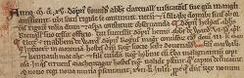
In the year 1215, sir Conrad, the abbot of Clairvaux, arrived in England for his visitation. And there he practised continence4 with sufficient rigour ' and moreover, because of the severit of his order, he appointed many hard and harsh [rules] to be observed in his daughter houses.5 . . .6[2]
se continuit.
I.e., the Cistercian monasteries.
Successions are noted here, in Rievaulx and Warden.
The lord king of Scotland's enemies entered Moray—namely Donald Ban1, the son of Mac-William ; and Kenneth Macheth2 ; and the son of a certain king of Ireland—, with a numerous band of malignants. Maccintsacairt3 attacked them, and mightily overthrew the king's enemies ; and he cut off their heads, and presented them as new gifts to the new king; on the seventeenth day before the Kalends of July.4 And because of this, the lord king appointed him a new knight. . .5[3]
Ban is written in red letters. It is the Irish bán "fair."
Kennauh mac aht (ht here, as often, written for th). This was probably a relative, possibly a son, of Malcolm Macheth († 1168). The patronymic Macheth seems to have become a family name. Cf. year 1157, note.
Machentagar. This is the middle-Irish macc in t-sacairt "son of the priest." See P.S.A.S., iii, 276. Cf. year 1235.
I.e., on 15th June.
Here follow verses (117-119 ; copied by C.L., 15-16) written upon the strife between king John and his nobles; (119-120) a continuation of the same subject in prose ; (120-121) a description of a council held at Rome, from 17th October to 1st November (in reality the Lateran council was held from 11th to 30th November). These pages are copied in part by C.L. (16-17)
ca. 1188-1226
Chronicle of Man, vol. i, pp. 82-903
We may still repeat rather briefly, for the edification of the
readers, something of the history of the brothers Reginald and
Olaf.
Reginald gave to his brother Olaf a certain island that is
called Lewis. It is said to be more extensive than the other
islands, but it is cultivated by few inhabitants, because it is
mountainous and rocky, and almost wholly inarable. Its inhabitants
live principally by hunting and fishing.[4]
In Munch's ed., pp. 16-19. This passage stands after the annal of 1217 (see above). It continues the narrative of 1187-1188.
Therefore Olaf set out to take possession of this island ;
and dwelt in it, leading a sorry life. And when he saw that it
was by no means sufficient for his own support, and that of his
army, he went confidently to his brother Reginald, who then
abode in the islands, and spoke to him thus : "Brother," said
he, "and my lord king, thou knowest that the kingdom of the
islands pertained to me by hereditary right. But since the
Lord has chosen thee to govern it, I do not grudge it thee, or
bear it ill, that thou art raised up in royal eminence. Now
therefore I beg thee to provide me with some portion of land in
the islands, in which I can honourably live with my followers
because the island of Lewis which thou gavest me is unable to
support me."
And when his brother Reginald heard this, he promised to
hold council concerning it with his subjects ; and to answer him
on the following day regarding this petition. When the morrow
had dawned, and Olaf had been summoned and had come to
Reginald's conference, Reginald ordered him to be seized and
bound with chains, and to be taken bound to William, the king of
Scotland, in order to be kept by him in prison ; and it was so done,
and Olaf was chained in the king of Scotland's prison for nearly
seven years.1 But in the seventh year William, king of Scotland,
died, and his son Alexander succeeded him. And before
[William] died he ordered that all the prisoners that were held
by him in his prisons should be set free.
So Olaf was freed from chains, and restored to liberty. And
he came to Man, to his brother Reginald ; and presently set out
with no small accompaniment of noble men for St James.2
And returning from pilgrimage he came again to his brother
Reginald, and was peacefully received by him.
At the same time Reginald caused his brother Olaf to marry
the daughter of a certain noble of Kintyre, the sister of his
own wife, named Lavon3; and gave him the aforesaid island
of Lewis in possession ; and Olaf bidding his brother farewell
set out with his wife, and dwelt in Lewis.4[5]
I.e., 1208-1214.
"To the shrine of St James at Compostella, Spain" Goss.
This name appears to be corrupt. "Johnstone and Oliver read this name Jauon, and translate it Joan" Goss. The MS. reads clearly lauon.
I.e., 1217×, since bishop Nicholas died in 1217.
And after some days Reginald, bishop of the islands, who
had succeeded Nicholas, came to the island regions, to visit the
churches. Olaf met him with rejoicing ; and, glad of his arrival,
as that of his sister's son, he ordered a great feast to be
prepared. But [bishop] Reginald said to Olaf: "I will not
communicate with thee, brother, until the catholic church frees
thee canonically from the bond of illicit wedlock" ; and added :
"Art thou unaware that thou hadst before the cousin of the
woman whom thou now hast as wife?"
Olaf did not deny what was true, but declared that he had
for a long time had her cousin as concubine. So bishop
Reginald assembled a synod, and canonically separated Olaf
Godfrey's son and Lavon his wife.
After this, Olaf took in marriage Christina, the daughter of
Ferchar, earl of Ross.[6]
And king Reginald's wife, the queen of the islands, grieving
at that time over the separation of her sister and Olaf, and
moved by the gall of bitterness ; being also the originator of all
the discord between Reginald and Olaf, sent a letter secretly
in the name of king Reginald to her son Godfrey in the island
of Skye, [bidding him] seize Olaf, and kill him.
As soon as he had heard the letter, Godfrey collected an
army ; and came to Lewis, intending to carry into effect the
perverse wishes of his mother. But Olaf entered a small boat
with a few men ; and escaping from Godfrey's face with
difficulty, came to his father-in-law, the earl of Ross. Godfrey
returned home, after destroying nearly the whole island, and
slaying certain men.
At that time, the sheriff of Skye, Paul Balki's son,'
(a vigorous man, and powerful in the whole kingdom of the
islands) fled from Godfrey's face, because he refused to consent
to the slaughter of Olaf. And he dwelt with the earl of Ross,
along with Olaf.
After a few days had passed, Olaf and the aforesaid sheriff
formed a treaty of friendship, by mediation of an oath of each.
And together, with one ship, they came to Skye, and they hid
themselves in remote places for several days. At last by
sending spies they learned that Godfrey was inapprehensively[7]
Vice-Comes de Ski . . . Pol filius Boke. Munch identified this man with the Paul Balki's son of Hakon Hakon's son's Saga.
abiding with few men in a certain island that was called the
island of St Columba.
Collecting to themselves all their friends and acquaintances,
and such men as were willing to join them voluntarily, in the
silence of the dead of night they brought five ships from the
nearest shore of the sea (which was at a distance of two
furlongs from the aforesaid island), and surrounded the island.
Godfrey and those that were with him, rising in the earliest
dawn and seeing that they were shut in on all sides by enemies,
were dismayed. But they put on their armour of war, and
endeavoured to make a valiant resistance : in vain, because
about the ninth hour of the day1 Olaf and the aforesaid sheriff
Paul entered the island with their whole army ; and they slew
all whom they found outside the enclosures of the church ; and
they seized Godfrey, and blinded and emasculated him. Nevertheless
in this deed Olaf did not consent, but he could not
oppose it because of Balki's son, the sheriff aforesaid.
This was done in the year of grace 1223.
In the next following summer [? 1224], having taken hostages
from all the nobles of the islands, Olaf came to Man and landed
at Ronaldsway with a fleet of thirty-two ships. At that time
Reginald and Olaf divided between them the kingdom of the
islands ; Man being given to 'Reginald in addition to his share,
with the name of king. And Olaf received provisions from the
people of Man, and with his company returned to his own share
of the islands.
In the following year [? 1225], Reginald took with him Alan,
the lord of Galloway ; and set out with the Manxmen to the
island regions, to take away from his brother Olaf the part of
the land that he had given to him, and to subject it again to
his own dominion. But because the Manxmen would not fight
against Olaf or the islanders, because they loved them, Reginald
and Alan, lord of Galloway, effected nothing, and returned
home.
After a short time, under the pretext of going2 to the court
of the lord king of England, Reginald received from the people
of Man a hundred marks, and set out for the court of Alan, lord
of Galloway. At the same time he gave his daughter in[8]
I.e., about 2-3 p.m.
sub occasione eundi.
marriage to Alan's son, And when the Manxmen heard it,
they were very indignant; and sending for Olaf they appointed
him their king.
In the year of grace 1226, Olaf recovered his inheritance,
namely the kingdom of Man and the islands, which his brother
Reginald had governed for thirty-eight years ; and he reigned
securely for two years.1[9]
I.e., 1226-1228. See below, 1228-1229.
1235
Chronicle of Melrose, pp. 144-147
In the year of the Lord 1235, sir W[alter],3 the bishop of
Whithorn, died. On the first Sunday of Lent,* sir Gilbert,
master of the novices at Melrose, and formerly abbot of
Glenluce,5 was elected bishop, by the whole people and the
clergy of Galloway, excepting the prior and convent of
Whithorn.
And on the Sunday on which Oculi Mei is sung,6 the aforesaid
prior with his convent elected Odo, formerly abbot of
Derecongal7 ; and [Odo] immediately went with [the prior] to
the archbishop of York, Walter de Gray, requesting of him the
award of consecration ; but he did not receive it : because [the
archbishop] had heard of the previous election. [The archbishop,]
therefore, examined the cause of both parties ; rejected
Odo, and consecrated the aforesaid Gilbert, the Melrose monk,
as bishop, in the greater church at York, on the first Sunday
before the Nativity of the blessed Mary.8
Also, sir Hugh, the [abbot] elect of Deer, after the
completion of one year in which he had ruled that church,
returned to the monastery of Melrose, and there resigned his[10]
See year 1209. Bower wrongly calls him William (ii, 61). Walter, bishop of Whithorn, witnesses charters Melrose nos. 199 (1214 x 1229) and 200 (1221 x 1235). Cf. H. & S., ii, 1, 56 ; D.B., 355-356. For the election of his successor, Gilbert, formerly abbot of Glenluce, see E.C., 347-348 ; Bower ; D.B. ; and a letter of pope Gregory IX, written on 19th June, 1241 (Bliss, i, 198). Gilbert died in 1253.
I.e., on 25th February, 1235.
See year 1233.
I.e., on 11th March.
de Derecongal in MS. "Odo, abbot of Dercungal," witnessed a charter of Duncan, lord of Carrick, on 21st July, 1225 (Glasgow, no. 139). For the place, see Melrose, i, 182, 183. Derecongal or Dercongal (Irish daire-Congaill) was Holywood, in Dumfriesshire.
I.e., on 2nd September, 1235.
office ; both because of the asperity of the air in [Deer], and
because of the infirmity of his body. Restored to the priorate
[of Melrose], he not long afterwards departed faithfully to the
Lord. And Robert, a monk of the same house [of Deer], was
made abbot of Deer.
[Consecration of Robert Grosseteste, to Lincoln.1
Henry, the king of England, married Eleanor.2]
In the same year, on the first Sunday before the festival of
the blessed Mary Magdalene,3 after collecting his army, the
lord king entered Galloway. And he came to a place sufficiently
fair to the eye ; where, since the day was now spent, he proposed
to fix his tents. But the Galwegians, knowing better the site
of the place, after lurking the whole day in the mountains, now
on the contrary gave battle to the king. The aforesaid place
had given them great confidence; because it was full of
marshes, covered4 over everywhere with grass and flowers;
and in these [marshes] the king's army for the greater part had
sunk.5
But in the beginning of the contest, the earl of Ross, named
[Ferchar] Maccintsacairt, arrived, and attacked the enemy in
the rear ; and after the enemy was aware of this, he turned his
back, and made for the mountains and woods. But the
aforesaid earl, and many others besides, pursued them, making
a great slaughter, and harassing them until dark.
On the following day, the king, with his accustomed piety,
granted peace to all who came to him. Therefore the
Galwegians who had survived came to the king's peace, with
ropes put round their necks.
But the aforesaid bastard Thomas, with his supporter
Gilrod,6 took his way to Ireland.[11]
Cf. R.S. 84, iii, 102 ; 44, ii, 376 ; 36, iii, 147 ; i, 97 ; ii, 316 ; ii, 87; iv, 82.
The last two paragraphs are notes added later, in the margin. A marriage by proxy seems to have taken place on 15th December, 1235 (R.S. 95, ii, 216). The final marriage ceremony was held on 14th January, 1236 ; and the new queen was crowned on Sunday, 20th January. See R.S. 36, i, 99 ; ii, 316 ; iii, 144 : cf. iv, 427, and 44, ii, 385-386.
I.e., on 15th July, 1235.
For coopertus reading coopertis.
erat dimersus.
Gilrodh. Stevenson's translation adds to the text : "who incited him to his rebellion" (Church Historians, iv, 1, 179). This is not in the manuscript.
So the king having obtained the victory went to other parts
of the kingdom, upon difficult affairs of the realm ; leaving
behind there the earl of Monteith,1 to tranquillize the country.
But after the king's departure, certain Scots, not masters of
knighthood, but servants of wickedness, despoiled the abbeys
of that land with so wicked and villainous madness that they
even denuded of the frock in which he was wrapped a monk
who had, at the point of death, been placed in the infirmary of
Glenluce, and laid upon a hair-cloth2; and they carried it away
with them. Also at Tongland, they killed the prior, with the
sacrist, in the church. But the Almighty did not permit their
sins to pass unavenged : not long afterwards the homicide was
caught, and was torn to pieces by horses at Roxburgh. And
the Scots, hearing that the aforesaid Gilrod had arrived with a
fleet from Ireland, and had brought with him Irishmen, and the
son of a certain sub-king, in their reckless flight came to a
certain water, in which many of that wicked army perished.3
And after the aforesaid Gilrod had returned from Ireland,
as soon as he touched the land, he broke up all his ships ;
employing this trick, so that those whom he had brought with
him should not be able to return to their country in any way.
After this was reported to G[ilbert], the bishop of Galloway ;
and to A[dam], the abbot of Melrose ; and also to P[atrick], the
earl of Dunbar, they did not omit to afford to the son (although
degenerating4) the friendship that they had had for the father,
while he lived. The bishop and the abbot went, unsupported 5
the earl, with his army, as far as the boundaries of Galloway,[12]
Walter Comyn, earl of Monteitli. See years 1255, 1257 ; and S.P., vi, 127-129. His father was the William Comyn, earl of Buchan, who died in 1233.
This passage ("certain Scots . . . haircloth") is copied from the Melrose chronicle's account of the plunder of Holme Cultram, in 1216 ; see that year, above. The next following sentence is not correctly joined to the quotation ; the pronoun "it" does not agree with its antecedent "frock," which is in the plural number.
This retribution (like the whole passage) is modelled upon the incidents recorded of the year 1216 ; it may therefore be entirely fictitious.
quamvis degeneranti : possibly "illegitimate"? This son was Thomas ; his father was Alan, Roland's son, who had been a benefactor of Melrose (see Melrose, i, nos. 79, 83).
simpliciter.
bidding the oft-named Gilrod either bow his neck to the king,
or fight with the earl's army. The oft-mentioned Gilrod, seeing
that he was inferior in strength, yielded to their advice ; and
the king gave him for some time into the custody of the
aforesaid earl.
The bastard [Thomas], being thus deprived of counsel and
support, was compelled to seek the king's peace. And the
king detained him for a short time in Maidens' castle; and
afterwards allowed him to go away.
After this, the Irishmen, stealthily departing from the
country, took their way near the city of Glasgow. Learning
this, the citizens went out in a body ; and they cut off the heads
of as many as they found, and caused them to give up the
ghost. But they kept two of the older men, and had them
torn asunder by horses, at Edinburgh.
Ultimately Galloway was tranquillized, and the heirs
received their lands ; which they divided among themselves
impartially.1
Also lady Marjory, a sister of lord Alexander, the king of
the Scots, was married at Berwick, on the day of St Peter ad
Vincula.2 The king himself was present at her wedding, and
the magnates of his realm ; and on the other side was lord[13]
The Chronicle of Lanercost (42) abbreviates the Melrose chronicle's account of Galwegian affairs of 1234 and 1235, and places it under the year 1233: "At this time, Alan, the lord of Galloway, died, about the Purification of the blessed Virgin [i.e., about 2nd February, 1234] ; and his rough nation [aspera gens], eager for wrong, did not hold their hands from evil for two years after the death of their lord ; but, wishing to withdraw from their subjection to the king of the Scots, they appointed as their lord, and (as it were) their king, an illegitimate son of the same Alan, Thomas by name ; rejecting the daughters. They joined to themselves also a certain criminal, Gilleroth ; and, leaving their own territories, they ravaged with sword and fire the adjacent lands, of the king, the barons, and the knights. The king therefore collected an army, and assailed them with war ; and, after killing an endless number of the wretched men, and capturing the leader of their wickedness, he restored the land in peace and quietness to the true heirs, the daughters of Alan. "Afterwards, when sir John de Balliol married the eldest of the sisters, Derbforgaill [Derforgoyl], the said bastard Thomas was at the same time given to him for custody ; and he remained, till decrepit old age, shut up in the interior of Barnard Castle." Cf. the same chronicle," below, s.a. 1286.
1st August.
G[ilbert], the marshal of England and earl of Pembroke, who
married her ; with many noble men of England.1
In this year, lord Alexander, the king of Scotland, bestowed
the forest of Ettrick upon the monastery of Melrose. And he
decreed that the abbey of Melrose, with the four granges
surrounding it, were free from his forest.2[14]
See E.G., 34. Cf. Annates Cambriae, MS. B. (R.S. 20, 81), s.a. 1235 : "Gilbert Marshal married the sister of the king of Scotland." A note (to the same efifect) is in the Annals of Winchester (R.S. 36, ii, 87), which say that Gilbert Marshal took the cross in the following year. He had become earl Marshal in 1234, in succession to his brother, Richard (R.S. 84, iii, 89 ; 44. ii, 370). On 14th July, 1235, it was announced that the marriage of Margery ("Margaret") to Gilbert Marshal had taken place, and that it was pleasing to king Henry (Patent Rolls (1906), 126). For Margery's death, in 1244, see E.G., 358.
aforesta sua liberam esse constituit: i.e., exempt from the forest laws. For the grant of Ettrick Forest, see charters no. 264 and 265 in the Chartulary of Melrose. No. 265 (a confirmation) is dated 28th May, 1236. On 24th February, 1235, the king of England had announced to his sister Joanna, queen of Scotland, to the king of Scotland, and others, the betrothal of his sister Isabella to the emperor Frederick II. Foedera, i, 1, 224. Alexander and Joanna had safe-conduct in coming to London to speak with king Henry, in remaining and returning, issued on 8th December, 1235 (Patent Rolls : Foedera, i, 1, 221). King Henry had summoned a conference to meet at London from 13th to 27th January, 1236, in connection with "certain of our difficult affairs that have recently arisen, concerning the state of ourselves and our kingdom" ; and he desired Alexander and Joanna to be present. He appointed as their escort W[alter de Gray], archbishop of York ; R[ichard Poor], bishop of Durham ; William de Vesci ; Gilbert de Umfraville ; Roger Bertram ; John de Veteri Ponte ; John Geoffrey's son, sheriff of York. They were to meet Alexander and Joanna at a day and place that should be announced to them by Bartholomew Peche, whom Henry had sent as his envoy to Alexander (Close Rolls (1908), 331; Foedera, u.s.). For Joanna's entertainment in England, see Bain, i, nos. 1258, 1260 1308-1312.
Property "Has citation sort" (as page type) with input value "Anderson|1922b" contains invalid characters or is incomplete and therefore can cause unexpected results during a query or annotation process.
Timeline
Below is a list of events that are evidenced by this source. They should appear in the 'Timeline' section of articles about people and places involved in the events.
Chronicle of Melrose15 June 1215 - We find in the Chronicle of Melrose the first mention of Maccintsacairt. He is not referred to here as Fearchar, only Maccintsacairt.
“The lord king of Scotland's enemies entered Moray—namely Donald Ban, the son of Mac-William ; and Kenneth Macheth ; and the son of a certain king of Ireland—, with a numerous band of malignants. Maccintsacairt attacked them, and mightily overthrew the king's enemies ; and he cut off their heads, and presented them as new gifts to the new king; on the seventeenth day before the Kalends of July. And because of this, the lord king appointed him a new knight”[3] <ref name="Early sources vol. 2 p. 404" />
Chronicle of Melrose15 June 1215 - The lord king of Scotland's enemies entered Moray—namely Donald Ban, the son of Mac-William ; and Kenneth Macheth ; and the son of a certain king of Ireland—, with a numerous band of malignants. Maccintsacairt attacked them, and mightily overthrew the king's enemies ; and he cut off their heads, and presented them as new gifts to the new king. And because of this, the lord king appointed him a new knight.[3] <ref name="Early sources vol. 2 p. 404" />
between 1217 and 1223 - At the same time Reginald caused his brother Olaf to marry the daughter of a certain noble of Kintyre, the sister of his own wife, named Lavon; and gave him the aforesaid island of Lewis in possession ; and Olaf bidding his brother farewell set out with his wife, and dwelt in Lewis. And after some days Reginald, bishop of the islands, who had succeeded Nicholas, came to the island regions, to visit the churches. Olaf met him with rejoicing ; and, glad of his arrival, as that of his sister's son, he ordered a great feast to be prepared. But [bishop] Reginald said to Olaf: "I will not communicate with thee, brother, until the catholic church frees thee canonically from the bond of illicit wedlock" ; and added : "Art thou unaware that thou hadst before the cousin of the woman whom thou now hast as wife?" Olaf did not deny what was true, but declared that he had for a long time had her cousin as concubine. So bishop Reginald assembled a synod, and canonically separated Olaf Godfrey's son and Lavon his wife. After this, Olaf took in marriage Christina, the daughter of Ferchar, earl of Ross. And king Reginald's wife, the queen of the islands, grieving at that time over the separation of her sister and Olaf, and moved by the gall of bitterness ; being also the originator of all the discord between Reginald and Olaf, sent a letter secretly in the name of king Reginald to her son Godfrey in the island of Skye, [bidding him] seize Olaf, and kill him. As soon as he had heard the letter, Godfrey collected an army ; and came to Lewis, intending to carry into effect the perverse wishes of his mother. But Olaf entered a small boat with a few men ; and escaping from Godfrey's face with difficulty, came to his father-in-law, the earl of Ross. Godfrey returned home, after destroying nearly the whole island, and slaying certain men. At that time, the sheriff of Skye, Paul Balki's son,' (a vigorous man, and powerful in the whole kingdom of the islands) fled from Godfrey's face, because he refused to consent to the slaughter of Olaf. And he dwelt with the earl of Ross, along with Olaf. After a few days had passed, Olaf and the aforesaid sheriff formed a treaty of friendship, by mediation of an oath of each. And together, with one ship, they came to Skye, and they hid themselves in remote places for several days. At last by sending spies they learned that Godfrey was inapprehensively abiding with few men in a certain island that was called the island of St Columba. Collecting to themselves all their friends and acquaintances, and such men as were willing to join them voluntarily, in the silence of the dead of night they brought five ships from the nearest shore of the sea (which was at a distance of two furlongs from the aforesaid island), and surrounded the island. Godfrey and those that were with him, rising in the earliest dawn and seeing that they were shut in on all sides by enemies, were dismayed. But they put on their armour of war, and endeavoured to make a valiant resistance : in vain, because about the ninth hour of the day Olaf and the aforesaid sheriff Paul entered the island with their whole army ; and they slew all whom they found outside the enclosures of the church ; and they seized Godfrey, and blinded and emasculated him. Nevertheless in this deed Olaf did not consent, but he could not oppose it because of Balki's son, the sheriff aforesaid.[15] <ref name="Early sources vol. 2 pp. 457-459" />
15 July 1235 - In the Chronicle of Melrose we again find mention of Maccintsacairt. He is referred to now as the earl of Ross, but the name Fearchar is not used. Official documents of the time referred to him as Fearchar, or simply F.
“In the same year, on the first Sunday before the festival of the blessed Mary Magdalene, after collecting his army, the lord king entered Galloway. And he came to a place sufficiently fair to the eye; where, since the day was now spent, he proposed to fix his tents. But the Galwegians, knowing better the site of the place, after lurking the whole day in the mountains, now on the contrary gave battle to the king. The aforesaid place had given them great confidence; because it was full of marshes, covered over everywhere with grass and flowers; and in these the king's army for the greater part had sunk. But in the beginning of the contest, the earl of Ross, named Maccintsacairt, arrived, and attacked the enemy in the rear; and after the enemy was aware of this, he turned his back, and made for the mountains and woods. But the aforesaid earl, and many others besides, pursued them, making a great slaughter, and harassing them until dark. On the following day, the king, with his accustomed piety, granted peace to all who came to him. Therefore the Galwegians who had survived came to the king's peace, with ropes put round their necks.”[11] <ref name="Early sources vol. 2 p. 496" />
15 July 1235 - On the first Sunday before the festival of the blessed Mary Magdalene, after collecting his army, the lord king entered Galloway. And he came to a place sufficiently fair to the eye; where, since the day was now spent, he proposed to fix his tents. But the Galwegians, knowing better the site of the place, after lurking the whole day in the mountains, now on the contrary gave battle to the king. The aforesaid place had given them great confidence; because it was full of marshes, covered over everywhere with grass and flowers; and in these the king's army for the greater part had sunk. But in the beginning of the contest, the earl of Ross, named Maccintsacairt, arrived, and attacked the enemy in the rear; and after the enemy was aware of this, he turned his back, and made for the mountains and woods. But the aforesaid earl, and many others besides, pursued them, making a great slaughter, and harassing them until dark. On the following day, the king, with his accustomed piety, granted peace to all who came to him. Therefore the Galwegians who had survived came to the king's peace, with ropes put round their necks.[11] <ref name="Early sources vol. 2 p. 496" />
It includes a translation of the first known mention of Mac an t-Sagairt ('son of the priest') which is found in the Chronicle of Melrose. He is not identified in this text specifically as Fearchar, only Maccintsacairt.
Images of the Melrose manuscript are available to view on the British Library website.[1]
Source citation
Each of the timeline events displayed above is followed by the reference code for that particular timeline event. This code is not displayed when the timeline event is included in the 'Timeline' section of an article. If an event is discussed within the body of an article, this reference code can be used to cite the source of the timeline event.
This source also needs to be included in the 'Sources' section of an article by adding the following: