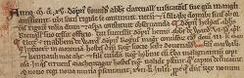
Descendants of Fearchar Mac an t-Sagairt Earl of Ross came to use the surname Ross. Therefore, events pertaining to his life, and to the lives of his descendants, which can be proved from contemporary sources, are of interest to this project. Included in this page is a list of events involving or related to the Earls of Ross that are supported by documentation.
Ross in the 12th century.Ross and Cromarty after 1890 demonstrating the approximate areas of Easter and Wester Ross.
The Earldom of Ross was created in 1162 and Malcolm MacHeth, Earl of Ross, died in 1168.[1]Fearchar Mac an t-Sagairt was the next to be Earl of Ross, but it was over 50 years before we find him mentioned as such in extant documents.
The Earldom was held by Fearchar's male line for 4 more generations. Upon the death of his 2nd-great-grandson William, 5th Earl of Ross in 1372, it passed to his daughter Euphenia and could by claimed by her husband and then her son, Alexander Leslie. It eventually passed again through the female line to the Macdonalds. It was forfeited to the crown by John Macdonald, Earl of Ross and Lord of the Isles circa 1475.
Ancestry
There is no mention of Fearchar until 1215 when an entry in the Chronicle of Melrose records his defeat of a rebellion which won him the king's favor. There are several theories about who Fearchar's ancestors may have been, but there is not direct evidence to support any of them. One of the goals of this project is to identify the Y-DNA signature of the line of Fearchar and, through this to identify his ancestral line.
Because this project is concerned only with genetic descendants that would would carry the surname Ross or a derivation, the timeline below begins with Fearchar. It is assumed that his predecessor, Malcolm MacHeth, was not the source of his Y-DNA and, therefore, not a Ross ancestor.
Descendants
The title Earl of Ross was held by Fearchar and his descendants from the early 13th century until it was forfeited to the crown around 1475. During this time, the family developed a close relationship with the Stewart kings.
The title was created again in 1565 and 1600 for descendants of the Stewart Kings. The last to be called Earl of Ross was Charles I King of England, Ireland & Scotland who died in 1649.
dates indicate time period as Earl or Countess of Ross
Notes:
Suo jure is Latin for "in her own right". It is used following the title of a noblewoman to specify that she holds the title independently of her husband. De jure uxoris is Latin for "by right of his wife". It denotes a title of nobility that is used by a man because his wife holds the office or title suo jure.
Cawley, Charles, ed. (20 May 2021). "Scotland, Earls Created 1162-1398". Foundation for Medieval Genealogy. B. EARLS of ROSS (FERQUHARD MacTAGGART). Retrieved 22 Sep 2021.
Cawley, Charles, ed. (20 May 2021). "Scotland, Earls Created 1162-1398". Foundation for Medieval Genealogy. C. EARLS of ROSS (LESLIE). Retrieved 22 Sep 2021.
Cawley, Charles, ed. (20 May 2021). "Scotland, Earls Created 1162-1398". Foundation for Medieval Genealogy. D. EARLS of ROSS (MACDONALD). Retrieved 22 Sep 2021.
Cawley, Charles, ed. (20 May 2021). "Scotland, Kings". Foundation for Medieval Genealogy. B. KINGS of SCOTLAND 1371-1603. Retrieved 22 Sep 2021.
Cawley, Charles, ed. (20 May 2021). "Scotland, Earls Created 1162-1398". Foundation for Medieval Genealogy. B. EARLS of LENNOX 1488-1571 (STEWART). Retrieved 22 Sep 2021.
Cawley, Charles, ed. (22 Feb 2021). "England, Kings 1066-1837". Foundation for Medieval Genealogy. Chapter 5. KINGS of ENGLAND and SCOTLAND 1603-1714 (STUART). Retrieved 22 Sep 2021.
18th century Earls
There has come to exist on the internet a Hugh Ross of the early 1700s who is often labeled 3rd Earl of Ross, Earl of 3rd Ross, Lord of Ross, or Lord Hugh Ross. At this point, however, the title Earl of Ross hadn't existed for almost a century and hadn't been held by a person by the name of Ross for over 300 years.
Surname
In 1639, Sir Robert Gordon, in his Genealogical history of the Earldom of Sutherland, stated, "that the laird of Balnagown his surname should not be Rosse, seing ther wes never any Earle of Rosse of that surname; bot the Earles of Rosse wer first of the surname of Builton."[2] From this, the story has been told that Fearchar was a descendant of the Irish Ó Beólláin family of Applecross.
The Cronicle of the Earlis of Ross, written prior to the year 1615, so at least 20 years before Gordon published his genealogy, stated, "Of this Farqr discendit fyve erlis, being Ross of surname, viȝt Farqr the first, Williame the second, Williame the third, Hew the fourt, and William the fift." This contradicts what Gordon says about the family's surname.
In the list below, we see that the earls themselves, along with the countesses, were addresses only by their given name and their title. No surname was used. Others were identified as 'of Ross' instead of by a surname until Hugh Ross, son of the last Earl of Fearchar's direct male line, and 1st laird of Balnagown. Gordon speculates, "that the lairds of Balnagowne, perceaveing the Earles of Rosse decayed, and that earldom fallen into the Lord of the Yles his hands, they called themselves Rosses, therby to testifie ther descent from the Earles of Rosse."[2]
His theory is, then, that Fearchar's descendants adopted the surname Ross in order to maintain a connection with their former glory as Earls of Ross. There is no evidence here, however, of Gordon's claim that they originally went by the name 'Builton'. It's important to note that surnames had not yet become standard in this time. They had begun to be used more often by the 'titled' families such as the Earls.[3] As we can see here, though, if a person did carry a title, they were most often just referred to by that title. And anyone related to them, was identified by their relationship to the title.
Where, then, did Gordon get this idea that their surname was Builton? And how did the story arise that the name somehow connected them to Applecross? This is discussed further in the Timeline of Earl of Ross references.
Timeline
12th century
between 20 November 1160 and 13 September 1162 - King Malcolm to Malcolm, earl of Ross; command to protect and maintain monks of Dunfermline, and cause them to have their rights by land and water as they had in time of King David[4]
Chronicle of Melrose15 June 1215 - The lord king of Scotland's enemies entered Moray—namely Donald Ban, the son of Mac-William ; and Kenneth Macheth ; and the son of a certain king of Ireland—, with a numerous band of malignants. Maccintsacairt attacked them, and mightily overthrew the king's enemies ; and he cut off their heads, and presented them as new gifts to the new king. And because of this, the lord king appointed him a new knight.[6]
between 1217 and 1223 - At the same time Reginald caused his brother Olaf to marry the daughter of a certain noble of Kintyre, the sister of his own wife, named Lavon; and gave him the aforesaid island of Lewis in possession ; and Olaf bidding his brother farewell set out with his wife, and dwelt in Lewis. And after some days Reginald, bishop of the islands, who had succeeded Nicholas, came to the island regions, to visit the churches. Olaf met him with rejoicing ; and, glad of his arrival, as that of his sister's son, he ordered a great feast to be prepared. But [bishop] Reginald said to Olaf: "I will not communicate with thee, brother, until the catholic church frees thee canonically from the bond of illicit wedlock" ; and added : "Art thou unaware that thou hadst before the cousin of the woman whom thou now hast as wife?" Olaf did not deny what was true, but declared that he had for a long time had her cousin as concubine. So bishop Reginald assembled a synod, and canonically separated Olaf Godfrey's son and Lavon his wife. After this, Olaf took in marriage Christina, the daughter of Ferchar, earl of Ross. And king Reginald's wife, the queen of the islands, grieving at that time over the separation of her sister and Olaf, and moved by the gall of bitterness ; being also the originator of all the discord between Reginald and Olaf, sent a letter secretly in the name of king Reginald to her son Godfrey in the island of Skye, [bidding him] seize Olaf, and kill him. As soon as he had heard the letter, Godfrey collected an army ; and came to Lewis, intending to carry into effect the perverse wishes of his mother. But Olaf entered a small boat with a few men ; and escaping from Godfrey's face with difficulty, came to his father-in-law, the earl of Ross. Godfrey returned home, after destroying nearly the whole island, and slaying certain men. At that time, the sheriff of Skye, Paul Balki's son,' (a vigorous man, and powerful in the whole kingdom of the islands) fled from Godfrey's face, because he refused to consent to the slaughter of Olaf. And he dwelt with the earl of Ross, along with Olaf. After a few days had passed, Olaf and the aforesaid sheriff formed a treaty of friendship, by mediation of an oath of each. And together, with one ship, they came to Skye, and they hid themselves in remote places for several days. At last by sending spies they learned that Godfrey was inapprehensively abiding with few men in a certain island that was called the island of St Columba. Collecting to themselves all their friends and acquaintances, and such men as were willing to join them voluntarily, in the silence of the dead of night they brought five ships from the nearest shore of the sea (which was at a distance of two furlongs from the aforesaid island), and surrounded the island. Godfrey and those that were with him, rising in the earliest dawn and seeing that they were shut in on all sides by enemies, were dismayed. But they put on their armour of war, and endeavoured to make a valiant resistance : in vain, because about the ninth hour of the day Olaf and the aforesaid sheriff Paul entered the island with their whole army ; and they slew all whom they found outside the enclosures of the church ; and they seized Godfrey, and blinded and emasculated him. Nevertheless in this deed Olaf did not consent, but he could not oppose it because of Balki's son, the sheriff aforesaid.[7]
probably mid-1220s - Agreement between Robert, bishop of Ross, and Johannem Byfeth, over the right of patronage of the church of Kiltarlity, Inverness-shire. Witnessed by H· decano et canonicis de Roſmarkyn · R· archidiacono de Ros · Hugone perſona de Burdin · Willelmo Noreys vic’ de Inuernys · Willelmo filio Horim · Hugone Corbeth · F· comite de Ros · Petro Biſeth · Anſelmo Biſeth · Willelmo Biſeth perſona · Nicholao clerico · Petro burgenſi de Inuernys · Radulpho clochere · Jocelino · Bartholomeo · Willelmo Sureys · Rogero filio Euſtachii · Patricio janitore · Roberto capellano de Bracholy · Johanne capellano domini Epiſcopi, who wrote this chirograph.[8]
between 4 September 1230 and 17 December 1242 - Ferkar comes de Roſſ, has given, granted, and established by his charter, to Waltero de Moray, son of the late Hugonis de Moray, two davochs of land in Ross, namely ‘Clon’, by its right bounds and with all just pertinents, holding in feu and heritage, for an annual render of one pound of pepper on the feast of St Martin, for all service and demand, and making forinsec service of the lord king[10]
12 September 1232 - Agreement is formed between Andrew, bishop of Moray, on one side, with the counsel and consent of the dean and chapter of the church of Moray, and Gillebrigte, son of Gillebrigte late earl of Strathearn, on the other, whereby Gillebrigte will hold at feuferme from the bishop one half davoch of ‘Kyncarny’. Witnessed by domino ·S· decano Moraviensis ecclesie · magistro ·W· precentore · Ranulpho archidiacono · Willelmo cancellario · Gylberto de Bradhouche · ·N· monacho vallis crescentis · Petro et Johanne clericis nostris · Symone de Orreby · R· camerario · W· de Sutherlandia · W· filio ·F· comitis de Ros[11]
1234 - Agreement between the chapter of Moray, and Sir Alexander of Stirling. Alexander and his heirs by his wife, the daughter of Sir Freskin of Kerdal, will hold at feuferme of the chapter a half davoch of land that they have at Daviot, Inverness-shire. Witnessed by domini ·F· comitis de Roſſ · et domini ·M· de Alto monte vicecomitis de Inuernys · Willelmi Prath’ · domini Alexandri Ruffi · domini Merlefueyni · Fercardi ſeneſcalli de Badenach · Edwardi ſeneſcalli de Lochabyr · Johannis et Johannis clericorum Epiſcopi · et aliorum[12]
1234 - Agreement between Andrew, bishop of Moray, and Walter Comyn, earl of Menteith, with the consent of the chapter of Moray, over certain portions of land that the bishop said pertained to a half davoch of the church of Kincardine. Witnessed by domini Abbatis de Hy · fratris Alani monachi · nobilium virorum doinini ·P· comitis de Ros · domini Willelmi Prath' · domini ·M· de Alto monte vicecomitis de Inuernys · domini Alexandri de Strinelyn · domini Merleſſani filii Comitis · domini Alexandri Ruffy · Fercardi filii Seth[13]
15 July 1235 - On the first Sunday before the festival of the blessed Mary Magdalene, after collecting his army, the lord king entered Galloway. And he came to a place sufficiently fair to the eye; where, since the day was now spent, he proposed to fix his tents. But the Galwegians, knowing better the site of the place, after lurking the whole day in the mountains, now on the contrary gave battle to the king. The aforesaid place had given them great confidence; because it was full of marshes, covered over everywhere with grass and flowers; and in these the king's army for the greater part had sunk. But in the beginning of the contest, the earl of Ross, named Maccintsacairt, arrived, and attacked the enemy in the rear; and after the enemy was aware of this, he turned his back, and made for the mountains and woods. But the aforesaid earl, and many others besides, pursued them, making a great slaughter, and harassing them until dark. On the following day, the king, with his accustomed piety, granted peace to all who came to him. Therefore the Galwegians who had survived came to the king's peace, with ropes put round their necks.[14]
7 August 1235 - Agreement between Walter of Moray, son of the late William of Moray, and Andrew, bishop of Moray, with the will and consent of the dean and chapter, over the churchland of ‘Ewen’ (Kirkton of Barevan, in Cawdor, Nairnshire). Witnessed by the lord Fearchar, earl of Ross, Sir Walter of Duffus, Sir Walter of Innes, Andrew Wiseman, William, chamberlain, Simon of Orby, Thomas, dispenser of the bishop of Moray.[15]
1237 - King Alexander and barons, the earl of Strathearn, earl of Lennox, earl of Angus, earl of Mar, earl of Atholl, earl of Ross, earl of Caithness, earl of Buchan, earl of Winchester, earl of Oxford, earl of Fife, and earl of Menteith, to Pope Gregory (IX); inform him that they have sworn in presence of Cardinal Otto, papal legate in England, Scotland and Ireland, and have prepared their charter, which remains in chirograph between themselves and lord king of England. They subject themselves to papal jurisdiction, to be enforced by any suffragan of archbishop of Canterbury.[16]
25 September 1237 - An agreement is made at York in the presence of Otto, cardinal deacon of San Nicola and papal legate, between Henry, king of England, and Alexander, king of Scots, over the complaints which the king of Scots raised, namely the counties of Northumberland, Cumberland and Westmorland, which the king of Scotland sought as his inheritance; also, over 15,000 marks which King John, the father of King Henry, had received from William, late king of Scotland, in return for certain agreements between the kings which Alexander asserted that King John has not kept; also, over agreements made between King Henry and King Alexander about a marriage to be contracted between Alexander’s sister, Margaret, which, according to the king of Scots, had not been kept. Alexander has remitted and quitclaimed to Henry, king of England, the counties of Northumberland, Cumberland and Westmorland, and all of the money and agreements mentioned above. In return for this quitclaim, King Henry gave and granted to King Alexander, 200 pounds’ worth of land in the counties of Northumberland and Cumberland, to be held in demesne by the king of Scots. The king of Scots has done homage and sworn fealty to the king of England for these lands. Witnessed by W., archbishop of York, R., bishop of Chichester, chancellor of the lord king of England, W., bishop of Carlisle, W., bishop of Worcester, W., bishop of Glasgow, chancellor of the king of Scots, W, bishop-elect of Valence, R., count of Poitou and earl of Cornwall, W., earl Warenne, J., earl of Lincoln, constable of Chester, W., count of Aumale, R., earl of Winchester, S. de Montfort, G. Marshal, earl of Pembroke, Earl Patrick, the earl of Strathearn, the earl of Lennox, the earl of Angus, the earl of Mar, the earl of Atholl, the earl of Ross, William Longespée, Ralph de Tany, W. de Ros, R. de Ros, William de Ferrers, R. Bertram, H. Painel, G. de Umfraville, Amaury de Saint-Amand, P. de Maulay, Master Peter de Bordeaux, Master Atho, clerk of the lord legate, John, son of Geoffrey, Hugh de Vivonne, Stephen Segrave, W. of Lancaster, W. de Say, Richard de Gray, Thomas Furnivall, John of Lexington, Johanne de Plesseto, Bartholomew Peche, William Gernun, Richard son of Hugh.[17]
1249 to 1271 - Charter by William de Monte Alto to David de Donouen of a davach of land in Feruenes, Cromarty, among the other davachs of Feruenes in tenement of Crumbauthin, lying next but one davach to castle of Crumbauthin (in excambion for land of Kyppen which said William's father gave to said David for his homage and service, and for 2 marks of land in land of Donouen which said David held of his brother), to be held in fee and heritage, for reddendo of 2 marks of silver annually and performing king's forinsec service pertaining to that davach, with provision that if said William fails to warrant said davach to grantee or his heirs said William shall provide land of same value at sight of lawful men (per visum proborum hominum). Witnesses - Sir Robert, bishop of Ross, Sir William, earl of Ross, Sir William French (Francisco), Sir William son of Augustine, Sir John, vicar of Innernes, Geoffrey Sures, burgess of Innernes, Malcolm, clerk.[18]
between January 1251 and 28 December 1272 - William, earl of Ross, in compensation for the damages, injuries and losses to the churches of Petty, Inverness-shire, and Brackle, Inverness-shire, imposed on him by Archibald, bishop of Moray, has given, granted, and by this his charter has established, to Elgin Cathedral and Bishop Archibald and the chapter of the same place, in pure and perpetual alms, two davochs of land in Ross called Cadboll, and one quarter-land called Pitkerrie, for the nourishment and support of the Friars Minor who might be dwelling at the time in their house at Elgin, Moray, near the cathedral church[19]
18 March 1258 - Walter Cumin earl of Menteith, Alexander Cumyn earl of Buchan, Justiciar of Scotland, William earl of Mar, William earl of Ros, John Cornyn, Justiciar of Galloway, Aimer de Makeswel (Maxwell), Chamberlain of Scotland, Fresekin de Moravia, Hugh de Abirnithun, William de Moliaut, William Cumyn, and Richard Cumyn, brothers of Sir John Cumyn, Hugh and Walter de Berkeley, brothers, Bernard de Mohaue, Reginald Cheyn, David Lochor, John Dundemor, William de Erth, Ector de Karrik, and their friends and allies, make known that on they made a bond of mutual alliance and friendship with Sir Lewelin son of Griffin, Prince of Wales, and David son of Gruffud, his brother uterine, Grufud son of Maduc, lord of Bromfeld, Maredud son of Ris, Maredud son of Oweng, Res the younger, Oweyn son of Maredud, Madaut son of Wenwywim, Maredud Seis [the Saxon ?], Lewellin Yechan, Owein Mared’ son of Leweliner, lord of Mechem, Owen son of Gruffud, Madaue the little (parvo), Owen son of Bledyn, Howel son of Maredud, Elisse and Gruffud, sons of Jorwerth, Gorone son of Eduenet, Joruerth Grugman, Eumay Yechan, Tudir son of Mad’, Enniaun son of Karaduc, Jorverth son of Maredud, David son of Enviayn, Jeneu Chch’, Roys son of Ednevet, and their friends and allies, as follows. That without the consent of the Welsh prince and magnates, they will make neither peace nor truce henceforth with the King of England, or any magnates of his realm, or of the realm of Scotland, who at the date of the instrument, are adverse and rebels to the Welshmen and the granters, unless they are all similarly bound with themselves.[21]
1262 - In summer there came letters from the Kings of the Hebrides in the Western seas. They complain'd much of the hostilities which the Earl of Ross, Kiarnach, the son of Mac-Camal, and other Scots committed in the Hebrides when they went out to Sky. They burned villages, and churches, and they killed great numbers both of men and women. They affirmed, that the Scotch had even taken the small children, and, raising them on the points of their spears, shook them till they fell down to their hands, when they threw them away lifeless on the ground. They said also, that the Scottish King purposed to subdue all the Hebrides, if life was granted him.[23]
2 July 1266 - Agreement between Sir Magnus IV, king of Norway, by his messengers, Sirs Asketin, his chancellor, and Andrew, son of Nicholas, his baron, and Sir Alexander III, king of Scots, and whereby Sir Magnus, king of Norway, has resigned all right and claim to Man, with the other islands of the Hebrides, and all the other islands of the western and southern side of the great sea; to be held without reservation by King Alexander and his heirs, together with the right of patronage of the bishopric of Man, saving the right, jurisdiction, and liberty of the church of Nidaros, in all respects; which right or jurisdiction the church of Nidaros has, regarding the bishop and church of Man; and excepting the islands of Orkney and Shetland, which the king of Norway has specially reserved for his own demesne[24]
17 February 1268 - Charter of confirmation by William earl of Ross to the church of Moray and to Archibald, bishop of Moray, of the gift by the late Freskinus of Moray, Lord of Duffus, of the two davachs of the lands of Clone in Ross for the upkeep of two chaplains in the church of Moray; renouncing a burden due him from the lands of Dowey and Duffus, with which Freskinus had endowed the chapel of St Laurence of Duffus in Strathspey. Dated at Innirnarryn. Witnessed by are William of Dun dean of Moray, William of Bather prior of Urchard, Archibald Herock archdeacon of Moray, William earl of Sutherland, Sir William of Montealto, Sir Alexander of Moray, Sir John Prath, William Wysman, Galfredo Surays.[25]
15 February 1269 - William, earl of Ross, has granted, and by this his present charter has established, to the church of Moray and Bishop Archibald, the donation made to them by the late Freskin of Moray, lord of Duffus, of two davochs of the land at Clyne in Ross, to support two chaplains in the aforesaid church to celebrate mass for the dead, in pure and perpetual alms[26]
5 February 1284 - Alexander Comyn, earl of Buchan, Justiciar of Scotia, Patrick, earl of Dunbar, Malise, earl of Strathearn, Malcolm, earl of Lennox, Robert de Brus, earl of Carrick, Donald, earl of Mar, Gilbert d’Umfraville, earl of Angus, Walter Stewart, earl of Menteith, William, earl of Ross, William, earl of Sutherland, Magnus, earl of Orkney, Duncan, earl of Fife, John, earl of Atholl, Robert de Brus père, James, Steward of Scotland, John de Balliol, John Comyn, William de Soules, then justiciar of Lothian, Ingram de Guines, William of Moray, the son, Walter of Moray, knights, Alexander de Balliol, Reginald le Chen père, William de St Clare, Richard Siward, William of Brechin, Nicholas de la Haye, Henry of Graham, Ingram de Balliol, Alan son of the earl (fitz Count), Reginald le Chen fils, John of Lindsey, Patrick of Graham, Herbert of Maxwell, Simon Fraser, Alexander of Argyll, Angus son of Donald (MacDonald) and Alan son of Ruardi, barons of the kingdom of Scotland, acknowledge Margaret daughter of the daughter of their lord the king, Margaret, of good memory, late Queen Norway by marriage to Eric, king of Norway, as the legitimate heir to the kingdom of Scotland and the Isle of Man and of all the other islands pertaining to the kingdom, in the event of King Alexander III’s death[29]
between circa 1290 and circa 1307 - William, earl of Ross, states that he delivered the king's letters to Reginald le Chyen who has said that he has the keeping of the shrievalties of Invernairn, Forres and Elgin and the issues of the forest which were assigned to him for his sustenance, which the earl does not think was the king's will, and he believes the issues could be spent more wisely on the repair of castles and fortresses.
The earl requests that whereas a woman of inheritance has died and her son who is not yet 16 has been taken into the king's hand, that he be granted the wardship and marriage for a lady who has served the countess his wife.
The earl is at the king's service but has been given no command and requests that he can be employed where the king thinks best.
The earl requests letters of safe-conduct to two merchants, Roger Boner and Andrew Slethy of Elgin, to come and go into England to buy and sell.[30]
17 March 1290 - William, bishop of St Andrews, and Robert, bishop of Glasgow, John Comyn and James Stewart of Scotland, Guardians of the realm of Scotland, Matthew, bishop of Dunkeld, Archibald, bishop of Moray, Henry, bishop of Aberdeen, William, bishop of Dunblane, Mark, bishop of Man, Henry, bishop of Galloway, William, bishop of Brechin, Alan, bishop of Caithness, Robert, bishop of Ross, and Laurence, bishop of Argyll, Malise, earl of Strathearn, Patrick, earl of Dunbar, John Comyn, earl of Buchan, Donald, earl of Mar, Gilbert de Umfraville, earl of Angus, John, earl of Atholl, Walter, earl of Menteith, Robert de Bruce, earl of Carrick, William, earl of Ross, Malcolm, earl of Lennox, William, earl of Sutherland, John, earl of Caithness, the abbots of Kelso, Melrose, Dunfermline, Arbroath, Holyrood, Cambuskenneth, Coupar Angus, Dryburgh, Newbattle, Paisley, Jedburgh, Lindores, Balmerino, Glenluce, Kilwinning, Inchaffray, Culross, Dundrennan, Dercongal (Holywood), Kinloss, Deer, Iona and Tongland, the priors of St Andrews, Coldingham, Lesmahagow, Pluscarden, Beauly, Urquhart, Whithorn, Restenneth, May, Canonbie, and Blantyre, and Robert Bruce, lord of Annandale, William Murray, William Soulis, Alexander of Argyll, Alexander de Balliol of Cavers, Geoffrey de Moubray, Nicholas Graham, Nicholas Biggar, Ingram de Balliol, Richard Siward, Herbert Maxwell, David Marischal, Ingram de Guines, Thomas Randolph, William Comyn lord of Kirkintilloch, Simon Fraser, Reginald Cheyne, the father, Reginald Cheyne, the son, Andrew Murray, John Soulis, Nicholas de Haya, William de Haya, Robert Cameron, William Sinclair, Patrick Graham, John of Stirling, John of Callander, John Melville, John Stewart, John of Glenesk, Alexander of Bunkle, Bertram of Cardoness, Donald le fiz Can, Magnus of Fothrif, Robert the Fleming, William Murray of Drumsargard, David of Betun, William Douglas, Alexander Lindsay, Alexander of Menteith, Alexander Menzies, William Mowat, Thomas de Somerville, John of Inchmartin, John de Vaux, John Murray, Malcolm of Frendraught, and John of Garioch, barons of the realm of Scotland, write to Edward, king of England, lord of Ireland and duke of Aquitaine, sending greetings and all the honours for his good fame and the rights that he does to everyone and for the good neighbourhood and profit that the kingdom of Scotland has received from him, his father and his ancestors; they note that they are happy that the pope has made a dispensation that the marriage may take place between their lord Edward, his son, and Lady Margaret, queen of Scotland, their most dear lady, notwithstanding their nearness of blood[31]
20 November 1292 - At Norham, in the castle of the same villa, John de Balliol, king of Scotland came and, in the presence of John, archbishop of Dublin, Anthony, bishop of Durham, William, bishop of St Andrews, Robert, bishop of Glasgow, William, bishop of Ely, John, bishop of Carlisle, and also Henry de Lacy, earl of Lincoln, John, earl of Buchan, William, earl of Ross, Patrick, earl of March, Walter, earl of Menteith, James, steward of Scotland; Alexander of Argyll, Alexander de Balliol, lord of Cavers, Patrick Graham, and William Sinclair, and many others of the realms of England and Scotland, made and swore fealty to the lord king of England in his presence, speaking in French: “I, John de Balliol, king of Scots, shall become faithful and loyal to you, lord Edward, king of England and overlord of the realm of Scotland, and I give fealty to you for the same realm of Scotland, which I hold and claim to hold of you, and I bring to you faith and fealty of life, limb and earthly honour, against all men, faithfully recognising and giving service to you, owed from the said realm of Scotland as God may favour me and these Holy Gospels.”[34]
20 November 1292 - John, king of Scots, makes known that he has made and sworn to his liege-lord, lord Edward, king of England and overlord of the realm of Scotland, at Norham, in the presence of William, bishop of St Andrews, Robert, bishop of Glasgow, John, earl of Buchan, William, earl of Ross, Patrick, earl of March, Walter, earl of Menteith, James, steward of Scotland; Alexander of Argyll, Alexander de Balliol, lord of Cavers, Patrick Graham, and William Sinclair[35]
9 February 1293 - The Earl of Ross. The lord king, for keeping the peace and stability of the kingdom established and ordained that there shall be [sheriffs] of the underwritten lands, namely of the lands of the earldom of Ross in north Argyll, the land of Glenc’, the king’s land of Skye and [?]Lewis, eight davachs of the land of [...], Eigg and Rum, Uist and Barra with the very small isles. And he should be called the sheriff of Skye.[36]
26 March 1296 - Lord John Comyn de Boughan, Earl of ‘Meneteth,’ Earl of ‘Strathern,’ Earl of ‘Leuenax,’ Earl of Rosse, Earl of Asthell, count of Mar, and son of John Comyn of Badenacgh, with a large army of Scots, numbering five hundred armed horse and 40 thousands of foot, they came out of the Valley of Anandia, crossing the water of Sulewath in three places, burning from Artheret and through the middle of the forest of Nicholay to Carliolum all the surrounding villages, destroying with the sword or at least slaughtering as many as they could find, not sparing sex, rank, or age. On Tuesday, however, they were preparing to besiege the city of Carliol from opposite the Bridge of Eden, but some archers came out and defended the bridge for a little while, carrying away what tables they could. Seeing this, armed, they led a part of the army around and crossed the water to the ford below the town of Ricardina, surrounding the city on all sides and burning the houses in the suburbs. Now there was in the city at that time a certain spy, Patrick by name, who, on account of a clear suspicion, had been arrested a little before and kept in chains under the custody of the prison of the city. When he heard that the Scots had arrived, he immediately broke his chains and set fire to the house in which he had stayed for a little while, and at once ascending the wall of the city, he cried out to the Scots to act bravely and to be strengthened. When he was recognized by the citizens in his outcry, he was again apprehended and imprisoned in the camp; The house, therefore, having been set on fire by him, set fire to others, and, blown by the wind, became a voracious flame to an immense extent, and a great part of the city was burnt, and the hearts of many were broken, saying, “The city is captured, let us flee!” Many therefore ran to the fire, and a few to the gates of the city. However, the women, acting manfully, brought stones and threw them at the enemy, and also poured hot water on them. The fire having at last been extinguished, they all then with one accord surrendered themselves to the enemy, and clung to the walls and gates. And it happened at one of the gates of the city, while the enemy were bringing wood, straw, and all kinds of inflammable things, that by setting fire to the gates, he entered, one of the enemy, trusting in his arms, clung to the gates, while some of our men, sitting on the boards above the gate, had an iron hook attached to them. they seized him by the shoulder, and cried out to the companions within to stab him, who immediately put their lances to him and pierced him, and he died. His companions seized him, when they saw him dead, and wept over him with a very loud cry. For he was, as it was said, one of the noblest ‘of all Galwalia.’ But on Wednesday, when the Scots saw that they were not making progress, but rather failing, they abandoned the siege they had begun, and returned to the valley of Anandia, whence they had departed.[37]
26 Mar 1296 - William 3rd Earl took part in the Scottish raids on England, laying siege to Carlisle and burning Hexham priory[38]
27 April 1296 - The battle of Dunbar was fought where Patrick of Graham and many nobles fell wounded ; while a great many other knights and barons, in the hope of saving their lives, fled to Dunbar Castle, and were there readily welcomed. But they were all — to the number of seventy knights, besides famous squires, together with William, Earl of Ross — made over, like sheep offered to the slaughter, by Richard Seward, warden of the said castle, to the king of England[39]
27 April 1296 - King Edward writes to the sheriffs of Bedford and Buckingham, noting that as he had commanded them that all the lands, tenements, goods and chattels of John de Balliol, lately king of Scotland, and others of the realm of Scotland who have lands, etc., in their bailiwicks, and who have remained in Scotland, etc. he commands that any Scotsman who is residing on the lands of Scotsmen in England should be removed. Robert of Roos of Wark among those who hold lands in England.[40]
between 1 May 1296 and 31 May 1296 - Scottish prisoners in London, England: the Earl of Ross, the Earl of Atholl, the Earl of Menteith, Sir J. son of Sir J. Comyn of Badenoch, Sir William Sinclair, Sir Richard Siward, Sir John son of Sir Geoffrey, Sir Andrew Murray, Sir John of Inchmartin, Sir David Graham, son of Patrick, Sir Alexander Menzies, Sir Nicholas Randolph, son of Sir Thomas Randolph[41]
16 May 1296 - List of Scottish prisoners taken at the battle of Dunbar and committed to Tower of London. The earls of Ross, Atholl, Menteith, John son of John Comyn of Badenoch, Richard Siward, John fitz Geoffrey, Andrew of Moray, John of Inchmartine, David son of Patrick of Graham, Alexander de Menzies, Nicholas Randolph son of Thomas Randolph, knights[42]
circa 3 September 1296 - The lord king has ordered that it is his pleasure that his cousin, Lady Joanna, wife of Sir John Comyn the son, should have 200 marks of land in Tynedale for her sustenance, to hold at his pleasure, until he has ordered otherwise therein; without escheats, wards and reliefs. Also, he has ordered that the countess of Ross shall have £100 worth of land for her support, outside the earldom of Ross; and if the lands outside are not sufficient, that she receive the surplus at the exchequer of Scotland in money, without escheats, etc. Also, he has ordered that the countess of Atholl shall have £100 worth of land outside the earldom of Atholl for her sustenance[43]
July 1297 - Euphemia, countess of Ross, writes to her lord, lord Edward, king of England, lord of Ireland and duke of Aquitaine, asking him to give credence to Sir Andrew of Rait, knight, and Bernard de Mowat, her clerk, concerning her great and arduous business, to be narrated to the king by these men.[44]
24 July 1297 - Henry, bishop of Aberdeen, John Comyn, earl of Buchan and constable of Scotland, and Gartnait son of Gartnait of Mar, write to their lord, Edward I, king of England etc., noting how in Moray and other neighbouring lands an insurrection had recently arisen under Andrew, son of Sir Andrew Murray, and others. They are making known to the king by this letter that they are determined to foster the king’s peace to quash the insurrection, and restrain the said areas, with the king’s and their own force being adequate; they have advanced beyond the Mounth of Scotland, and have inspected it in every place, and sought out the evildoers by means which Sir Andrew of Rait will very soon explain to the king in more detail. And when they arrived at the town of Inverness, they sent a message to the most noble countess of Ross, that she should come, and provide them with her own advice, power, and assistance, about keeping the peace, setting royal justice in order, and observing it afterwards, so that in future she might gain favour and thanks from the king as her merits required. She most favourably agreed to their request, and placed herself in their charge for the purpose of putting everything in order. And since she was faithful and friendly (which they can make known to the king) they humbly ask that they may take pains to declare to the king true witness to her standing, her efforts and devotion. Inclined to her just supplications, in the faith and fealty which they believe she has towards the king, or which she can draw or ask from her other neighbours, the great, the middling, and the least, they commend her as most faithful in all things, which is proved since her profession of love and affection which she exhibited was most true.[45]
25 July 1297 - The constable of Urquhart writes to the king, referring to letters received from him as to wool and hides. Some evil disposed people having joined Andrew of Moray at the castle of Avoch in Ross, and Alexander Pilchys, Sir Reginald le Cheyne wrote asking him to meet him at Inverness on the king’s business on Sunday next after Ascension day. When […] was returning to Urquhart after the day’s business, Andrew of Moray and Alexander Pilchys with their abettors wounded and took him prisoner and also […] of Loveth, and 18 horses. On Monday morning Andrew and Alexander besieged the castle, and the Countess of Ross sent an esquire to say this was not her doing, and offering assistance; but advising him to surrender, which he refused to do. The esquire departed, leaving Andrew and his army and the burgesses of Inverness. He then saw the Countess’s army which she had sent under her son to his aid. He met and dismissed an emissary from the besiegers, and received help from the Countess’s son in provisioning the castle. In a night assault William Puer and Richard the constable’s son were killed, and Sir Alan […]. The besiegers drew off and went to the castles of Avoch and Bakeny and the woods there. He greatly praises the Countess for her assistance, and begs the king will release her husband on sufficient security, in which request her son joins.[46]
circa 25 July 1297 - The writer [the constable of Urquhart?] writes to [the king?] informing him that a certain noble called John de Laarde (del Ard) to whose active zeal he was indebted for his own safety and the lives of his children, has a son at Corffe castle called Cristinus, who was made prisoner in the earl of Ross’s retinue. He begs that this son may be sent to his assistance at Urquhart, as his appearance there will have the effect of winning the country to his side and gaining the king favour with the inhabitants. If this does not please him, begs him to retain him in his court.[46]
28 August 1297 - The king to all his servants and faithful to whom, etc., greeting. When William, Count of Ros, being detained in our prison below the Tower, sent to London for his son Hugh, to come to him there, and to speak with him with our permission, we received the aforesaid Hugh as our servant safe and secure in coming to his father the aforesaid Hugh as far as the Tower aforesaid, and staying there. And therefore we command you that in coming and staying, as has been foretold, you do not inflict or allow to be inflicted upon the same Hugh, any injury, trouble, damage, hindrance, or burden. In which, etc., until the feast of St. Michael next will last. Witness Edward the king's son, at Tunnebrigge.[47]
6 November 1297 - The Sheriffs of London are commanded by King Edward to pay William earl of Ros, Andrew de Moray, John de Moubray, Nicholas Randolf, William Duglas, John de Fortone and Thomas de Morham, knights, Scottish prisoners in the Tower, for their sustenance since Michaelmas last, viz., the earl 6d. and the others 4d. a day, and their three warders 3d. each. Witness J. of Droxford, etc. as reported by P. de Willoughby, chancellor of the exchequer.[48]
between 1298 and 1299 - Letter from Alexander Comyn to King Edward, he has suffered the dishonour of imprisonment and great loss of his goods because of the king, and is daily likely to suffer more if the king does not provide aid and remedy. The countess of Ross and her son are bound not to rise against the king for the sake of their lord, whom the king has in his keeping[49]
between 1299 and 1311 - Charter by Elizabeth Byseth, relict of Sir Andrew de Bosco, in her lawful widowhood and with full power, giving, granting and confirming forever to William, Earl of Ross, and his heirs, the whole barony of Edidouer, namely the castle with the davach called Glastulauch, another davach called Davauchnakaryn, a third davach called Culyncurch, a fourth davach called Cuulcolli [Kilcoy], the half davach called Lechdavauchfur, and three-fourths of a davach called Gargyhishille, in wood and plain, meadows and grazings, etc, malt-kilns, etc, mountains, hills, valleys, and birds' nests, and also with the patronage of the hospital-house of Edirdouer, and the rents pertaining to said house, and all and sundry other just pertinents, etc, belonging to said barony, in excambion for 3 davachs of land in Roger, namely, the davach called Ardtarbard, another davach called Tarbard, and the half-davach called Byndal in said tenement of Tarbard, and the half-davach called Estirmuirachy, which 3 davachs said Earl William gave, granted, and confirmed to her in his charter; said barony of Edirdouer to be held by said Earl, and his heirs, with pertinents as aforesaid, in chief, fee and heritage, of the King of Scots and his heirs, as freely, quietly, wholly and honourably, as any barony held or possessed in the Kingdom of Scotland in the northerly part of the mountains[50]
14th century
Northern Britain circa late 13th century, Skene's Celtic Scotland.
19 September 1303 - Safe conduct for William, earl of Ross, and his retinue whom the king has ordered to come to him from England, till Christmas next. Kynlos.[51]
circa 29 September 1303 - Orders by Sir John de Drokenesford and others of the Council that the following persons escort and guard the Earl of Rosse till he joins the king in Scotland.
Sir Francis le Vylers, and Hugh le Rous his esquire, 3 horses, 3 grooms; William de Whetelay, clerk, 1 horse, 1 groom; Nicliol of Chilham, 2 horses, 2 grooms; Elys Skarlet and Elys his son, 2 horses, 2 grooms; William of Tuddeham, 2 horses, 2 grooms; Beynald Lumbard, marshal, 2 horses, 2 grooms; Master John le Sausser of London, cook, 1 horse, 1 groom.
Also for the earl, 2 palfreys, 2 sumpter horses, and 4 grooms. Sir Francis and William de Whetelay and two of the King’s sergeants shall lie nightly in the earl’s chamber, and four of the King’s sergeants outside with the other company. At each town where the earl rests at night, he shall have fire and light in his chamber. Two horse and two foot men, shall keep watch all night in his chamber, and 6 of the townsmen outside. No man is to be harboured in the earl’s house, save only his escort. The following are appointed by the sheriffs and mayor of London to join the earl’s escort as far as Berwick, viz., Thomas atte Welle ‘sergaunt a mace,’ 1 horse and 1 groom ; John le Cotiller, William his brother, of London, 2 horses and 2 grooms; John of Lonesdale, and Adam of Blaksale, 2 horses and 2 grooms; Walter of Henelay, 1 horse and 1 groom. Ordered that these people’s ‘hostel’ be kept at the king’s cost till they reach him in Scotland with the earl, and their horses have hay and oats; also that the ‘Londoners’ return from Berwick.[52]
10 October 1303 - The king commands the constable of Berwick castle to receive William earl of Ros, whom Nicholas de Chilham, William de Tudenham, and Reginald le Lumbard, the king’s vallets in charge, will deliver to him, and assign the earl, his men, and these vallets, competent chambers and houses within the castle. Kynlos.[51]
circa 6 December 1303 - Account of cost of the armour for the Earl of Ros, by the Dec. 6. hands of Gefrei Merre at Dunfermelyn.
For a ‘gambessoun’ of which an ‘aketun’ was made for the earl, 60s. ; another ‘gambessoun’ for him, 40s. ; a ‘pissane’ and ‘gorger,’ 30s.; a chapel de fer,’ 30s.; a ‘bacinet,’ 8s.; a pair of ‘jamberis ov’ ‘les wampes,’ and a pair of ‘poleyns,’ 10s. 8d. ; a ‘colret’ of iron, 5s. 6d. ; 20 ells of red ‘sandal’ at 14d. an ell, 23s. 4d. ; 6½ ells of white ‘sandal’ at 18d. an ell, 9s. 9d. ; 8½ ells of ‘cele vermayl,’ at 4d. an ell, 2s. 10d.; 9 ells of ‘worytstede’ at 4d. an ell, 3s.; silk (saye) bought 2s. 8d. ; thread, 16d. ; 4 ells of ‘aylisham,’ 10d. ; for candles, 19½d., wages of 6 ‘valez’ helping in the work for 8 days, at 6d. each daily, 24s. Total, 12l. 13s. 6½d. Also for a mail coat for the earl’s body, bought from Walter de Rye, 100s. Total, 17l. 13s. 6d. He received on llth Nov. 1303, 10 marks; aud 6th Dec. following 100s.; still due him, 6l. 0s. 2d.[53]
1304 - William, earl of Ross shows the king that as the ‘foreign isles’ of Scotland and their ‘chieftains’ were quite opposed and disobedient to King John, he commanded him to make war on them, wherein he spent £1,000 and more of his own, but took Llewellyn and the other chieftains and brought them to King John’s will; for which costs and expenses the king leased him in feu ferme the lands of Dingwall and Ferintosh, at the same rent as in King Alexander’s time. Wherefore he prays the king that he may not lose them, as he only got them by gift as above, and not for making war on the king who is now.[54]
1304 - Again the said earl of Ross having laboured in his ward under the king’s commands, especially in these foreign isles, to do justice, and not yet had any allowance for himself or his servants, prays the king for his pleasure in this matter.[55]
1304 - John, earl of Atholl, prays the king to supersede his order to deliver the castle of Aboyne to Sir Alexander Comyn till he is better advised, for the land around it is savage and full of evil-doers, and the king has no other fortress where the country or his servants may be in safety to keep the peace; and Sir Alexander has two of the strongest castles in the country already, that is, those of Urquhart and Tarradale, and may commit his prisoners to the castle of Aberdeen at his pleasure. Besides, the earl of Ross and the bishop of Ross have informed the earl that Lachlan and his friends have ordered that each davoch of land shall furnish a galley of 20 oars. Therefore it appears to the earl and others that it will not be good to deliver Aboyne Castle to any till they see what Lachlan and his friends will do, the other castles named above being enough for Sir Alexander.[55]
13 April 1304 - Draft writ from King Edward I to the sheriff of Edinburgh. At the king's command, William, earl of Ross, was again given seisin of the lands in the sheriffdom which he held as his wife's inheritance at the beginning of the first Scottish war. Sir Thomas de Morham had seisin of them, and has been uplifting the fermes and other issues after the earl was given seisin, also pulling down houses and committing other destruction. The sheriff is not to allow this and is to see that amends are made to the earl for any injury done. Beaupre.[56]
13 April 1304 - Draft privy seal writ from King Edward I to William, earl of Ross. The men of the barony of Urquhart which is of the inheritance of William de Soulis, who is in the king’s peace and faith, have made fine to William of 8 milch cows and 40 ‘marters’[56]
24 June 1304 - Compotus of James de Dalileye and John de Westone, Feb. 28. clerks, making an extent of all the king’s lands in Scotland, both beyond the Scottish Sea towards Orkeneye and on this side in Galloway and elsewhere, in the 32nd year. Bishopric of Caithness :—From Sir William earl of Ros, of the issues of the bishopric of Caithness and Sutherland, 40l.[57]
27 August 1304 - Compotus of James de Dalileye and John de Westone, Feb. 28. clerks, making an extent of all the king’s lands in Scotland, both beyond the Scottish Sea towards Orkeneye and on this side in Galloway and elsewhere, in the 32nd year. Rosse :—From Sir William earl of Ros, of the issues of his bailliary by the hands of Gervase the clerk, constable of Invernarn, 40l[58]
22 March 1306 - From the Account Book of John of Droxford, keeper of the Wardrobe, for receipts and expenses, from king to Andrew le Corour, messenger of the earl of Ross, bringing letters to the king and returning with the king’s letters, 6s 8d.[59]
4 April 1306 - The king commands the guardians of Scotland to deliver the temporalities of the bishopric of Caithness, to Ferchard, late dean of Caithness, whose election has been confirmed by the pope, and whose fealty the king has taken. Similar writ to William, earl of Ross, guardian of the see.[60]
July 1306 - From the Account Book of John of Droxford, keeper of the Wardrobe, for receipts and expenses, To William, earl of Ross, for supply of the castle of Urquhart in his keeping, from Robert de Thorp in 10 qrs. wheat and 1 tun wine, by hands of Reginald de St Clar, esquire, taking them from the mariners, £7[61]
7 September 1306 - From the Account Book of John of Droxford, keeper of the Wardrobe, for receipts and expenses, To Cristin Dulard, Oliver Avenel and William de Cambow, valets of the earl of Ross, coming with 3 falcons sent to the king by the earl, and returning, Bradele in Tynedale[62]
24 October 1306 - From the Account Book of John of Droxford, keeper of the Wardrobe, for receipts and expenses, from king to Christian de Lard’, valet of the earl of Ross, taking letters from the king to the earl, Lachlan mac Ruairi, Ruairi his brother and John mac Nakyl, for expenses going and returning, 20s[59]
between July 1307 and July 1308 - Wardrobe account book. To John, messenger of the earl of Ross, coming to the king at Carlisle with letters of Hugh, son of the earl and returning with king’s letters by the king’s gift in July, 3s.[66]
July 1307 - From the Account Book of John of Droxford, keeper of the Wardrobe, for receipts and expenses, To Hugh de Ross, son of the earl of Ross, sailing from Berwick to his own parts, for himself and others with him in the ship by the king's command, in 7 chalders wheat, £8 8s.[61]
Let it be known that we have the coming of Lord Robert of Bruse towards the parties of Rosse or great poer because we have not met him but we do not dare to do so? to see our people, and we have spent a fortnight or three thousand people on our coasts in the borders of our county and in two other counties, namely the counties of Southland and Cathenesse and will destroy them beyond measure if we have not taken three from him and prayed for good people and religion as from other jesus at the approaching Pentecost, so that we may be comforted by you our Lord if it pleases you, because all our hope and all our fear is in you, Lord. And know dear Lord that in no way have we taken any advantage of him but for that the Guard of Moref was not far from the country that the people of his guard would not come to us without his command to destroy our enemies as well as that no help even from our leading people would be given. Therefore dear Lord, if you would please remember us and inform us of your will of the things that we have heard. This request cannot be answered without the King.
A feast to know that William formerly Count of Southland made to the fair our Lord your father. And when he died, Sir Aymer de Valaunce guarded Scots to this binder who gave the custody of the same countee to Johan our fiz then took pure responsibility for the issues even this countee saved his expenses. And because the son of this county is not sufficient to govern this county, dear Lord, command us by your letter that we allow the title of the aforementioned Count, and that we are to take over the succession of this county and that we can have it if you please, for our graciousness of the expenses that we have incurred in defense against your enemies, and that the aforementioned county be granted by us at your will and at your grace since the son of this county is not sufficient.
Make it known that we have taken the lands of the Isles from our Lord your father whom God grants. The lands that we assume in Loulan the fiz Aleyn pur respoundre to us from the issues of the same lands. And it is pure that he does not respond to us from the same celes lands dear sire, please order that he responds to us alone as what is his request. Ivar we had answered your chamberleyn of the issues of the same lands; because he is so graunt lord that he does not want to take responsibility for anyone except through grunt distress or through loss of you.
Feast to know that the Bishop of Morefe was one year from your kingdom of Scots against your fey. Purely because he did not want to come to the country, we were on his land and on the lands of others who were against your country and his land was wasted by us and our people, and because even the leveske is now received by your people, they made us a premonition that we face the restoration of the goods destroyed and wasted by us and our people in tense against your pees. Don't piss off, Lord, please order the desired telephony device back. (?) From this let a letter be sent to the King, Bishop of Moravia, that he cease from these warnings and grievances concerning these things which were done at the time when he was against the peace, &c.[67]
7 July 1307 - To our Lord the King and his council prays his liege lord Hugh of Rosse that as his lands of Auaxh were granted to him and cloned in the county of Ros by our Lord the King's father the King who is now that Gods help, which lands well after were given by our Lord the King aforesaid to the request of the said Hugh to Lord Dauid of Berkeley, a feud which is now reverted to Lord Robert of Bruse against the maid our Lord the King, that the said lands may be reverted to the said Hughe and that he may join them with special thanks to the King said islands unt as forfetz by the said Lord David.[68]
13 December 1307 - The king, being about to set out to Boulogne, begs the clergy of Scotland to keep peace in that realm. Westminster. Addressed to the bishops of Aberdeen, Dunkeld, Ross, Brechin, Whithorn and Caithness, the abbots of Melrose, Jedburgh, Kelso, Holyrood, Newbattle, Dunfermline, Scone, Coupar Angus and Arbroath and the prior of St Andrews.
Similar to the nobles and to be obedient to the earl of Richmond. Westminster. Addressed to: John Comyn, earl of Buchan, Patrick of Dunbar, earl of March, William, earl of Ross, Robert de Umfraville, earl of Angus, John of Menteith, earl of Lennox, Patrick, son of the earl of March, James Steward of Scotland, Alexander of Abernethy, John de Vaux, Edmond Comyn, David of Brechin, Robert of Keith, Henry Sinclair, David of Graham, John of Graham, Adam of Gordon, Henry of Halliburton, Duncan of Frendraught, Alexander of Argyll, Reginald le Cheyne, Dougal Macdowell, Gilbert of Glencarnie, senior, Gilbert of Glencarnie, junior, Hugh son of the earl of Ross, John of Argyll and William Bisset.[69]
13 March 1308 - From the Account Book of John of Droxford, keeper of the Wardrobe, for receipts and expenses, To Walter, son of the earl of Ross, scholar in Cambridge, for his expenses during the Scottish war, paid by the sheriff of Cambs and Hunts, London, 10 marks.[70]
between 7 April 1308 and 1 May 1308 - Letter from Duncan of Frendraught, sheriff of Banff, to Edward, king of England, lord of Ireland and duke of Aquitaine. His earlier letter was intercepted. He now sends details of Robert Bruce's campaign in the north during the past winter. concluding with his renewal of the siege of Elgin on Palm Sunday 1308.[71]
20 May 1308 - The king thanks David, earl of Atholl, David of Brechin, David of Graham, Reginald le Cheyne, and seven other Scottishmen for their faithful service to his father and himself. The king thanks John Comyn, earl of Buchan for his good service in the district committed to him [north of the Forth], and requests him to remain there till the Feasts of St Peter ad vincula. Similar to John de Mowbray, Alexander of Abernethy, Edmund of Hastings, John son of Marmaduke, Duncan of Frendraught, Gilbert Pecche. Similar to William, earl of Ross, lieutenant of the guardian, to remain till midsummer next. And to Ingram de Umfraville, John de St John, Richard Siward, Robert de Mauley, Ebulo de Montibus, Peter de Lubaud, Henry Beaufitz [south of the Forth].[72]
31 October 1308 - William, earl of Ross, notes that because Sir Robert, king of Scots, has remitted to him his rancour of spirit and forgiven him of all manner transgressions of offences against him and his men and graciously granted all his lands and tenements and has undertaken to infeft him heritably in the lands of Dingwall and Ferincoskry in the earldom of Sutherland, William subjects and binds himself and his heirs and all his men to his said lord the king in all circumstances; that they shall be faithful to him and his heirs henceforth, and faithfully give service, aid and counsel against all men and women who may live or die. Upon this, William made homage to his lord the king and performed an oath upon God’s holy Gospels. He appends his seal along with the seal of Hugh, his son and heir, and John, his son, along with the seals of the lords David of Moray and Thomas of Dundee, bishops of Moray and Ross.[73]
16 March 1309 - William, earl of Ross, Malcolm, earl of Lennox, William, earl of Sutherland, and the communities of the earldoms of Fife, Menteith, Mar, Buchan and Caithness, the heirs of which are in ward, likewise the communities of all the other earldoms of the kingdom of Scotland except Dunbar; Edward de Bruce, lord of Galloway, James Steward of Scotland, Alexander of Argyll, Donald of Islay, John of Menteith, Hugh, son and heir of the earl of Ross, Gilbert de Haya, constable of Scotland, Robert Keith, marischal of Scotland, Thomas Randolph, lord of Nithsdale, James, lord of Douglas, Alexander Lindsay, Alexander Fraser, William Wiseman, David Barclay, Robert Boyd, barons; and also all of Argyll and the Hebrides and the inhabitants of all the kingdom of Scotland recognising the fealty of the lord Robert, king of Scotland. They write to lord Philip, king of France, noting his credence revealed to them in writing and having been fully understood by them in full parliament of their lord the king held at St Andrews recently, impressed upon their minds the joyfulness of his devotion. They note Philip’s intent to take on the business of the Holy Land, and how it was contained in his letter that he considers and calls to mind the treaties between France and Scotland made long ago and confirmed; they also note the special affection he says he has towards their lord Robert, king of Scots, whom justice and truce has raised up as their prince and leader. They return thanks to him for restoring the liberties and rights of the kingdom of Scotland. If the kingdom of Scotland returns to its former free condition, then he will be able to have them as supporters to achieve his desires concerning the Holy Land.[74]
between 12 April 1312 and 29 October 1312 - Robert, king of Scots, has given, granted and by this his present charter made firm to Thomas Randolph, knight, his beloved nephew, in return for his homage and service, all his lands in Moray, just as they were held in the hands of the lord Alexander, king of Scotland, his deceased predecessor, along with all the other adjacent lands, within specified limits and bounds, which include the northern marches of Argyll that belong to the earl of Ross, in feu and heritage, in free earldom and also in free regality, with the four pleas belonging to his royal crown, etc. Apart from this, he instructs and commands his sheriffs of Inverness and his bailies, provosts and the bailies of the burgh, whoever they may be at the time, to help out and answer to the earl and his heirs concerning this grant (if it should be necessary), and they should intervene without any other special mandate by the king[75]
29 October 1312 - An agreement is made between Haakon V, king of Norway, through his messengers, Berner de Berkerey, the baron, and Ivar son of Olaf, canon of Bergen and Orkney, and Robert, king of Scotland, to renew, and by the present document, establish, the treaty of 1266 between Scotland and Norway, which is copied in full. Berner de Berkerey and Ivar son of Olaf, along with Fercard, bishop of Caithness, and Master Roger of Inverness, chancellor of of the church of Moray, swear that the treaty will be upheld. Sealers: Lord Henry, bishop of Aberdeen, Lord David, bishop of Moray, Lord Thomas, bishop of Ross, Lord Fercard, bishop of Caithness, Sir William, earl of Ross, Sir David, earl of Athol, Sir Thomas Randolph, earl of Moray, and the lord, the bishop of Orkney, Sir Magnus, earl of Orkney.[76]
probably 24 June 1314 - Robert, by the grace of God, king of Scots, has given his beloved and faithful Hugh of Ross knight, and his beloved sister Matilda, his spouse, in free marriage, the land of Nairn with burgh, by the bounds by which he held it when it was a sheriffdom in the time of Alexander III, with barons and freeholders within the aforesaid land having baronies and lands; holding of Thomas Randolph earl of Moray in feu and heritage, in free barony, as any land granted in free marriage according to the law of the realm may be held[77]
probably 24 June 1314 - Robert, king of Scots, has given his beloved and faithful Hugh of Ross knight, the thanage of Glendowachy in the sheriffdom of Banff, in feu and heritage, for eight carriage horses annually from each davoch of the thanage[78]
5 December 1315 - Robert, king of Scots, has given to our beloved and faithful Hugh of Ross knight, son of William earl of Ross for his homage and service the whole sheriffdom and burgh of Cromarty, Ross-shire, for forinsec service, saving the custom called 'malatouta' (maltolte).[79]
7 December 1315 - Robert, king of Scots, notes that due to his gift of the sheriffdom and burgh of Cromarty, Ross-shire, to Hugh of Ross son and heir of William earl of Ross, he promises to warrant the aforesaid against all men and women.[80]
10 March 1316 - Robert, king of Scots, has given to his beloved and faithful Hugh of Ross knight his whole burgh of Cromarty, Ross-shire, and the annual rent owed to us from William Mowat (de Monte Alto) his sheriff of the same place, holding in feu and heritage, saving the custom called malatout (maltolte).[81]
between June 1316 and 28 January 1323 - Robert, king of Scots, has given his beloved and faithful Hugh of Ross knight, for his service, that half of the land of Kinfauns, Perthshire, which he now has in his hand, with the half of the same fishing, in exchange for the land of Glenken in Galloway which Hugh had due to his brother the late Walter of Ross knight, and which the late Walter had by the donation of Edward, king of Ireland, the king’s brother; in feu and heritage, for 3d. at Perth on Pentecost, for ward, relief, marriage, suit of court, and other services and demands, and without transit to the army except when the men inhabiting the king’s demesne lands may transit to the army.[82]
between 25 June 1316 and 28 January 1323 - Robert, king of Scots, has inspected and truly understood the ordination and hereditary institution made by John of Ross of Hugh of Ross knight his brother of all the lands which he held within the kingdom, dated at Inverness on the morrow of Nativity of St John the Baptist, 1316. The king approves this ordination, saving his service of those lands.[83]
1 June 1317 - Pope John XXII to the bishop of Ross. Commission and mandate to grant a dispensation to Edward de Brux, earl of Catrik, and Isabella, daughter of William, earl of Ros, who being related in the fourth and third degrees of affinity have intermarried, to remain in the marriage they have contracted. (It is assumed that the marriage never took place.)[84]
5 August 1321 - Robert, king of Scots, has given William earl of Ross for his homage and service all the land of Dingwall, Ross-shire, with castle and burgh and all burgh liberty which other burghs in Moray have with the annual ferme of two marks from the moorland of Strathconon, Ross-shire, and all the land of Ferincoskry in the earldom of Sutherland, holding in feu and heritage for his forinsec service and his aid customarily owed in the time of King Alexander III, and rendering 20 pounds for the support of six chaplains in the chapel of St Duthac of Tain perpetually celebrating mass for the souls of King Alexander III and John earl of Atholl and all faithful Christians.[85]
5 August 1321 - Charter by Robert I. to William Earl of Ross of the land of Dinguall, with castle and burgh, with an annual ferm of 2 merks from the land of Mora in Strathonan, and the land of Frencroskerie in the earldom of Sutherland[86]
27 March 1323 - Hew, goodsone to the King, was made erll of Ross upon St. Patrike his day, efter the deceis of his father, and leived erll ten yeiris[87]
28 March 1324 - Robert, king of Scots, has given his beloved and faithful Thomas Charteris (de Carnoto) an annual rent of 10 marks which the late John Comyn earl of Buchan used to collect from the tenement of Uras in the sheriffdom of Kincardine, and which was a forfeiture of war, and two thirds of which was resigned by Hugh earl of Ross by staff and baton in front of the nobles of the realm at Aberdeen, and the third part of which was granted to Thomas hereditarily by charter; holding the entire annual rent together with the lordship ('dominium') of the said land of Uras, in feu and heritage.[89]
17 March 1328 - Indenture of treaty with Edward III of England, with provision for peace, the marriage of David de Bruce with Johanna sister to Edward III, an income for Johanna, the death of David or Johanna before their marriage, the Scottish alliance with France, rebellion in Ireland or the Isle of Man, the handing over of documents to Scotland, the process against King Robert at the papal court, the penalties for non-payment the sum due to England under the treaty, the laws of the marches, and the confirmation of this treaty.
“And on the occasion of the said marriage to Monsignor Hughe counte de Ros, in the presence of the said King of Scotland & by special command from him, & in his soul, & to be kept, held & accomplished in good faith without coming to the meeting, all the the above-mentioned things and none of these, if ad Monseur Robert de Lawedre justice of Loeneys in the presence of even this King of Scotland & by special command of him, & in his soul, make oaths as the best evangelies. And on the subject of the said marriage, & to be kept, held & accomplished in good faith without coming to the account of all the above-mentioned things & chescone of them, if ad the said Monseur Henri de Percy in noun of the said King of England, & by special poer from him and in his soul, swore an oath to all the gospels.”[90]
17 March 1328 - Notarial instruments recording the king's promise to pay £20,000 to Edward III, and his submission to the jurisdiction of the papal court in this matter.[91]
4 May 1328 - Ratification by the K. of England of the obligation of the K. of Scotland to pay 100,000l. for the K.'s renunciation of his rights in Scotland, and for the marriage between prince David and the K.'s sister.[92]
8 December 1329 - Pope John XXII to the bishops of Moray and Ross. Mandate to grant a dispensation to Hugh earl of Ross, and Margaret de Gram his wife, of the diocese of St. Andrews, to remain in the marriage which they have contracted, declaring their past and future offspring legitimate. A dispensation had been granted to them on its coming to the knowledge of Hugh that a woman with whom he had had connexion before marriage was related to Margaret in the fourth degree; but it has since come to light that Margaret and this woman were related in the third and fourth degrees[93]
6 February 1331 - David, king of Scots, notes that Lord Robert, king of Scots, his father, infefted Thomas Charteris (de Carnoto ) in the lordship (superiority) of the land of Uras, Kincardine, with the annual rent of 10 marks from the said land, which was forfeited by John, earl of Buchan, to his father (King Robert) due to his rebellion and hostility, of which two thirds had been resigned by Hugh, earl of Ross, to his father by staff and baton, and all right of his in the tenement of Uras quitclaimed; and the third part of the rent was granted hereditarily by his father to Thomas Chartres, and all of which rent and lordship (superiority) had been previously granted hereditarily by his father (King Robert) to the same Thomas, as evidenced by his charter, and after the aforesaid Thomas resigned by staff and baton in the presence of the magnates of the realm at Clackmannan. King David II has given his beloved and faithful William of Irvine the whole integral lordship of the land of Uras with the aforesaid rent of 10 marks from that land; having and holding in feu and heritage, free from all secular service, exaction and demand.[94]
24 November 1331 - David, son and heir of King Robert, was anointed king of Scots, and crowned at Scone.[95]
10 May 1333 - Charter by Hugh, earl of Ross, to Hugh Ross, his son, of all lands in hands of Margaret Ross excepting the manor of Kynedward. Witnesses: Roger, bishop of Ross, Mr Andrew, dean of Murray, William Londors, chancellor of Ross, William Ross, granter's son, and heir, William le Ross, John Ogstoun. At Balkomy.[96]
10 May 1333 - Charter by Hugh, earl of Ross, to Hugh Ross, his son, of the manor of Fylorth in earldom of Buchan, and demesne lands pertaining to granter and advocation of churches of Abbyrdone, of Thiry and Crechmund. Witnesses: Roger, bishop of Ross, Mr Andrew (Herdmanston), dean of Moray, Mr William Londors, chancellor of Ross, William Ross, granter's son and heir, Thomas Lythcou, John Ogstoun. At Balkomy.[97]
10 May 1333 - Charter by Hugh, earl of Ross, to Hugh Ross, his son, of 4 davachs of land of Rarechys in earldom of Ross. Witnesses: Mr Andrew, dean of Moray, William Lindors, chancellor of Ross, William Ross, granter's son and heir, Thomas Lythcou, William (torn) [Clerk]. At Balkomy.[98]
19 July 1333 - At length the Scots, out of breath with climbing Halidon hill, were forced to give way and scattered in flight, cut down and pitifully massacred, killed and taken prisoners and led off to the army of the king of England. Next morning the king of England ordered them to kill all the prisoners ; and this was accordingly done, save only with such as were kept in concealment. Now the names of the chief nobles who were slain on the side of David Bruce were these : James, John and Alan Stewart, sons of the noble Walter Stewart and brothers of Robert, afterwards king after David; Archibald Douglas, the aforesaid guardian of Scotland ; Hugh earl of Ross ; Kenneth earl of Sutherland ; Alexander Bruce earl of Carrick; Andrew, Simon and James Fresale, brothers ; and countless other nobles, whom it would be tedious to enumerate, and more pitiful than useful.[100]
1336 to 1350 - Charter by William, Earl of Ross, Lord of Sky, to Robert de Munroo of Westerlogy, and his heirs, for faithful service rendered and to be rendered, of the davach land of Pethnadwy and of Morverach, which grant is also made in default of warrandice of the land of Findon in the Barony of Awach, which Lord Hugh, progenitor of said Earl William, granted to the father of said Robert for faithful service; to be held of said William, Earl of Ross and his heirs, in fee and heritage, under reservation to said Earl of Ross and his heirs of the woods of le Derwerach to the top of the hill thereof, and granting to said Robert and his heirs for their said land liberty and use of the woods of le Neboh and Kanrwe as often as necessary for building and repair; said Robert and his heirs rendering therefor one pair of white gloves or 3d sterling yearly at Whitsunday and also each year 3 suits at the Earl's court of le Derwerach and forensic service to the King such as pertains to a devach land; with clause of warrandice. Witnesses, Roger, bishop of Ross, Mr John de Kynkell, dean thereof, Sir Robert de Lawedir and Sir Oliver de St Clar, knights, John de Bolany, Adam de Urchard, Sir Cristine and Earl's chaplain, Mr John Oliver, the Earl's clerk, John Yonge of Dingwall and Thomas his brother.[102]
between 1336 and 1372 - Charter by William, earl of Ross, to Marion, cousin and fosterchild of Emma, spouse of Thomas Abbachia, of the davoch of Awchale. Witnesses: Maurice, prior of Beauly, sir Robert, vicar of Fotherdy, Donald called Bane, Andrew Grwyde, William, son of Mr John called Yung, and Thomas, his brother. Tag, seal gone.[103]
between 1336 and 1372 - Charter by William, earl of Ross, to Marion, cousin and fosterchild of Emma, spouse of Thomas Abbachia, of the davach of Achaile, formerly belonging to Andrew Grwyde[104]
11 May 1336 - Williame was made erll efter returning from his exyle in Norroway, upon Friday, before Whitsonday[105]
30 September 1338 - Extract charter by William, Earl of Ross son and heir of the deceased Hugh, Earl of Ross, in favour of Adam of Urquhartt, son of William of Urquhartt, for his homage and faithful service, of the land of Incherury in Ross to be held of the said Adam and his heirs of the granter and his heirs in feu and heritage for payment yearly of a penny sterling in name of blench farm, if asked, and for answering three suits yearly at the three head pleas of the granters court at Kincardy together with the Kings forinsec service effeiring to the said lands. Dated at Dingwall the day following the feast of St Michael the Archangel.[106]
4 January 1339 - Charter by Cristian son of Niell in favour of Robert de Monroe and his heirs of the land of Achmolan, which said Cristian and his predecessors held of the predecessors of said Robert, and which said Robert for himself and his heirs bought outright from said Cristian in his urgent need for a certain sum of money and goods full paid: to be held of said Cristian and his heirs as freely and wholly as the predecessors of said Robert held the same of the predecessors of said Cristian, without service, burden, custom, or secular exaction; with warrandice against all men and women. The seal of said Cristian appended, and for greater security and confirmation the seal of his revered Lord William Earl of Ross, son and heir of Hugh late Earl of Ross. Witnesses, Sir Oliver de St Clare, knight, John de Berkelay, William de Urchard, John son of Cristian, Roger son of Robert, burgesses of Dyngevale. Dated at Kynchuldrom.[108]
1 April 1341 - Pope Benedict XII to the bishop of Ross. Mandate to grant a dispensation to John de Berclay and Margaret de Graam, relict of Hugh, earl of Ross, widow, to intermarry, notwithstanding that they are connected in the third degree of affinity[109]
8 June 1342 - Pope Clement VI to the bishop of Moray. Mandate to grant a dispensation to William, earl of Ross, and Mary, daughter of the late Angus de Ile, donsel, to intermarry, they being related in the fourth and third degrees of kindred[110]
circa 12 June 1343 - David, king of Scots, has inspected and truly understood a charter of his beloved nephew William, earl of Ross dated 4 July 1342, finding it neither erased nor destroyed. The king approves and ratifies this charter.[111]
1346 - The king of France wrote to king David, beseeching him, that with all his forces at his disposal, by his grace, he might wage a civil war against the king of England; because he promised to place a siege around the town of Cales, so that the king of England, being narrowed or cornered, might be subdued by force and violence. King David, agreeing to his request, collected a large army from all quarters, desiring to have an encounter with the English beyond measure. They assembled from all parts of the kingdom, and made a show of arms at Perth. Whereupon among the rest, with his army, was the count of Rossen. And in the monastery of Elquho was entertained Raynald of the Isles with his people. To whom in the night the Count of Ross sent certain assassins out of ambushes, who killed Raynald himself, together with seven others who had fallen asleep: the Count himself with his army as soon as possible sought his own parts, leaving the King.[113]
18 February 1348 - Charter by the Adam of Urquhart Laird of Inchrore and Sheriff of Cromarty granting to God and the Virgin Mary and to the chaplain celebrating divine service in the chapel of St Mary of Inchrore, for the souls of William, Earl of Ross and of his parents, and for the souls of the granter and of his parents and of all the faithful dead, of an annual rent of 5 merks out of the said lands of Inchrore together with a croft of land called the Alehouse Croft in the territory of Inchrore, for a sufficient maure to the said chaplain, with pasture for one horse, 12 cows, one bull, and 80 sheep in the said land of Inchrore, and the right of having fuel from the moors woods and mountains etc without hindrance from any one. To be held by the said chaplain and his successors, in free, pure, perpetual alms, as freely as any kirklands in Scotland, under reservation to the granter and his heirs, of the right of patronage and presentation of the chaplain as often as a vacancy occurs. Dated at Kilcoldrum.[114]
17 May 1350 - Charter by William, Earl of Ross, son and heir of Hugh late Earl of Ross, in favour of Robert called Lyttyl, son of Peter, and his heirs, for faithful service rendered and to be rendered, of the half davach of land of Dachynmore: to be held of said Earl and his heirs in fee and heritage, with woods, etc, fishings, hawking and hunting, meadows and grazings, mills and maltkilns, pertaining to said land; performing therefor to the King forensic service relative to said land, and delivering to said Earl and his heirs yearly a pair of Parisian gloves at Whitsunday in name of blench-farm, if asked; with warrandice against all men and women. Witnesses, Roger, bishop of Ross, Donald, abbot of New Ferin, Hugh de Ross, brother of said William, Earl of Ross, John de Haya, cousin of said William, Earl of Ross, Adam de Urchard, sheriff of Crombachy, Robert de Munro, Thomas de Dyngevale, William de Clyne. At Dyngevale[117]
13 July 1354 - Agreement between the English and Scottish commissioners for the ransom of Sir David de Bruis for 90,000 marks sterling, payable in 9 years, during which time there is to be a truce, including Sir Edward de Balliol and all the other allies and adherents of the K. of England. Twenty hostages to be given for payment, viz., the sons and heirs of the Earls of Sutherland and March, the heir of the Earl of Wigton, the heir or brother of Sir William de Conyngham, the sons and heirs of Sir William More and Sir David de Graham, William son of Sir William de Levyngston, the softs and heirs of Sir Robert de Erskyn, of Sir Thomas Somervylle, of Sir John de Danieliston, of Sir Thomas Bysett, of Sir Andrew de Valence, of Sir Adam de Foulertone, of Sir John Steward of Derneley, and of Sir Roger de Kyrkpatrik ; one of the sons of John de Berkelay,the sons and heirs of John Kenedy, John Gray, of Sir David de Wemys, and of Sir William del Hay lord of Loehorwart. Among the hostages proposed was the son and heir of the Earl of Ross, when he was of an age to travel, or the brother of the said Earl. Newcastle-on-Tyne.[122]
6 May 1355 - Pope Innocent VI to the bishop of Glasgow. Mandate to dispense Robert Stiuard, steward of Scotland, and Euphemia, relict of John, earl of Moray, to intermarry, in order to put an end to the strife between Robert and William, earl of Ross, Euphemia's brother, the said Robert and John having been related in the third degree of kindred, and Robert and Euphemia being therefore related in the fourth degree of kindred and the third of affinity[123]
1357 - Receipt, indented, by William de Wheteley, clerk, to John Mareschal, Clerk of the King's stores at Linlithgow, for wine and beans for the Earl of Rosse at Cambuskynel.[125]
9 July 1357 - Charter by William, earl of Ross, son and heir of Sir Hugh, sometime earl of Ross, to Hugh Ross, his brother, of lands of Munlochy. Witnesses: Alexander, bishop of Ross, Adam, abbot of New Fearn, sir Robert, prior of Beauly, John Ross, granter's brother, John Hay, laird of Tolybothvill, Adam Urcharde, sheriff of Crombathy, Robert Munro. At the monastery of New Fearne.[126]
16 Aug 1357 - Safe conduct for David de Bruys after his liberation. Safe conduct for the 20 hostages to be given for David de Bruys. The king promises that the hostages shall not be detained after stipulated time, unless guilty of some crime against the laws of England. Names of the hostages; John son and heir of the seneschal of Scotland, Umfred son and heir of Roger de Kirkpatrick, and 18 others. William, son & heir of the count of Rosse is ill, & King David & the bishops of Seint Andreu & Brechyn, & the count of the March are obliged that he will be delivered if he is alive in the gardein of Berwik before Kwismas, and if he is dead, that the person close to the said Count go in his place.[127]
3 Oct 1357 - Indenture attesting the treaty concluded at Berwick between the English and Scottish Ambassadors for the ransom of K. David for 100,000 marks, payable in 10 years, during which time there is to be a truce, including Sir Edward de Balliol, John of the Isles, and all other adherents of England.
Johan Seneschal, son & heir Mister 'Robert Seneschal of Scotland.
5 October 1357 - Ratification by David K. of Scots of the treaty for his ransom at Berwick-on-Tweed. Attested by three apostolic notaries, before Sirs Roger de Percy, Pochard Tempest, and Prichard de Totesham, knights of England, and William de Kamesey, William de Vaux, and John Herys knights of Scotland.[129]
5 October 1357 - Instrument attesting the ratification of the treaty for the release of David II. by Patrick earl of March and the other deputies of the magnates of Scotland.[130]
between 1358 and 1364 - Charter by William Earl of Rosse, Lord of Sky, son and heir of Hugh late Earl of Rosse, granting and confirming to Robert de Munro, for good and laudable service, the whole davach of land of Estirfowlys with 'le fortyr' of Strathskehech and other pertinents, in equal exchange made to him for the davach land of Petmadwy and of le 'morwrach', which davach was formerly given to him in defect of warrandice of the land of Fyndwne, within the barony of Auach, in which the father of said Robert was infeft by said Hugh late Earl of Rosse; to be held by said Robert and his heirs of said earl and his heirs for ever in fee and heritage, in woods and plains, etc, meadows and grazings, etc, mills and malt kilns, fishings, hunting and hawking preserves, and peat-bogs, and also with neyfs ('hominibus nativis') thereof, and with all and sundry other liberties, etc, now belonging or at any time in future by any right or custom known to belong to said davach of land of Estirfowlys with 'le fortyr', as freely as any other land within the Kingdom of Scotland granted by any other Earl or Baron for good deeds; conferring also upon said Robert and his heirs freedom and use of said Earl's woods of Fowrys as often as necessary for buildings and himself and his husbandmen upon said land of Estirfowlys: said Robert and his heirs rendering to said Earl and his heirs a pair of white gloves or a penny silver at the said earl's castle of Dyngevale at Whitsunday, if asked, in name of blench-farm, for suits of court, ward, relief, marriage, and for all other service, burden, exaction, etc, required from said land; and doing forensic service to the King as known to pertain to said land; with warrandice to the extent of an equivalent 10 merk land within the lands of Ross agreeable to said Robert and his heirs if on any pretext he lose said land. Witnesses, Alexander, bishop of Rosse, Donald, abbot of New Ferin, Mr Thomas de Wrchard, archdeacon of Rosse, Hugh de Rosse, Laird of Fyloich, John de Rosse, his brother, sheriff of Invernyss, Adam de Wrchard, sheriff of Crombachy, and Thomas de Dyngevale.[131]
12 November 1358 - Inspection by King David II of charter by Thomas, Earl of Mar, lord of Garviauch, to his ally Sir Robert de Erskyne, Kt, and his kinswoman Lady Christian de Keth, Robert's spouse, of lands in lordship of Garviauch. Witnesses - William, Bishop of St Andrews, Patrick, Bishop of Brechin, Chancellor, Robert, Steward of Scotland, Earl of Stratheryn [Strathearn], King's nephew, William, Earl of Ross, his kinsman, William de Cunyngham [Cunningham], William de Levyngstoun [Livingstone], Hugh de Eglyntoun [Eglinton], Kts. At Scone, in full Parliament.[133]
18 November 1358 - David, king of Scots, has given his beloved and faithful Adam of Urquhart for his faithful service the whole sheriffdom of Cromarty, Ross-shire, with court and office of sheriff, which his beloved relative William, earl of Ross, and Richard Mowat chaplain, son and heir of William Mowat knight preserved through diverse infeftments by gift of his progenitors; which the persona (i.e., Richard Mowat) resigned by staff and baton as his letter of resignation attests; holding with inhabitants, neyfs and freeholders, as freely as his relative William Mowat held it, for suit at his justiciar court of Inverness and making Scottish service for all custom, service, or aid.[134]
16 November 1362 - David, king of Scots, has approved, etc., that donation which Thomas, earl of Mar, made to John of Ross, of the land of Gilcolmston, Aberdeenshire, in the sheriffdom of Aberdeen, holding by John and his spouse Joan in feu and heritage, as the earl's charter attests, saving the king's service.[137]
10 March 1364 - David, king of Scots, has approved, ratified, and confirmed that donation which his most beloved relative, William, earl of Ross, lord of Skye, made to his beloved and faithful man Alexander of Urquhart, sheriff of Cromarty, of a certain annual rent of 20 marks from the burgh of Cromarty, Ross-shire; in feu and heritage, as contained in the earl's charter or letter, saving the king's service.[139]
28 June 1364 - William, earl of Ross, lord of Skye, son and heir of the late Hugh, earl of Ross, gives his beloved relative John of Tarrell all his land of Inverbrekie, Ross-shire. David, king of Scots, has inspected and truly understood a charter of his beloved relative William, earl of Ross, to his beloved and faithful John of Tarrell, as copied in full. The king confirms this to John, saving his service.[140]
5 April 1366 - Charter to Paul Mctyre all our land of Gerloche with its appurtenances, below the parts of Ergadie, in perpetual fee and inheritance To be held and held by us and our heirs to the aforesaid Paul Mctyr and his heirs, who begotten or begotten heirs between him and our beloved Maria de Grahame, failing whom, which is absent, we will continue the aforesaid land of Gerloche to the lawful heirs of the aforesaid Paul; , hunting, trapping, fishing, mills, and breweries, and all other easements, liberties, and easements pertaining to the said land from now on or in any other way that are capable of being looked upon by any other legal title in the future, so freely, quietly, fully, peacefully, honorably, well and in peace as any land under our fuller dominion. to be held or possessed · By rendering thence to us and our heirs the aforesaid Paul Mctyr and his heirs as is aforesaid one penny of silver in the name of the white firm yearly, for all other service due to secular exaction or demand, at the feast of the feast of Pentecost if requested except the forensic service of our lord the king as to he looks upon the said land when the royal will shall come. Which indeed we will warrant our grant in all its points and articles as preferred against all men and women, we will pacify and defend in perpetuity. Written under our seal at Delgheny. By these witnesses, the venerable father in Christ and the Lord Alexander, by the grace of God, bishop of Rossen, our brother Hugh de Rosse, Henry Senescalli, Johanne de Tarale, Eumondo de Wytona, with many others.[142]
13 September 1366 - David, king of Scots, has given his beloved and faithful Walter of Leslie knight, and Euphemia of Ross, his wife, the king's relative, for his homage and service, all of New Forest in the sheriffdom of Dumfries, and their legitimate male heirs, in one integral and free barony, in feu and heritage, with bondsmen and bondages, neyfs and their offspring, with pit and gallows, sake and soke, toll and team and infangenthef, as freely as any barony, for homage and forinsec service owed to the king.[143]
9 August 1369 - Charter by William Earl of Ross Lord of Sky to his beloved cousin ('dilecto consanguineo') Hugh de Munro, for his faithful service rendered and to be rendered during his time and also for the laudable service of his father lately killed in defence of said earl, of the davach of land of Catuell with le 'fortyre' which is called Badgarwy, under exception of mills and multures; to be held by said Hugh and his heirs of said earl and his heirs in fee and heritage, in woods and plains, etc, meadows and grazings, etc, fishings, hunting and hawking, and also with inhabitants and neyfs thereof, and with all and sundry liberties, etc, belonging to said land, as freely as any other land within the Kingdom of Scotland granted by any earl or baron for good deeds; said Hugh and his heirs rendering to said earl and his heirs a pair of white gloves or one silver penny at the said earl's castle of Dyngwale at Whitsunday, if asked, in name of blench-farm for suits of court, ward and relief, and marriage and for all other service, aid, burden, exaction, etc, required from said land; and doing forensic service to the King relative to said land; with clause of warrandice. Witnesses, Alexander, bishop of Ross, Donald, abbot of Feryn, Adam de Wrqwerd, Mr William de Lychtona, Henry Stewart, John de Tarrell. At Dyngwale (Dingwall).[145]
8 December 1369 - Charter of Hugh Ross, lord of Philorth, son of Lord Hugh earl of Ross to his beloved relative Adam of Urquhart, sheriff of Cromarty, of his land of Fishrie in Buchan in the bailliary of King Edward and the 'fortyr' called Clochforbie, Aberdeenshire. David, king of Scots, has inspected a charter of Hugh Ross of Philorth. The king confirms this, saving his service.[146]
26 February 1370 - David, king of Scots, has given his beloved and faithful Hugh of Ross an annual rent of 10 pounds, and four chalders of wheat from the lands of Doune, Banffshire; holding by Hugh and his spouse Margaret Barclay, whichever lives longer, for the time of their lives.[148]
27 February 1370 - David, king of Scots, has given his beloved relative Walter Leslie, for his faithful service, all the lands of his thanage of Aberchirder and the land of Blairshinnoch, Banffshire; holding by Walter and his spouse Euphemia, the king's relative, and their lawfully procreated heirs; in feu and heritage, in one integral and free barony, for the service of one knight, and three suits of court at his sheriff court of Banff[149]
6 May 1370 - David, king of Scots, noting that his beloved relative William, earl of Ross, resigned by staff and baton all right he had in the forest of Plater, Angus, in the lands of Finavon (Oathlaw, Angus) and in the advowson of church of the same; all right and claim to the said forest, lands and advowson, which the king's relative resigned as noted above, the king now grants his said relative the same, holding in feu and heritage, as he had them before his resignation.[150]
17 Sep 1370 - David, etc., to all, etc. Be it known that we have given, etc., to our dearest nephew, Robert, the Earl of Strathern, the elder of Scotland, the whole barony of Methfen with its appurtenances, below the sheriffdom of Perth, which was our said nephew's, and which our said nephew has returned and resigned to us above, to be held and held by the said to our nephew and Euphamie, Moravia, his spouse, our beloved kinsman, and to the heirs of the said nephews, to whomsoever, of us and our heirs in fee and inheritance, in one whole and free barony with the services of the same freehold and the advowsons of the same churches. usual, in whose case, etc.[151]
16 October 1370 - Resignation by Elyzabeth de Bercley, daughter and heir of Robert Lytyll, with consent of John de Bercley, her spouse, in favour of her beloved cousin Hugh de Monrooch, for good deeds ofttimes rendered to her by him and his parents, of all right and claim in the lands of Dachynmore, Carbystoll, Kylmacholmowch and Innerlawyn, with their pertinents, which she holds of her lord the Earl of Ross; to be held by said Hugh and his heirs of said earl, as freely, quietly, etc, as is more fully contained in the charter made by said earl to her father; and if it happen that her spouse, John de Bercley aforesaid, whould predecease her, she binds herself to ratify and confirm this grant in her widowhood. As she has not a seal of her own, the seal of said John de Bercley, her spouse, together with the seals of Alexander, bishop of Rosse, and John called Merser, burgess of Perth, are appended. Dated at Perth.[152]
23 October 1370 - David, king of Scots, has given his beloved relative William, earl of Ross, the earldom of Ross and lordship of Skye, with all the lordships and lands belonging to the earl throughout the kingdom, except those in the sheriffdoms of Aberdeen, Dumfries and Wigtown, which lordships, lands and earldom the earl resigned at Perth in his full parliament, in the presence of Robert, steward of Scotland, earl of Strathearn, the king's nephew, William, earl of Douglas, George, earl of March, John Stewart, earl of Carrick, Archibald Douglas, Robert Erskine, Alexander Lindsay, and William of Dissington, knights, and many other barons and nobles of the realm, by his letters patent, and with staff and baton, by the hands of his procurator; holding by the earl and his male heirs, failing which, by Walter Leslie knight, and Euphemia his spouse, and their heirs; and if there is no male heir, by the eldest daughter, without division of the lands, and if the line of Walter and Euphemia defaults, then by Joan, the younger daughter of Earl William, and her heirs, in the same way; holding in feu and heritage, with tenancies and services of freeholders, and advowsons of churches, as Earl William held it, for service owed and wont.[153]
1 November 1370 - David, king of Scots, has approved, ratified, and confirmed that donation which Hugh Ross of Philorth made to Alexander Sinclair, son of the late Thomas Sinclair of the land of Easter Tyrie, Aberdeenshire; as contained in Hugh's charter; saving the king's service.[154]
1 November 1370 - David, king of Scots, has approved, ratified, and confirmed that donation which William, earl of Ross, made to Alexander Sinclair, son of Thomas Sinclair, of the whole davoch of Brae, Ross-shire, in the marsh of 'Fornewyr' in the sheriffdom of Inverness; as contained in Earl William's charter, saving the king's service.[155]
4 February 1371 - Charter by William Earl of Ross, son and heir of Hugh late Earl of Ross, granting and confirming to Hugh de Munroo, son and heir of Robert de Munroo, and his heirs, for faithfull services rendered, the half davach of land of Dachynmore, the davach of land of Innerlawyr in Lochbrene, the land of Kylmocholmok, and Carpstole in Strathcaroun and Strathokele, under reservation to said earl and his heirs of the freshwater with fishings belonging to said lands; to be held by said Hugh and his heirs of said earl and his heirs in fee and heritage, in woods and plains, etc, malt-kilns, mills and multures, meadows, grazings, hunting and hawking, and smithies, and all and sundry liberties, etc, and specially with liege-men and neyfs ('nativis') and inhabitants ('incolis') of said lands, as freely as any other land within the Kingdom of Scotland granted by any other earl or baron for good deeds; said Hugh and his heirs doing therefor forensic service to the King, and rendering to said earl and his heirs yearly at Whitsunday at the said earl's castle of Dyngvale a pair of white gloves, if asked, in name of blench-farm, for suits of court, ward and relief, and marriage, and for all other service, burden, exaction, etc, required from said lands; with clause of warrandice. Witnesses, Alexander, bishop of Ross, Donald, abbot New Ferine, granter's nephew ('nepote nostro'), William de Ross, granter's cousin, John del Hay, granter's cousin, Adam de Vrchand, Thomas de Dyngvale, John de Tarrel, granter's chamberlain and William de Clyne. At Dyngvale.[156]
22 Feb 1371 - On the Feast of St. Peter's Chair, David Bruce, king of Scotland, died at Edinburgh Castle, and was buried in the monastery of Holyrood. He reigned forty-eight years, and had no children.[157]
3 March 1371 - Procuratory of Resignation by Elizabeth Bercley, daughter and heir of deceased Robert Lytyll, with consent of her spouse, John de Bercley, appointing John de Tarrell, Henry Steward, and Belan son of Andrews, her attorneys, to resign in full court by staff and baton in the hands of her superior William Earl of Ross Lord of Sky, her lands of Dachynmore, Carbystoll, Kylmocholmoc, with Achnegorc, and Innwrlawona, in Lochbrene. Sealed with the seal of her said husband, and of Donald, abbot of New Ferin. At Perth.[158]
25 March 1371 - Robert Stewart, who was then of age, succeeded David Bruce by right of inheritance, and was enthroned and crowned at Scone on Lady Day.[159]
8 April 1373 - Charter by King Robert II confirming a grant by William, Earl of Ross to Hugh Harper, of the land of Inchefure lying within his dominical land of Delgeny in the earldom of Ross. To be held by the said Hugh and his heirs of the said Earl and his heirs in feu as freely in all respects as the said Earl's charter to the said Hugh bore. Sealed with the Kings seal and dated at Edinburgh.[163]
8 May 1373 - By the grace of God, Robert, king of the Scots, hastened to all good men the greetings of his land to the clergy and laity. Let it be known that we have read the charter in good memory of William Count de Rosse, lord of Sky, at our command, and have carefully observed it, not canceled it, nor in any part suspected of it, understood it in full, in these words. You know that we have granted and confirmed by this present charter to our beloved and faithful Paul Mctyre, for his faithful service to us many times spent, all our land of Gerloche with its appurtenances, below the parts of Ergadie. in all things and through all things alike in form and effect we ratify, approve, and confirm for us and our heirs in perpetuity. In witness whereof we have ordered our seal to be affixed to the present charter of our confirmation. In witness of the venerable fathers William and Patrick of St. Andrew and the bishops of the churches of Brechin, by the grace of God, our firstborn John, earl of Carrick, seneschal of Scotland, Robert, earl of Fyf, and Menetethe, our beloved son, William, earl of Douglas, George, earl of Dunbar Marquis, John de Carric, canon of Glasgow, our chancellor, Hugh de Eglynton, and Robert de Erskyn, soldiers.[142]
8 May 1373 - Robert, by the grace of God, king of the Scots, sent greetings to all his honest men, to whom the present had literally arrived. Be it known that we have granted and confirmed by this present charter to our dear friend Euphemia, Queen of Scots, our castle of Lake Levyn with its appurtenances, and for the maintenance of the same castle the lands written below, viz. and the annual rents of the hostile town of Kynrosse, as well as the land of Cultbuy, the two Tulyocheis, Maucuych, Latherathe, Tomenaygne, Drumgarlet, Techyntulchy, Achteveny, Mauuerler, and half the town of Urwelle, Croft martyn, the brewery, Brochlache, and the annual rent of Culcarny, with their appurtenances, below the sheriffdom of Kynross · To be held and held by the said Euphamie our partner, and our dearest son and David the Earl of Strathern and the other of them living longer, the castle of Terrasmolen and the annual rents aforesaid with the appurtenances of us and our heirs, by all the right measures and their divisions, free and quiet, fully intact and honorable, with all the liberties, easements, easements, and just appurtenances to any of the aforesaid castle lands of mills and annual rents, or those who are justly able to look, for the whole time the life of the aforesaid, our partner and David our son and his and any of them.[164]
10 August 1374 - Robert, etc., to all, etc. approved, etc., that donation and concession which William, Count of Rosse, our brother once made and granted to Hugh de Rosse his brother, of the lands of Balnegoune, Achauylle, and Corty, as well as of the annual rent of four pounds of Tarbarde with appurtenances, in the county of Rosse under the sheriff of Inverness. To hold and hold to William de Rosse, son and heir of the said former Hugh and his heirs in fee and inheritance, by all their rightful lands and divisions, as freely and quietly in all and by all as the charter of the said former earl to the said former Hugh then executed in himself justly contains and proportion · Save to us the ward and relief of the said lands and the rent whenever the ward or relief of the aforesaid county will be due to us as well as save to us our other services. In whose case, etc. Witnesses, etc. At Nude in Badenache.[165]
10 August 1374 - Robert, by the grace of God, king, etc., to all, etc. Be it known to us that he has approved, etc., that donation and grant which our brother William Earl of Rosse once made and granted to Hugh de Rosse his brother, of the lands of Balnegoune, Achehavil, and Corty, as well as of the yearly rent of four pounds from Tarbart with the appurtenances, in the county of Rosse under the sherrifdom of Invirnys. To hold and hold William de Rosse, son and heir of the said former Hugh and his heirs in fee and inheritance.[166]
20 April 1378 - Hugh de Ross, lord of Balyndolch, shall make to be brought within the diocese of Dunblane, the Lady Johanna the wife of Alexander de Moravia, at the next coming feast of St John the Baptist, for which he is to have seven marks beforehand, and seven more when he intimates that he has performed his engagement, and the divorce being completed, he is to receive a similar sum ; and the said Hugh promises to give his advice and assistance to the said divorce.[168]
30 Apr 1379 - Charter by Eufame, Countess of Rosse, in her pure and simple widowhood, granting and confirming to her dearest cousin Hugh de Monro, for his faithful and laudable service rendered and to be rendered in his time, the whole davach of land of Contulich and le 'Fortyr' of Ardach, and their pertinents: to be held by said Hugh, his heirs and assignees, in fee and heritage forever of said Eufame and her heirs, in woods, plains, etc, malt-kilns and mills, with hunting, hawking, and fishings, and with liege-men and neyfs ('nativis'), and all and sundry commodities, etc, as freely as any other land granted within the Kingdom of Scotland by any earl or baron; said Hugh and his heirs rendering to the granter and her heirs yearly a pair of white gloves or 2 pennies of silver at Whitsunday upon the soil, if asked, in name of blench-farm, for all other service, exaction or secular demand, required from said lands, and doing forensic service to the King relative to said davach of Contulich, with pertinents; with clause of warrandice. Witnesses, Alexander Stewart, Lord of Badenach, Mr William de Dyngvale, dean of Ross, Adam de Wrcharde, sheriff of Crumbachy, Alexander de Chisholme, Thomas de Foderynhay and Robert de Appiltona. The granter's seal was appended at Dyngvale. [Note: date of document, though very clear, may be doubted as in Apr 1379 Euphemia, countess of Ross could not be said to be a widow.][169]
20 February 1380 - Charter by Walter de Lesly, knight, Lord of Ross, and Eufame, his spouse, eldest daughter of William late Earl of Ross, granting and confirming, for the salvation of their souls and those of all their ancestors, the Earls of Ross their heirs and successors as also their other parents and successors, to the blessed virgin Mary and Saint Boneface, patron of the church of Ross, the whole town of Drwme, with common pasture within the park ('parcham'), for ever for the sustenance of one chaplain doing divine worship in the chapel of St Boneface adjacent to the town of Rosmarkie, which is called Cuthyl Curitin [?] according to the ordination of Alexander de Kylquos, then Bishop of Ross: to be held forever in pure and free alms, without any secular service, custom, contribution or demand, so that the granters, their heirs and successors, will do and be answerable for forensic service and aid to the King for said town of Drwme; with clause of warrandice to the effect that if they infringe the grant in anywise they shall be bound to pay to said chapel 100 merks and to submit to ecclesiastical censure by the Bishop of Ross for the time being; and reserving the presentation and appointment of said chaplain to the dean and chapter of the cathedral church of Ross. Witnesses, Mr William de Dyngwale, dean of Ross, John de Lyndesay, Adam de Wrchard, William Bedow, David de Dunhowyn, Hugh de Munroo. Dated at the granters' castle of Dyngwale.[170]
25 November 1380 - Charter by Walter Lesly, Lord of Ross, to Hugo le Roos of Kinfauns, of lands of Raa and Dunbethe, in sheriffdom of Caithness; formerly belonging to Andrew Berclay. Witnesses: Alexander, bishop of Ross, Patrick, abbot of Ferne, Mr William Dyngvale, dean of Ross, Sir John Sutherlande, Sir Robert Innes, Sir Richard Comyne, kts., William Ross, Nicholas Sutherlande, Adam Urcharde, Alexander Murray, Hugh Munro. At Tayne in Ross, the day following the feast of St. Catherine the Virgin[171]
26 November 1380 - Charter by Walter Lesly, Lord of Ross, to Hugh Ross of Kynfaunis, of lands of Raa and Dunbethe, in sheriffdom of Caithness; formerly belonging to Andrew Berclay. Witnesses: Alexander, bishop of Ross, Patrick, abbot of Ferne, Mr William Dyngvale, dean of Ross, Sir John Sutherlande, Sir Robert Innes, Sir Richard Comyne, kts., William Ross, Nicholas Sutherlande, Adam Urcharde, Alexander Murray, Hugh Munro. At Tayne in Ross, the day following the feast of St. Catherine the Virgin[172]
18 August 1381 - You will all see and hear this charter that Walter de Lesley, lord of Ross, has granted us eternal salvation in the Lord of Noueritis, and confirmed our present charter to our beloved kinsman Andrew Mercer on the fifth day of the month of June in the year of our Lord one thousand three hundred eighty-first . . He simply resigned the holding and holding of the same Andrew to his heirs and assigns of us and our heirs in perpetual fee and inheritance. . . Paying thence to us and our heirs. . . one pair of gilded shoes at Faythley aforesaid at the feast of Pentecost in the name of the white firm yearly only if requested. . . In witness whereof we hereby affix our seal to these venerable witnesses in Christ, the Lords Alexander and Alexander, by the grace of God, the bishops of the churches of Moravia and Ross, Lords Alexander and Willelmo de Lindisay, our dearest brothers, the Lords Walter Senescall Robert de Innes and Richard Comyn, the soldiers of the Magistrates Willelmo de Dyngvale and Alexander Man dean and archdeacon of the church of Ross Adam de Vrchart Alexander de Cheeshelm Hugh de Monro Robert Burnen' and many others at Elgyne.[173]
14 February 1382 - By the grace of God, Robert, King of the Scots, to all the good men of his whole land, clerics and laymen, has ratified us the salutation of Sciatus, and confirmed by this present charter that donation and grant which our beloved kinsman Walter de Lesley de Ross and our beloved kinsman Euphamia his wife, by free consent and assent they made and granted to our beloved and faithful Andrew Mercer the land of Faythley with its appurtenances in the barony of Kynedward under the sheriff of Abirdene and the land of Tire with its appurtenances in the same barony under the same sheriff of Holding. . . to the heirs and assigns of the said Andrew. . . Salute to our service. In witness whereof we have ordered our seal to be affixed to the present charter of our confirmation. To our venerable witnesses in Christ, our fathers William and John, our chancellor, bishops of the churches of St. Andrew and Dunkeld, John, our firstborn, Robert de Fytf of Carrick, seneschal of Scotland, and our beloved son William of Menteth, and William of Douglas, our kinsman of Marr, to James de Lyndesay, our dearest nephew, and Robert de Erskyne, our kinsman, to the soldiers at Meahfen.[174]
4 March 1382 - Document by Alexander Stewart Earl of Buchan Lord of Ross and Badzenach declaring that Andrew Terrell appeared by his procurators before his Lordship in a Court held at Dingwall and declared that the Charter by which he held the Lands of Terrell was burnt in the Church of Tarbet and that his predecessor John called Boner was heritably infeft in the said Land by Charter of Infeftment from William Father of Hugh Earl of Ross for his homage and Service and for answering three suits at the three head Courts of the Earldom of Ross. Dated at Dingwall.[176]
22 July 1382 - Robert, etc. Know that we have granted and confirmed by this present charter to our beloved son Alexander the Senescall, Lord of Badenache, the whole and entire barony of Kynnedward with its appurtenances, below the sheriffdom of Abirdene; which barony with its appurtenances our beloved kinswoman Euphamia de Rosse was not taken by force or fear nor did he fall into error, but of his own free and spontaneous will he returned it to us by means of club and staff, and resigned it purely and simply, etc. To be held and to be held by the same Alexander and Euphamie and their longer living, as well as to the heirs legitimately procreating among them, who may fail, to the heirs of the said Euphamie lawfully whatever, of us and our heirs in fee and inheritance, through all their rightful lands and divisions, etc., with the holdings and services of the freeholds and the advowsons of the churches, etc.[177]
25 July 1382 - Robert, etc., to all honest men speedily the safety of their country. Let us know that he has approved the rafication, and by this present charter of ours you confirm [that] that donation and concession which our beloved kinswoman, Lady Euphamia de Rosse, made and granted to our beloved son Alexander Senescall, count of Buchanie, of the county of Rossie with its appurtenances. By holding and having for himself for the whole time of his life, in all and through all things, as the said charter of our kinship, he justly contains and propounds in himself the things done to him from thence.[177]
29 Aug 1382 - Robert, by the grace of God, king of the Scots, etc. Be it known that we have granted and confirmed by this present charter to our beloved son John Lyon, the soldier, that annual rent of four bushels of corn and ten pounds sterling coming out of the lands of Doune with its appurtenances, below the sheriffdom of Banff; Hugh de Rosse alienated the same annual rent to Andrew de Berclay without our license to this effect · To be held and held by the said John to his heirs and assigns of us and our heirs in fee and inheritance, free and quiet · Doing thence due and customary services to us.[177]
4 March 1383 - Notification by Alexander Stewart, earl of Buchane, lord of Ross and of Badynach, that Andrew de Terrel was cited to compear before the granter at [Dingwall] Dyngwale to show by what evidents he claimed to hold his tenement of Terrel; that he was unable to compear on account of infirmity but his procurators stated on oath in granter's court at Dyngwale that said Andrew's charter was burned by fire in the church of Terbart but that his manner of holding was as follows, viz., that John called Boner, said Andrew's predecessor, was infeft in lands of Terrel, in heritage, by charter of infeftment of deceased William, earl of Ross, father of Sir Hugh, earl of Ross, for homage and service and three suits of court annually to the three head courts of the earldom (comitatus) of ross, under reddendo of 3 marks [Scots] annually plus 10s. annually from toun of Ester Ard, and that William, earl of Ross, son and heir of said Sir Hugh, gave same to said Andrew by his charter; and that all the above was put to the assise of lawful men of the neighbourhood, viz., Sir William de Fodirgay, Sir John de Swthirland, Sir Richard Commyn, kt., Adam de Wrchard, Hugh de Monro, Alexander de Cheshelme, David de Dunnowyn, William de Kyngorne, James Prat and James, son of Stephen, who declared on oath that said Andrew and his predecessor were hereditarily infeft and chartered (infeodati et cartati) as stated above.[178]
2 November 1389 - We Alexander and Alexander, by the grace of God, the bishops of the Moravian and Rossian churches · the diocesan parties and ordinary judges · sitting as a tribunal and having God alone as their preoccupation · from the advice of the experts to whom we communicated all this · having heard and understood what each party wanted to propose against the other · and in a careful way of acting · we pronounce, distinguish and declare in these writings that Lady Euphamia Countess of Rossie shall be restored in effect to Sir Alexander Senescall, Count of Buchanie and Lord de Ross as husband and husband · together with their possessions · and as far as we can by law we restore · to be treated with respect to marital affection in bed and at table · in food and clothing and everything else according to the decency of his state · and that Mariota's daughter Athyn should be removed · and we will remove as much as we can by law · the said Count will handcuff us and find for us the security surety of great and notable persons and under penalty of two hundred pounds that he will treat her honestly in everything as stated above · and without danger of death · In witness whereof our seals are attached to those present · This was our opinion that was read widely and pronounced in these writings in the church of the preacher brothers of Inuernys in the presence of the magnificent man Robert, count of Sutherland · and religious men Ada abbot of Kynloss · masters William de Spyni and William de Dyngwale deans of the churches of Aberdon and Ross · William de Chesholm treasurer of Moravia · Mauricio de Stratheryn archdeacon of Dumblan Johanne de Sancto Claro the Armiger and many other witnesses specially called to the premisses. Earl of Sutherland · Alexander de Moravia, lord of Culbyn · and Thomas de Chesholm present there and agreeing to pay us the aforesaid penalty whenever and wherever he comes or does anything contrary to the premises or anything of the kind[180]
4 May 1394 - Charter by Euffame, Countess of Ross, daughter and heir of William, late Earl of Ross, with consent of her dearest son and heir Alexander de Lessly and in his presence, giving, granting, and confirming, to her dearest and faithful cousin Hugh de Monro, laird ('domino') of Fowlys, for his homage and service, and for laudable good deeds oft-times rendered and to be rendered to her, the whole davach of land of Wesstir Fowlys with 'le Fortyr' of Strathschech pertaining thereto, with all their just pertinents; to be held by said Hugh and the heirs of his body lawfully procreated or to be procreated in fee and heritage, of her and her heirs, by all their right boundaries and marches, in woods, plains, etc, hunting and hawking, meadows, pastures, malt-kilns, smithies, mills and multures, and with liege-men and neyfs, as freely as any other land within the Kingdom of Scotland granted by any earl or baron for good deeds; said Hugh and his heirs as aforesaid rendering therefor to her and her heirs yearly a pair of white gloves or 2 pennies at Whitsunday, if asked, at her castle of Dyngwale, and 3 suits at her 3 head courts yearly at Kinardy, as also doing forensic service to the King relative to said lands; with clause of warrandice. Her seal was appended at Dyngwale. Witnesses, her dearest son and heir Alexander de Lessly, Sir John de Spens, vicar of Kyltyarne, Mark de Rate, Thomas de Munro, John de Munro and John de Tarrell.[181]
24 July 1411 - On the vigil of St. James Apostoli, the conflict of Harlaw in Marria, where Dovenald of Insuli with ten thousand of the Insuli and men who were from Ross entered the land of these mountains with great speed, trampling and destroying everything, and reducing it to waste; carrying out in that expedition to plunder the royal town of Abirdene, and in the end to secure the control of the water of Thaya. And because the wild beasts occupied the land in such a large number as the luxuries, all those who saw them were troubled about the Lord's land, and every man was afraid. Alexander Stewart, earl of Marr, met him with Alexander Ogilby, sheriff of Angus, who always and everywhere loved justity, with the power of Mar and Garioch, Angus and Mernis, and, having made a most vigorous gathering, they were slain on the part of the earl of Mar, Jacobus Scrymgeour Dunde, Alexander de Irevin, Robert de Malvile and Thomas Murrave soldiers, William de Abirnethy, son and heir of the lord of Salton and grandson of the governor, Alexander Straiton D. of Lauranston, George de Ogilby the heir of the same lord, James Luvale, Alexander de Strivelyn, and others valiant men-at-arms, as well as Robert David consul of Abirdene, with many burgesses. On the side of the Insulani fell a master-at-arms, named Maclane, and Lord Dovenaldus, the captain, was put to flight, and on his side nine hundred men and more, on the other side five hundred, and nearly all the sons-in-law of Buchan.[186]
22 February 1439 - Charter by Alexander de Ile, Lord of the Isles, Earl of Ross and Justiciar of the north side of the Water of Forth, confirming the grant which Sir John de Lyndesay, Lord of Byres, made to Sir Walter de Innes of that Ilk, knight, of the lands of the barony of Abirkerdore in the sheriffdom of Banf: To be held to the said Sir Walter as freely as in the charter of said lands granted by the late Sir Walter de Lesly, grandfather of the granter, to the late Sir William de Lyndesay of Byris, his Kinsman: At the Castle of Dingvelle. Witnesses, William de Lesly, sheriff of Innerys, George de Munro, lord of Foulis, William de Vrchard, William de Caldor, Hugh de Rose and Murchard Revach, esquires.[188]
24 October 1439 - Bond by Alex. of Ile Earl of Ross, in favour of Alex. of Suthirland, to defend the Castle and lands of Dunbeth and the lands of Ra. Dated at Inverness.[189]
21 January 1440 - Precept of clare constat by Alexander 'de Ile', earl of Ross, lord of the Isles, in favour of John Ross, as heir of deceased Hugh Ross, his father, in lands of Balnagowan, Achavill, Gorry, Culcarne, Badcoll, Moltvy, Petmodvoy, Estirallane, annualrent from Tarbart, and lands of the 2 Rareychis, Culnyss, Westray, Strathcaron, and Strathocale, Osbudule, Innercasly, Mullochy, in granter's earldom and sheriffdom of Inverness. Bailies: George Munro and Alexander McCullach.[190]
18 January 1442 - Be it made kende till all men be thir present letteris me Thomas Frasar lord of the Lovet to haf becummyn and becummys lele man and trew to a rycht he and mychty lorde my lorde Sir Alexander of Ila Erle of Ross ande lorde of the Ilis ande Justice of the north half of the Watter of Forth ande that I sall mak to my saide lorde lele ande trew service at all my gudely powar quhat tyme I be chargit tharto, Ande assiste to him in contrar of all man ande men that lyffis or lyff may or de may myne allegeance to my soverine lorde the kinge owtane, ande my fewte to the rychtwise Erle of Murray that beis for the tyme. Ande giff it happin me the forsaide Thomas Frasar to brek my manrent ande obelysinge made to my forsaide lorde the Erle I obeliss me lely and treuly but fraude gile exceptioun or ony cavillatioun to pay my saide lorde but forthir delay als sone as I breke or cummis aganis him fyfetene hundir markis of gude ande suale monay of the kinrike of Scotlande in all forme ande maner lyke as all evidentis ande oblygaciounis of my borowis that I fande to my forsaide lorde in his Castale of Dingvele proportis ande beris wytnes tharapoun, na remede of law canoun or civele to avalze or stande me instede in the contrar of this myne obligacioun, Ande I obelyss me straitly to ger the forsaide evidentis of my borowis be selyt ande delyverit in possibill haste to my forsaide lorde as was concordit ande forspokin betuix my forsaide lorde ande me in Dingvale. In the forthir wytnes of all ande sindry thingis befor writin I haff put my Sele to thir presene letteris of myne oblygacioun at the Lovet.[191]
28 May 1448 - Instrument of transumpt, of charter by William, earl of Ross, lord of Sky, confirming to monastery of New Ferne its liberties and freedom from all taxes. Notaries: Richard Holand, priest, archdeacon of Caithness, and George Forestar, archdeacon of Brechin.[196]
28 May 1450 - Instrument narrating that John Ross, laird of Balnagowine, compeared in Castle of Dingvaile, with Alexander McCuloch, laird of Pladdis, sir Henry Graa, vicar of Kilmuir, and Christian Foras, burgess of Tayne, and deponed before John, earl of Ross, lord of the Isles, and his council, that a certain charter by William, formerly earl of Ross, son and heir of Hugh, his predecessor, formerly earl of Ross, kt., of lands of Olsbustule and Innerovyrcascelayne in Farnacoskyre in earldom of Suthirlande, sheriffdom of Invernys, was sealed, was not cancelled or in any way suspect, and had been in custody of said Christian for 24 years and of said Henry for 4 years. Notary: Thomas White, clerk, St Andrews diocese. Witnesses: John Stewart, lord of Lorne, Lachlan McGillione, laird of Douarte, William, thane of Caldore, John McGillione of Colla, Roland, son of Alexander.[197]
9 June 1456 - Notarial Instrument under the hand of Beanus Paterson, notary public, narrating that there compeared in presence of Sir John de Yle, Earl of Ross, and Lord of the Isles, and the said notary and certain witnesses, Sir Gilbert McBean (Beani), a priest of the diocese of Moray, as procurator for Malcolm McInthosych, Lord of Moye and of Keppach, and their pertinents, within the lordship of Lochabera, and perpetual Steward of the lands of the said lordship, and desired that these lands and office, which had been recognosced by the said Earl, might be wadset to the said Malcolm McInthosych; offering as cautioners Sir Torkell McLoyd of Leows, and Alexander McAyne [McIan] of Ardnamurchan, who undertook to answer for the same before James, King of Scots, or any other unsuspect judge; but that the said Earl refused to grant what they desired. In the island of Kara [Cara], beside the Monkshaven. Witnesses, Alexander M'Inthosych [McIntosh] of Gumbri [?Cumbrae], Lord Arddrostan [Ardrossan]; Donald Ballach [Balloch] of Glennys [Glens], Lachlan McGyllane [McLean] of Doward [Duart], John McLoyd [McLeod] of Glenelg, Lachlan, juvene, son and heir of Mr. Lachlan, Malcolm McLoyd [McLeod] of Mignis [?Minginish], Donald Brehiff, and Alexander Flemyng [Fleming], esquire.[200]
14 June 1456 - Notarial Instrument narrating that Gilbert McBean, priest of the diocese of Moray, compeared before Sir John de Yle, Earl of Ross, to the same effect as in the immediately preceding writ, and with the same result, that the Earl refused the desire. In the Chapel of St. Finla, in the island of Cana [?Canna]. Witnesses: Alexander Flemyng [Fleming], esquire, Duncan McOhanak [McO'Shannig], James Wylie, clerk to the said Earl, and Sir Duncan Obrolchan [O'Brolachain], notary public.[201]
10 October 1457 - Charter under the Great Seal of James II whereby, in praise and honour of God Almighty, the Virgin Mary, St. Duthac the Confessor and all the Saints and for the salvation of the souls of James I, his father, Joan, Queen of Scots, his mother, and Mary, Queen of Scots, his consort, and also of his own soul and the souls of his children and all his predecessors and successors, and for the increase of divine worship, he grants to God and to St. Duthac and to the chaplain celebrating divine worship in the Collegiate Church of St. Duthac of Tayne for his sustentation the lands of Dunskaith with pertinents lying in the lordship of Ardmanach and sheriffdom of Innirnis, together with an annual-rent of two merks Scots from the freight and profits of the port and ferry of Croma[r]ty. To be held in pure and perpetual alms ad manum mortuam. The said chaplain when appointed to the church is to celebrate mass daily at the high altar for the foresaid souls and at the beginning of each mass to exhort the people to say a pater noster with a Salutacione Angelica and to be present in the choir at matins high mass and vespers cum nota in his habit like the other chaplains of the church; and if he should happen to be promoted to a better benefice so that he was unable to minister in the said service personally the said chaplainry was to become vacant and the presentation to pertain to the granter and his successors and the collation to the bishops of Ross. Witnesses, John, Bishop of Moray, George, Bishop of Brechin, Chancellor, Thomas, Bishop of Ross, and William, Bishop of Caithnes, John, Earl of Ross, Lord of the Isles, Alexander, Earl of Huntle, Lord Gordoune and Badzenach, Alexander, Lord Montgomerre, Patrick, Lord Glammys, James de Levingstoun of Calentar, Great Chamberlain, Robert, Lord Flemyng, William de Moravia of Tulibardin and Ninian Sprot, Comptrollers. At Innirnis[202]
16 May 1458 - Precept by William, thane of Caldore, ordaining Hugh Ostillare, formerly provost of Inverness, and John Flemyng, to resign in hands of John of the Isles, earl of Ross and the Isles, the lands of Balmakyth in sheriffdom of Narne.[204]
4 September 1460 - Procuratory of Resignation by William de Cryne to certain persons to make resignation of his sixth part of the lands of Easter Dryny in the hands of John, Earl of Ross, his superior, and to receive new infeftment thereof for himself. Dated at Dingwall.[205]
22 April 1461 - Retour of the inquest made at Dingvale by the persons afternamed, eg Celestine de Insulis of Lochailche, sheriff of Inverness and lieutenant of John de Yle, Earl of Ross and Lord of the Isles, John Ross lord of Balnagowyn, Torlet Oge M'Ranald, Alexander Forbes, John Tullach lord of Estir Arde, Andrew Dunnowne, Lawrence de Monro, Donald McWonleve, John Nycholson (Nycholai), Donald Walterson (Walteri), Donald Huchonson (Hugonis), Duncan de Monro, Donald Torlet Ferchardson (Ferchardi), Donald Roderickson (Roderici), Thomas Johnson Huchonson (Johannis Hugonis), Angus Tormacson (Tormaci), Thomas Man and Ewat Patrickson (Patricii) tenant of Petfur who being examined and sworn upon the holy evangels found that umquhile William de Clyne grandfather of William de Clyne died vest and seised of the two Catbollis in the earldom of Ross and sheriffdom of Inverness, that the last-mentioned William, his grandson, was his lawful and nearest heir in the said lands and was of lawful age: that the said lands were then of the value of £6 and in time of peace £10 yearly and were held in chief of the Earl of Ross in blench farm: Rendering 1d yearly into the hands of the chaplain of the cathedral kirk of Moray, according to a claim made by them on a gift of the late Earl of Ross. Five seals of the inquest are said to be attached, Andrew de Dunnowne (having no seal of his own) procuring that of Thomas of Dingvale, subdean of Ross. Witnesses: Sir Ferchard, William Squiar and William Clerk.[206]
1461 July 8 - Exchequer of Receipt: Warrants for Issues. James, earl of Douglas, whom the king has sent at this time 100 marks for certain matters to the earl of Ross, lord of the king’s isles, and Donald Balagh. Dated at Westminster, 8 Jul 1 Edw. IV.[207]
12 April 1463 - Charter by John of Yle Earl of Ross and Lord of the Isles to his Lovite and native Squire Donald Corbatt of the Lands of Easter Arde with the pertinents in the Earldom of Ross and Shire of Inverness which belonged heritably to the deceased John Tullach and were resigned by him into the Granter's hands to be held by the said Donald Corbatt and his heirs whom failing by Margaret Corbatt his Daughter and the heirs begotten between her and the foresaid John Tullach of the Granter and his heirs and successors Earls of Ross in feu and heritage for ever for rendering yearly three suits at the three head Courts to be held at Kynnardy. Sealed with the Granters Seal and dated at Tayne.[210]
8 November 1463 - Charter by John, earl of Ross and lord of the Isles, with the consent of his council to Celestine of the Isles his natural brother and his heirs male by Finvola, daughter of Lachlan MacLean of Duart, whom failing to heirs male of Celestine by any other wife, of the lands of Sleat in the lordship of the Isles. Dingwall.[211]
10 January 1464 - Charter by John de Ile, Earl of Ross and Lord of the Isles, with consent of his whole council, giving granting and confirming to his natural brother Celestine de Isles the lands of Fernacostrech, eg, Auchnes, Spanegydill, Devachcarry, Plodd and Pulrossy, with pertinents, in the Earldom of Sutherland, within the sheriffdom of Innernys; to be held of the granter and his heirs by said Celestine and the heirs lawfully procreated or to be procreated betwixt him and Fynvola, daughter of Lachlan McGillean of Doward, whom failing the lawful heirs of said Celestine and any other wife in fee and heritage forever, by all their right marches, in woods, plains, meadows, moors, marshes, grazings and pastures, etc, with 'wrak' and 'waith', mills, etc, courts and their issues, herezelds, bloodwites, etc; rendering therefor to said earl and his successors 6 pennies Scots in name of blench-farm yearly if asked; with clause of warrandice. Sealed at the castle of Dingvale.[212]
14 November 1466 - Charter by John de Yle, Earl of Ross and Lord of the Isles whereby he grants and confirms to his beloved cousin, Duncan McIntosche [McIntosh], Captain of Clanchattan [Clan Chattan], the lands of Keppach [Keppoch], Innerroygart [Inverroygart], Achnacrose, the two Bointynnis [Bohuntines], Bohene [Bohenie], Murvalgane [Murlaggan], Tullach [Tulloch], Dailadenenderg [Dalindundearg], Achderre [Achaderry], Innerroyg Muor [Inverroy Mor], Mischeralych [Musherlich], Achinnellane, Weyndale, Cloynis [Clunes], Glastor more, Micomer [Muccomer], Leachtnerynoch [Lechterynich], Cloyerkattych [Cloyer Kattych], Strounabay [Stronabay], Tornessa, Blarrowir [Blairour], the two Ratullychis [Ratullichs], Achinesk, Innerghie and Achrone, with the pertinents, lying in the granter's lordship of Lochabbria [Lochaber] and his sheriffdom of Innernys [Inverness], together with the office of bailiary of the said lands, and also the office of bailie of the following lands, belonging heretably to the granter, viz. Achdrome, Glengarre [Glen Garry], Letterfinlay, and the lands of the two towns of Lanachannis [Leanachan], with their pertinents; for homage and faithful service done and to be done to the granter and his heirs; to be held by the said Duncan McIntosche and his heirs of the granter, and his heirs and successors in fee and heritage, with customary rights, paying for the lands of Innerroygart with the aforesaid service two merks Scots yearly. There is a clause of warrandice. Dated at Urchard [Urquhart].[216]
9 August 1467 - Bond of friendship in indenture form between William, Lord Forbes, Sir Alexander Forbes of Petsclego, Alexander Forbes of Thothquhane, Arthur of Forbes and John of Forbes of Burthuhis on one part and Duncan Makyntoschy, chief and captain of Clanchattane, Hutcheon Ross, baron of Kilrawake, and Allan and Lauchlan Makyntoschy, brothers of said Duncan, on the other, the latter party reserving their allegience to the Earl of Ross[218]
6 February 1474 - A Precept by the said John of Yle Earl of Ross and Lord of the Isles commanding the said Donald Corbat to compear in his Court at Kinnardy and answer to a charge made against him by Angus McCullocht of Terrell of withholding from him an annualrent due to him out of the Lands of Esterarde. The Precept is given under the Signet of the said John of Yle and is dated at Dingwell.[220]
2 April 1475 - Charter by John Earl of Ross and Lord of the Isles, to his native esquire John Davidson, son and heir of Gilbert Davidson, of the lands of Greenan, lying in the Earldom of Carrick; To be holden of the Earl and his successors for payment of £20 money of Scotland at the Feasts of Pentecost and St. Martin yearly equal portions[221]
2 April 1475 - Precept by John Earl of Ross and Lord of the Isles for infefting his native esquire John Davidson in the lands of Greenan in consequence of the above Charter[222]
8 October 1475 - Obligation by Donald de Ilay of Glins and Dunivaig, principal councillor of John Earl of Ross and Lord of the Isles to warrant and defend the Charter (GD25/1/116) by the Earl to John Davidson, of the lands of Greenan[223]
20 August 1476 - Charter by John de Ilay Lord of the Isles to his native esquire John Davidson son and heir of the deceased Gilbert Davidson of the lands of Greenan; To be holden of the said John de Ilay Lord of the Isles and his successors, for payment yearly of £20 money of Scotland at the Feast of Pentecost. Witnesses: Donald Balloch [Ballache] of Donovan [Dunnowan], Roland Maclean [Makclane] of Dowart, Hector Maclean [Makclane] of Caulochboy, Nigel Macbryde [Makkilbride] Archdean of Soder and Sir James Werk Clericus et scribe. Dated at Ilay.[226]
10 November 1495 - James, King of the Scots, confirms the bank charter, “John de Yle, Earl of Ross, and the Lords of the Isles. and that, by early deliberation, our Council has agreed to give and confirm by this present charter to our dearest brother Hugh Alexander of the Isles, Lord of Slete, all and each of our underwritten lands, viz. thirty lands purchased from Skerehowg twelve lands purchased from Beanbeacla denarii de Gergremynis sixty denarii lands purchased from the Eastern part of Wist two denarii from Scolpic four denarii from Gremynis two denarii two denarii from Talawmartin six denarii from Orvinsaig half a denarii from Waynlis and half a denarii from the Isle of Gillegerre together with twenty lands eight mercantiles of Slete with their appurtenances lying in our possession of the Isles: To hold and have the whole and entire aforesaid lands with their appurtenances to the aforesaid Hugh and his heirs male between himself and Fynvol Alexander John of Ardnamurchan legitimately or illegitimately begotten or procreated and their legitimate heirs to whom all failing which is absent from his male heirs after the death of Finvole between Hugh himself and any other woman of our counsel as well as the counsel of our relatives viz. Donald de Insuli Lord de Dunnowaig and Glynnis Celestini de Insuli de Lochalche Lachlani M'Gilleoin de Doward and Alexander John de Ardnamurchan”[228]
16th century
Pont's map of Wester Ross ca. 1583-1614, NLSPont's map of Tarbet Ness, Easter Ross 1590, NLS
28 May 1502 - Charter by James Archbishop of St Andrews Duke of Ross Marquis of Ormond Earl of Ardmannoch and others to the said John Corbat son and heir of the deceased Donald Corbat of Ester Ard of the Lands of Ester Ard near the Lands of Ester Terbat in the Dukedom of Ross and Shire of Inverness, which Lands belonged to the said deceased Donald Corbat and were recognosced to the Granters in consequence of having been disponed by him without their permission to be held by the said John Corbat and his heirs of the Granters and their heirs for rendering yearly the Services of Ward and Relief. Sealed with the Granters round Seal at Edinburgh.[229]
5 December 1519 - Charter by the said John Corbat Laird of Ester Ard to John Caldor Precentor of Ross of the said Lands of Estirarde. To be held by the said John Caldor and his heirs whom failing by the other persons therein mentioned from the Granter and his heirs of the King and his Successors as Earls or Dukes of Ross in feu and heritage for ever for rendering yearly to the Crown the rights and Services due and want to be rendered for the said Lands. Sealed with the Granters Seal at Culbyn[230]
24 June 1529 - Papal bull of Clement VII addressed to Donald, abbot of New Fearne, of the Premonstratensian order, confirming to the said abbey liberties and immunities formerly granted by Urban IV, viz: the site on which the monastery is built, vicarage of church of St. Colman in Terbert, chapel of BVM in Cathabul, teinds sheaves of Alen in Terbert, pertaining to said vicar, 4 acres of land next the said church, with free passage in harbours of Ardnacolternach, Hardnanen and Ardnadoler, land called Dav(ach)naclerach near the towns of Cathabul and Gathern, land in place called Innerladour, coal and wood from the woods pertaining to the Earl of Ross, which deceased Ferchard, earl of Ross, gave to said monastery, 1 acre of land in Terbert, annualrent of 21b wax over lands there, another of 81b wax in town called Conten, 2 'mensuras' commonly called davachs, in Innercharron, pasture in H[----]hmaguli and Braghlugudi and Salki, fishing on the water of Okeal in the place called Banaff and the fishings called Choro in town of Kyncardin, 1 davach in town called Greater Fern, and half a davach in Lesser Fern, land in place called Archanagart, fishing and passage and 1½ davachs in Dwne, 3 davachs in towns called Rathne and Pitkeri, loch called Lochlin, 1 davach in Gathne, 1 davach there, 2 davachs in towns of Rochani and Balmochi, 1 davach in Cathbulnacrene and half a davach in Lochclawak. Rome.[231]
16 August 1533 - Charter by the said William McCulloch to the said Walter Innes of Twquhis and his heirs of the two part of the Lands of Pytnely and of the half part of the Lands of Balmachoche to be held from the Granter his heirs and assignees of the King as Earl of Ross in feu and heritage for ever for rendering the rights and Services of the foresaid Lands due and wont and Reserving to the Crown the Escheato of the Courts of bludewilis and theft. Dated at Innerbreke.[232]
3 January 1536 - Charter by Hugh, lord Fressar of Lowet, to Hugh Symsoun, his servitor, of lands of Belladrum and Culmolly Beg and Archilie with mill of Broyach[233]
3 February 1541 - Notarial Instrument on the appointment by the said Angus McCulloch of Alexander Sinclar of Pitcarnis John Tenent and others as his Procurators for resigning in the Lands of King James V as Earl of Ross the said Lands of Meikle Tarrell in the Earldom of Ross and Shire of Inverness and also an annualrent of 40/- out of the Lands of Estirard for new Infeftment thereof to be given to John McCulloch his grandson and his heirs male whom failing to Hugh McCulloch son of the said Angus and his heirs male under reservation to the said Angus of his liferent of the said Lands and annualrent and a reasonable terce thereof to his wife[234]
2 May 1542 - Retour of Inquest held in the tolbooth of Innernes before John Cuthbart, sheriff-depute of Innernes, by John Mckenze of Kyntaill, Thomas Mcculloch of Pladdis, Allexander Doles of Cantra, Thomas Dingwall of Kildoune, George Munro of Dawachcarty, Kenneth Mckenze, son and apparent heir of said John Mckenze, John Innes of Innachbreky, Mr George Gordoune, captain of Rowan, Duncane Bane of Terodoll, John Polsoune of Crethmoir, Thomas Ross of Ballatrait, Hugh Mcculloch, in Terrelmekil, Allexander Mckenze of Forbryne, John Dunbar of Bennengfeld, Dowgall Blane, in Coniche, William Paterson, Andrew Achlek, burgesses of Innernes, Allexander Spine and Allexander Gibsoune, inhabitants of Tane, who sworn say that deceased Hector Munro of Fowlis, father of Robert Munro, died last vest and seased in the lands of Ester Fowlis, Wester Fowlis, Cattoll, Logy, Contolich, Dachane, Corbistill, Kilmilcalmok and Innerlawill, lying in the earldom of Ross and sheriffdom of Innernes, and in the lands of Fyndoune, lying in the lordship of Ardmanach, as also in the lands of Ferrynenkosky in Braquhat, namely, the half of Innerane, with fishing and mill thereof, half of Lynset croy, half of Lynset moir, half of Altesbeg and Altesmoir, half of Achinnes, with fishings thereof, and also in the lands of Crethmoir, with the fishings fresh and salt of the water of Kelisokkel, lying in the sheriffdom of Innernes; and that said Robert Munro is lawful and nearest heir of said deceased Hector, his father, therein, and that he is of lawful age; that said lands are valued in time of peace at £80 Scots and now at £148 13s 8d Scots; that said lands of Wester Fowlis, Fyndoune and others, are held of the King in chief, and said lands of Ester Fowlis, Cattoll and others, are held of the King as Earl of Ross, by service of ward and relief; 3 suits at the 3 head pleas of the sheriffdom of Innernes to be rendered yearly; and that said lands have been in non-entry and relief by the death of said Hector, father of said Robert Munro, who died in Mar last.[235]
1566 - The xix day of June 1566 the quyneg ves lychter of ane prince [‘calidJames Stewart the vj kyng of thatt souenye’ overwritten in later hand].[237]
6 May 1567 - Gift by Mary, Queen of Scots to David Chalmer and his heirs of the ward and nonentry duties of the said Lands of Meikle Tarrell and of the said annualrent of 50 shillings out of the Lands of Eister Ard and others which belonged heritably to the deceased John McCulloch of Terrell and were in Her Majestys Lands by reason of Ward and nonentry and by reason of the death of Henry Duke of Albany Earl of Ross Her Majestys Spouse Superior of the said Lands and also of the Marriage of Angus McCulloch son and apparent heir of the said John whom failing the Marriage of any other heir succeeding the said John in the said Lands and others[238]
5 February 1582 - Charter by King James VI following on resignation, dated 4 February 1582, in favour of Colin McKenzie of Kintail and his heirs and assignees, of the lands of Culteleude and Glenskauych in the earldom of Ross and shire of Inverness. To be held of the King as Earl of Ross and his successors in feu and heritage for ever for rendering the rights and services used and wont. Dated at Holyroodhouse.[240]
7 December 1745 - Correspondence from the Earl of Home to the Earl of Ross, Glasgow, concerning the defence of Scotland against the Jacobite 'rebels': “the Arms are here [Glasgow] & if two hundred men will come here they shall have Arms compleat with ammunition deliverd to them. As to the necisarys I dont see anything wanting but a good pair of shoes.”[245]