

William Ross Sr. of Martin County (-1760)
More actions
William Ross Sr. | |
|---|---|
| Born | bef. 1719 |
| Era | Colonial America |
| Ethnicity | Scottish |
| Residence | the islands section, Tyrrell County, North Carolina |
| Occupation | planter |
| Spouse(s) | Elizabeth Smithwick (1705-1765) |
| Children | |
| Progenitor of | Rosses of Martin County |
| Public trees (may need correction) | |
| WikiTree | Ross-3169 |
| FamilySearch | M7ZT-ZLJ |
| Geni | William-Ross-Sr/6000000016716877762 |
William Ross ( – 1760s) was a planter who lived in what was then Tyrrell County, North Carolina, in the mid to late 1700s. By the time of William's death, this area had become part of Martin County. Much of what we know of his family is found in the family history written by his great-grandson, the Life and times of Elder Reuben Ross, which was published in 1882.
DNA Evidence
Y-DNA
No Y-DNA test kits have been identified as descendants of William Ross. Several participants in the Ross Surname Project descend from men once thought to have all been related to this William Ross or his assumed ancestors, but these participants are not a match to each other, so more research is needed to determine which test results represent William's line.
Descendants of James Ross Jr. and Henry Ross of Guilford County fall into a very small subgroup in the Ross Surname Project. These Rosses of Guilford are thought to be descended from James Ross Sr. of Rowan County.
Several participants are also descended from another Guilford County Ross, John Ross who left a will there dated April 19, 1791. They are not a match to the descendants of James Jr. and Henry. They match instead the Rose of Kilravock group.
Lastly, one descendant of James Ross who died in Anson county in 1849 falls into the Norse-Gaelic group.
Therefore, we have:
Y-DNA R Haplogroup - Family 11
Descendants of these 4 grandsons of James Ross Sr. of Rowan County have matching Y-DNA results.
1-James Ross Sr. will 1 Nov 1788, Rowan County, NC d. bet. 1 Nov 1788 & 4 May 1789, Rowan County, NC
  + 1st wife
...2-James Ross Jr. b. Ireland d. Oct 1809, Giles County, TN
     + Mary Mitchell b. England, dau. of Robert & Margaret Mitchell
......3-Henry Ross b. abt 1780, NC, d. 11 Nov 1845, near Rock Springs, IL
       + Martha Dickey b. 9 Dec 1776, South Carolina, m. 3 Jul 1800, d. 1828, Rock Springs, IL, dau. of Robert Dickey and Margaret Hillhouse
......3-Robert Ross Sr. b. 1775-1780, NC, d. 30 Apr 1849, Pope County, AR
        + Mary Dickey dau. of Robert Dickey and Mary Henry
......3-Samuel Ross b. abt 1776, Guilford County, NC, d. 1826, Todd County, KY
        + Judith Acock b. 1783, Warren County, NC, d. bef 1850, Polk County, MO
...2-Henry Ross  b. abt 1744 d. 1827, Wilson County, TN
     + Ann Anderson, m. 26 Oct 1786, Guilford County, NC, dau. of Elder John Anderson
......3-John Ross b. 1787, Guilford County, NC, d. 1839, Wilson County, TN
        + Lucinda Barnes
Y-DNA R Haplogroup - Family 01
Descendants of these 2 grandsons of John Ross of Guilford County have matching Y-DNA results.
1-John Ross b. circa 1738, d. May 1791, Guilford County, NC
 + Mary d. 1794, Guilford, NC
...2-Andrew Jackson Ross b. 12 Aug 1784, Guilford County, NC, d. 29 Dec 1836, Gibson, TN
    + Mary Ann Cummins b. 21 Aug 1777, Guilford County, NC, d. 1832, Gibson, Gibson County, TN
......3-Melvin Ross b. 12 Oct 1810, Guilford County, NC, d. 19 Nov 1896, Arcadia, Crawford, KS
       + Rebecca Smith b. 6 Dec 1818, Smith, Gibson County, TN, d. 5 Aug 1895, Arcadia, Crawford County, KS
......3-Thomas Washington Ross b. 15 Sep 1814, Guilford County, NC, d. 12 Oct 1898, Joseph, Sevier, UT
       + Margret Maria Meacham b. 24 Feb 1840, Springfield, Sangamon, IL, d. 9 Feb 1909, Coyote, Garfield County, UT
Y-DNA R Haplogroup - Family 02
One descendant of James Ross of Anson County falls into R Haplogroup - Family 02.
1-Pvt. James Ross b. 8 Jun 1761, Tyrrell County, NC, d. 1 Feb 1849, Union County, NC
 + Lydia Coburn b. 22 Apr 1766, NC, m. cal 1781, Martin County, NC, d. 18 Aug 1858, Marshville, Union, NC
...2-Dugal Ross b. between 1780 and 1790, d. between 6 Oct 1843 and Oct 1845
    + Jemima Brewer b. 1790, NC, m. 1808, Anson County, NC, d. bef 25 Jan 1881, New Salem, Union, NC
......3-Dugal W. Ross b. 4 Mar 1821, Anson County, NC, d. 15 Nov 1900, Henderson County, TN
       + Nancy Jane Johnson b. 4 Feb 1851, TN, m. 9 Jul 1879, Henderson County, TN, d. 7 Mar 1913
Test results from confirmed descendants of several different sons of this William Ross are needed to confirm his line and to determine if any of these other Ross lines are, in fact, descended from, or related to, him. Test results from confirmed descendants of Hugh Ross and Francis Ross, sons of Hugh Ross of Elizabeth City County, would also be very helpful here.
Autosomal DNA
We do have autosomal test results for multiple descendants of William Ross in the Ross Ancestor Project at GEDmatch, but no lines have been confirmed by overlapping segments yet. Unfortunately, William lived long enough ago that we would not expect living descendants to carry DNA segments large enough to be useful in genetic genealogy. Additionally, the chances of locating several descendants who carry the same overlapping segments would be very low. It would, therefore, be difficult to confirm his descendant lines using autosomal DNA alone. It will probably require Y-DNA and mtDNA testing.
It may be possible to confirm descendant lines If you are a descendant of William who has done DNA testing, please request to join the project, upload a tree that includes William, and let us know if you have already been able to confirm your line through autosomal matches.
Biography
In the Life and times of Elder Reuben Ross, James Ross tells his daughter, "Your grandfather's family was originally from Scotland."[1] He goes on to say, "His grandfather, William Ross, a descendant of these supposed traditional ancestors, emigrated from Virginia to Martin County, North Carolina; date unknown."
"His grandfather, William", would refer to William Ross Sr. In telling the story of his family to his daughter, James states only that his ancestors came from the state of Virginia, not a specific location in Virginia.
Life and Times also tells us that William Sr.'s son William was born in 1731.[2] This means that William Sr. was an adult by 1731.
Martin County was not created until 1774. During William Sr.'s lifetime, the area in which he lived was part of Tyrrell County.
Roanoke
It is in the Introduction that James Madison Pendleton, an associate of James's father Reuben, states that William settled "in an early day" specifically at Roanoke, Virginia.[3]
James Ross, in writing about his recent ancestors, is very clear that they came to North Carolina from Virginia. It is J. M. Pendleton who claims that their location in Virginia was Roanoke. When he made this statement in 1882, long after these original ancestors were gone, was he referring to the area of Virginia that had only been known as Roanoke for about 10 years? Was he referring to the area near the Albemarle Sound which was originally part of Virginia, but had become part of North Carolina by the time William Sr. would've lived there? Or was he making a statement that was not based in fact?
Tyrrell County
William first appears in extant Tyrrell County records in 1749, when he purchases 147 acres from Edmund Smithwick.[4] He is described in the deed as William Ross planter of Tyrrell County, indicating that he was already a resident and acting as a plantation owner. The deed describes the property as lying on Baylies Creek and a swamp. One of his neighbors listed is Smithwick, assuming the Edmund Smithwick who is selling him the property. By 1749, Edmund Smithwick owned several parcels on Smithwick Creek.[5] Today, there is a creek south of Williamston called Smithwick Creek.
In 1759, William sold 47 acres on Baylies Creek to William Hyman.[6]

In February of 1760, William Ross Sr. planter, and Elizabeth his wife, sold the remaining 100 acres, dividing it between John Ross and William Ross Jr.[7][8] The second deed, that to William Jr., is dated specifically February 25, 1760 and includes "my house and plantation where the aforesaid William Ross Jr. now lives". This is the last we see of William Sr. in records, leading many family trees to cite this as William Sr.'s death date.
In Life and Times, James notes that his father Reuben, son of William Jr., was born in 1776, a little to the east of the town of Williamston, in a locality known as the "Islands".[9] It is assumed that this is the same land that had been owned by William Sr. since 1749 and transferred to William Jr. in 1760. According to the Martin County History, written in 1977, William Sr. settled in "the islands section of what is now known as Williams Township".[10][9]
North Carolina was divided into townships in 1868 and they appear to be unchanged since that time.[11] Williams Township encompasses the area just east of Williamston. This agrees with James's statement that their home was "a little to the east of the town of Williamston".
Ancestors
- William Ross Sr. of Martin County ( -1760)
- m. 9 Aug 1731(?) Elizabeth Smithwick (1705-1765)
- Martin Ross
- John Ross Sr. of Martin County (1720-1790s)
- William Ross Jr. of Martin County (1731-1801)
- m. 1756 Mary Griffin Ross (1738-c1802)
- Pvt. John Ross of Stewart County (1757-1840s)
- William Ross of Cape Giradeau (1760-1820)
- Rev. Martin Ross of Martin County (1762-1828)
- Winifred Ross Rogers (1765-)
- Nancy Ross Reddick of Stewart County (1767-1830)
- Rev. James Ross of Bertie County (1769-1853)
- Mary Ross (1771-1773)
- Capt. Nathan Ross Sr. of Stewart County (1773-1834)
- Rev. Reuben Ross of Clarksville (1776-1860)
- James Ross, author of Life & Times
- Elizabeth Ross Reddick (1779-)
- m. 1756 Mary Griffin Ross (1738-c1802)
- Nathan Ross
- m. 9 Aug 1731(?) Elizabeth Smithwick (1705-1765)
An excerpt from an an "old family record that was brought from North Carolina in 1833" is included as a footnote in Life & Times . This seems to mean it was brought to Reuben or his son James in Tennessee by one of his family members. It states,
William Ross, Senior, of Martin County, was the son of William Ross, formerly of the State of Virginia, who came to this State, namely North Carolina, and settled in the above-named county. His son, the father of the children whose names are under-written, was born on the 9th of August, 1731, 0. S., and departed this life the 25th of December, 1801.[2]
If we construct a family tree from this, we get:
1-William Ross formerly of the State of Virginia
...2-William Ross Sr.
......3-William Ross Jr. b. 9 Aug 1731, d. 25 Dec 1801
Nowhere else in the text of the book is William Sr.'s father named. Was his father's name actually William or this an issue with the old style of writing being confusing and making it sound as if they are speaking of 3 generations of Williams when they were actually speaking only of William Sr. and William Jr.?
In Life & Times, James Ross tells his daughter,
Your grandfather's family was originally from Scotland. The name is identified there with many places, and is also borne by many persons. There was, as he used to say, a tradition that in early times several persons of this name left Scotland together, crossed the Atlantic, and settled in Virginia; that their descendants — many of them — emigrated into Maryland and Pennsylvania; that their complexions were generally dark (Ross Dhu); and that almost every family had a John, William, or James in it.[1]
We should be able, then, to find William Sr.'s ancestors in Virginia and connect them to Ross families in Maryland and Pennsylvania. Y-DNA testing would be helpful in doing this.
We see in Ancestry’s U.S. and Canada, Passenger and Immigration Lists Index many Rosses who came to Virginia before 1700. Potentially 50 or 60, depending on how many of these entries are duplicates. As we determine the fates of these early Virginia immigrants, we may be able to identify within them the ancestors of William Sr.
In speaking of William Sr.'s grandson Luke Ross in House of Plant, George Dickerman says,
Mr. Luke Ross' mother was a Bennett, his wife a Grimes and her mother a Llewellyn, all of families which were originally from the vicinity of Norfolk where the names are found in early records.[12]
In the 'Historical Notes' section at the back of the book, Dickerman lists several Virginia families that he things might be the progenitors of William Sr.
William of Pasquotank County
Dickerman points out that the last mention of a William Ross in Pasquotank County was in 1742.[13] This was 7 years before William Sr. appears in Tyrrell County. This makes it possible, but not proven, that these are the same Williams.
Hugh Ross of Elizabeth City County
William Sr. is often said to be the son William, or the son of the son William, mentioned in the will of Margaret Cheeley Ross Priest of Elizabeth City County, Virginia.[14]
This is based partly on the fact that William Sr. came to North Carolina from Roanoke, Virginia, as stated in the biography of his grandson, Elder Reuben Ross.
Current-day Roanoke, however, is about 200 miles from Hampton in Elizabeth City County, which is where Hugh & Margaret settled. Around the time that William Sr. would've been born, Roanoke existed outside the western boundary of Virginia. However, the Roanoke River, or connecting branches, do run from Roanoke to near William's land in North Carolina. So maybe this is where the idea of Roanoke could've come from? Without further information, it seems like just this idea that William Sr. came from Virginia is not enough to connect him to Hugh & Margaret Cheeley Ross of Elizabeth City County, Virginia.
In his book House of Plant, George Dickerman makes an argument that William Ross of Martin County was 'of this Norfolk family', meaning brothers John & Alexander Ross who were landowners at Edenton, North Carolina.
Norfolk would be just across the river from Hugh & Margaret Ross, but it is unknown how these brothers, John & Alexander, could be related to Hugh & Margaret.
Timeline
- July 26, 1743 - John Duggin was granted 100 acres in Bertie County, North Carolina on the island of Conine opposite the mouth of Smithwicks creek beginning on the Roanoke River then continuing with the coarse of the river[15]
- March 25, 1749 - Edmund Smithwick, planter of Tyrell Co., sold to William Ross, planter of Tyrell Co., 147 acres joining Jno Dugan, Baylis Creek, Thomas Benet, Peter Steencell, John Gardner, Smithwick, sd Portee. Witnessed by Edward Griffen, John Ross, Edmund Smithwick.[4]
- 1754 - Willm Ross on the Edmd Smithwick Esqr List for Tyrrell County, North Carolina, with 4 tithables, which included all white males age 16 and above and all male or female negroes, mulattos, mustees and persons of mixed blood to the fourth generation age 12 and above[16]
- 1755 - William Ross household taxed in Tyrrell County, North Carolina, for 1 white and 0 blacks[17]
- December 25, 1759 - William Ross, Sr, (of Tyrell Co, NC) sold 47 acres to William Hyman, also of Tyrell. The line begins on Baley's Creek and runs to Great Swamp and thence to a oak on John Duggan's line, witnessed by William Ross, Hugh Ross (with a mark), and Elizabeth Ross (also signed with a mark)[6]
- February 2, 1760 - William Ross Senr planter of Tyrrell County in consideration of the sum of fourteen pounds Proclamation money paid by John Ross, planter of Tyrrell County have bargained and sold unto John Ross one tract of land lying in Tyrrell County beginning at a sypress standing in the Great Swamp and running with Thomas Burnetts line to the middle of a swamp joining the aforesaid William Rosses plantation then up the swamp to John Dugans line ... containing by estimation 50 acres. Witnessed by Edmund Smithwick, Elizabeth Willipen or Willissen. Registered 2 July 1761.[7]
- February 20, 1760 - William Ross, Sr, sold for 14 pounds proclamation money to John Ross 50 acres joining the long swamp known as Great Swamp and the lines of Thomas Bennett, sd William Ross plantation, John Dugan, witnessed by Edward Smithwick and Elizabeth Willisen, who signed with a mark[8]
- February 25, 1760 - William Ross, Sr., planter, and wife, Elizabeth, for sum of 30 pounds proclamation money paid by William Ross, Jr. Bounded and joining the lands of Peter Stansill, John Gardner and Smithwick, John Dugen’s (?) line to Jno. Ross corner. Containing by estimation 50 acres, more or less. Including my house and plantation where William Ross, Jr., now lives.” Attested by Edward Smithwick, Esq., justice of the peace, September, 1760.[18]
Common Discrepancies
Roanoke, Virginia
In the Introduction to the Life and times of Elder Reuben Ross, written in 1882, James Madison Pendleton, an associate of Reuben's, says,
The Ross family is of Scotch descent, and the grandfather of Reuben settled in an early day at Roanoke, Virginia.[3]
Pendleton claims that William Sr. moved from some place else to a place called Roanoke, Virginia. This appears to be a paraphrasing of what is said in the text of the book. There is, however, no additional information that supports this idea that William Sr. moved to a place named Roanoke, Virginia. In fact, it seems to be improbable that he did so.
It's important, first, to note that the city we now know as Roanoke did not exist in William's day. Today's city of Roanoke began as the settlement called Gainsborough in 1834, over 100 years after William Sr. would've been in Virginia.[19] Soon after it's establishment, it came to be called Big Lick. Roanoke County was formed out of Botetourt County in 1838, and, in 1871, Big Lick was renamed Roanoke for the river and the county.
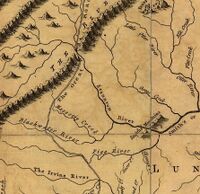
Today, the Roanoke River runs through the city of Roanoke, southeast past William's home near Williamston, into the Albemarle Sound, and out into the Atlantic. If we look at the city of Roanoke area on a map of Virginia published in 1755, however, we find that the river this far north was called the Staunton.[20] There was nothing in this area by the name of Roanoke.
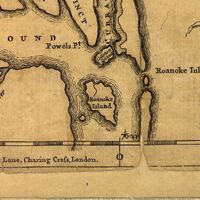
On this 1755 map, we find near the coast, at the mouth of Albemarle Sound, Roanoke Inlet, along with Roanoke Island. Flowing into the other end of the Sound, we find what was called the Roanoke or Moratuc River. It continues to be called this until it splits into the Staunton and Dan Rivers. This would've been just north of the state line in Virginia. The area on the 1755 map is labeled Occoneachey Islands. Today, it is Kerr Reservoir.
It is this area between Roanoke Inlet and the Roanoke River that, during William Sr.'s time, would've been considered "Roanok".[21] In the earliest of Colonial times, it also would've been considered part of Virginia.
Roanoke Island was the location of the Roanoke Colony established in 1585. This was the first attempt by the English to establish a permanent settlement in North America. A map drawn at the time by several men associated with the colonization attempt shows Roanoke Island labeled as Croatoan and depicts it as part of Virginia.[22] Again, in 1640, we find Roanoke Island on a map of Virginia.[23]
When King Charles II granted the Carolina charters of 1663 and 1665 to the original Lord Proprietors, this area around Albemarle Sound that would've been considered Roanoke was just within the 36°30′ northern boundary.[24] Although, there were several border disputes and attempts at surveying before an actual boundary was agreed upon, the area around Albemarle Sound known at the time as "Roanok" would've been within the Province of Carolina and then the Province of North Carolina. Albemarle County originally encompassed the entire area around Albemarle Sound and the east past the Roanoke River. When it was divided up in 1684, the Albemarle Sound area was in 3 different Precincts, Shaftesbury, Berkeley, and Carteret.[25]
By the time William Sr. was old enough to "settle" anywhere, the "Roanok" area was firmly within North Carolina. On a map drawn in 1709, we see the North Carolina boundary much as it is now, with the Roanoke area around the Albemarle Sound falling completely within North Carolina.[26] The area was now divided between the Chowan, Perquimans, Pasquotank, and Currituck Precincts.
It's difficult to say, then, where Pendleton may've been referring to when he said, "the grandfather of Reuben settled in an early day at Roanoke, Virginia." There was no place that would've been considered Roanoke, Virginia, between 1665 and 1871. And the place that would've been considered Roanoke, Virginia, before 1665 was far from the place that was called Roanoke, Virginia, in 1871.
James, in the telling of the story to his daughter, says, “Your grandfather's family was originally from Scotland. There was, as he used to say, a tradition that in early times several persons of this name left Scotland together, crossed the Atlantic, and settled in Virginia.”[1]
In this passage, James says it is the ancestors of William Sr. who settled in Virginia. But it is not stated precisely where.
He goes on to say, "His grandfather, William Ross, a descendant of these supposed traditional ancestors, emigrated from Virginia to Martin County, North Carolina; date unknown."

He says that William Sr. was still in Virginia before coming to North Carolina, but, again, does not say specifically where in Virginia. What it is saying, though, is that wherever William Sr. was, it was north of the now-settled North Carolina-Virginia border. This would exclude the "Roanok" area around Albemarle Sound.
Also included in Life & Times is an excerpt from an an old family record that was brought from North Carolina in 1833, meaning it was brought to Reuben in Tennessee by one of his family members. It states that, "William Ross, Senior, of Martin County, was the son of William Ross, formerly of the State of Virginia, who came to this State, namely North Carolina, and settled in the above-named county. His son, the father of the children whose names are under-written, was born on the 9th of August, 1731, 0. S., and departed this life the 25th of December, 1801."
This statement seems to be saying, too, that there was a move from somewhere in Virginia to North Carolina. It does not mention specifically where in Virginia and, again, the area known as Roanok at the time had technically been in North Carolina since 1665.
Unfortunately, this adds another layer of complexity because it also seems to be saying that it was William Sr.'s father, not William Sr. himself, who came to North Carolina from Virginia. Does this mean that, by the time the book was written in the 1880s, some of the details had been lost or confused?
This leads us again to Pendleton's statement that William Sr. "settled in an early day at Roanoke, Virginia". Where would Pendleton have gotten such an idea?
James Madison Pendleton was an associate of Reuben Ross, father of the James Ross who was the author of Life & Times. Pendleton never met Reuben's father, William Jr., or his grandfather, William Sr. Both men were dead before Pendleton was born. In fact, even Reuben had been dead for 22 years by the time Pendleton wrote his Introduction to Life & Times.
Had Pendleton heard these stories directly from Reuben while he was still alive or was he relying on what was written by Reuben's son James had written in order to craft his Introduction?
James Ross mentions Roanoke many times in the text of the book, but, each time, he is referring to the Roanoke River, never a town called Roanoke. One of the sections of Chapter 2 is titled "The Roanoke River".[27] In it, he speaks in general of the fishing on the Roanoke River and specifically of his father being a fisherman.[28] He also speaks earlier about William Sr.'s accumulation of property and how "the vast cane brakes on the rich alluvial lands along the Roanoke River afforded abundant food for cattle, summer and winter, and the mast that fell from the forest trees enabled him to raise hogs to good profit, but little corn being needed, and that only to keep them gentle.[29]
Every mention of Roanoke made by James in the text of the book refers to the Roanoke River and the life lived there by William Sr. and his descendants. He is speaking, then, of the area where William Sr. lived around Williamston, which was very near the shores of the Roanoke River, in North Carolina.
James Ross was born in September of 1801.[30] Just 3 months later, his grandfather, William Jr. died.[31] William Sr. had already been dead about 40 years. James, therefore, never heard any of these stories from William Jr. or William Sr. He heard them from his father, Reuben.
Reuben moved his family to Tennessee when James was only a small boy.[30] James, therefore, never lived in the Roanoke River area when he was old enough to have real memories of it.
Pendleton wrote Reuben's obituary. In it, he eludes to having seen Rueben preach as a child.[32] Pendleton was ordained in 1833 by a by a council that included Reuben.[33] This may have been when they became acquainted as adults. The point is, Pendleton was not personally familiar with the area of North Carolina where William Sr. lived. He did not know Rueben well until he was an adult and living in Tennessee.
Pendleton states in the Introduction that James spent 10 years writing these 'Recollections'.[34] This means that he started writing 9 years after Rueben died. Pendleton himself wrote the Introduction 3 years after James died.[35]
This means that Reuben wasn't available to proofread James's text and James wasn't available to proofread Pendleton's Introduction.
What appears to have happened is that, in paraphrasing James's text for his Introduction, Pendleton took the idea from the family tradition told to James by Reuben that their ancestors settled in Virginia. He also took this idea that William Sr. settled in the Roanoke River area and/or the area of North Carolina that would've, early on, just been called "Roanoke". He combined these into one sentence in which he stated that William Sr., "the grandfather of Reuben", "settled in an early day at Roanoke, Virginia." This is a convolution of facts that actually belong to several generations of ancestors, not just William Sr.
William Sr.'s ancestors settled in Virginia. William Sr. settled in the Roanoke area of North Carolina.
Research Notes
Life and Times Virginia references
"Roanoke" and "Virginia" passages in the Life and times of Elder Reuben Ross. In the old way of speaking, it is sometimes difficult to decipher exactly what is being said.
From an account of the family from an old family record that was brought from North Carolina in 1833, meaning it was brought to Reuben in Tennessee by one of his family members.
- "William Ross, Senior, of Martin County, was the son of William Ross, formerly of the State of Virginia, who came to this State, namely North Carolina, and settled in the above-named county. His son, the father of the children whose names are under-written, was born on the 9th of August, 1731, 0. S., and departed this life the 25th of December, 1801."[2]
- This appears to be saying that this William Sr. was the son of another William. The tree described here possibly looks like the one below.
- It also appears to be saying that it was William Sr.'s father William who was in Virginia and then came to North Carolina.
- The "above-named" North Carolina county is not actually named in this excerpt.
1-William Ross formerly of the State of Virginia
...2-William Ross Sr.
......3-William Ross Jr. b. 9 Aug 1731, d. 25 Dec 1801
In the Introduction, written by Reuben's associate, J. M. Pendleton.
- "The Ross family is of Scotch descent, and the grandfather of Reuben settled in an early day at Roanoke, Virginia. The year of his emigration from Scotland cannot now be given."[3]
- The grandfather of Reuben was William Sr.
- This passage seems to be saying that William Sr. was in Scotland and then Virginia.
- Today's town of Roanoke did not exist when William Sr. would've been in Virginia. That area would've been far west of the more populated coastal areas of Virginia. The Roanoke River did pass through the area, but was not, at that time, referred to as the Roanoke River. The village that became Roanoke wasn't settled until 1834. It was not actually called Roanoke until 1871, just a decade before this Introduction was written. Pendleton was the only one to refer to the specific place Roanoke. All other references made by William Sr.'s great-grandson James were to Virginia in general.
Written by James Ross, son of Reuben and great-grandson of William Sr.
- "Your grandfather's family was originally from Scotland."
- "There was, as he used to say, a tradition that in early times several persons of this name left Scotland together, crossed the Atlantic, and settled in Virginia; that their descendants — many of them — emigrated into Maryland and Pennsylvania; that their complexions were generally dark (Ross Dhu); and that almost every family had a John, William, or James in it."
- "His grandfather, William Ross, a descendant of these supposed traditional ancestors, emigrated from Virginia to Martin County, North Carolina; date unknown."[1]
- "Your grandfather" refers to Reuben. This section was written by James, speaking to his daughter.[34]
- "His grandfather", therefore, refers to William Sr.
- This seems to be saying that it is William Sr. who came to North Carolina from Virginia, not his father.
- Martin County didn't actually exist in North Carolina during the time that William Sr. or his father would've migrated there.[25] At that time, it would've been Tyrrell County. Martin was created from Tyrrell in 1774.
Currituck Precinct
In the early 1700s, Roanoke Island would've been part of the Currituck Precinct of North Carolina. There was a William Ross who was granted 134 acres of land there on October 9, 1716.[36][37]
It's impossible to tell from the grant where exactly in the precinct the land was located. However, it does tell us that he shared property lines with Luke White, Michael ONeal and Thomas Vince. In 1715, Luke White owned 2 tracts of land in Currituck totaling 279 acres.[38] One hundred seventy five acres on the River Pocoson at Thomas Taylor's corner were granted to him on December 2, 1712.[39] He purchased another 143 acres from Thomas Vince and his wife Margaret on April 12, 1714.[40][41] This parcel was near Poyners Point, part of a tract of land patented to Anne Baly on February 21, 1696.
Considering that William Ross shares a property line with both Luke White and Thomas Vince, it's likely that his property was next to Luke White's 143 acres near Poyners Point that was purchased from Thomas Vince. Unfortunately, Poyners Point is not found on any of the available maps of the day.
William Ross is not found on any tax lists after he was granted the land.[42] He seems to have owned the property, though, until he and his wife Hannah sold it on September 27, 1735.[43][41]
As of now, there is no known evidence of a connection between William Ross of Currituck County (fl1716-1735) and this William Ross Sr. of Martin County.
Disputed Origins
Sources
- ↑ 1.0 1.1 1.2 1.3 Ross (1882). Life and times of Elder Reuben Ross. p. 22.
- ↑ 2.0 2.1 2.2 Ross (1882). Life and times of Elder Reuben Ross. pp. 22–23.
- ↑ 3.0 3.1 3.2 Ross, James; Pendleton, James Madison (1882). Life and times of Elder Reuben Ross. Philadelphia: Printed by Grant, Faires & Rodgers. pp. 11–12.
- ↑ 4.0 4.1 Tyrell County vol. 2 1755, p. 53.
- ↑ "Edmond Smithwick grants in Tyrrell County". North Carolina Land Grant Images and Data. Retrieved Sep 8, 2022.
- ↑ 6.0 6.1 Martin County, North Carolina 1905, p. 72.
- ↑ 7.0 7.1 Deeds, v. 4-4a 1761-1770, pp. 16-17.
- ↑ 8.0 8.1 Deeds, v. 4-4a 1761-1770, pp. 11-12.
- ↑ 9.0 9.1 Ross (1882). Life and times of Elder Reuben Ross. p. 21.
- ↑ Manning, Francis M.; Booker, W.H. (1977). Martin County History. 1. Williamston, N.C.: Enterprise Publishing Company. p. 223.
- ↑ "Towns and Cities". NCpedia. Nov 20, 2012. Retrieved Oct 5, 2022.
- ↑ Dickerman 1900, p. 54.
- ↑ Dickerman 1900, p. 204.
- ↑ Neal, Rosemary Corley, comp. (1988). Elizabeth City County Virginia Deeds, Wills, Court Orders 1715 - 1721. Bowie, MD: Heritage. p. 46. Retrieved Oct 20, 2022.
- ↑ "Bertie Co. File No. 473, John Duggin". North Carolina Land Grant Images and Data. North Carolina Historical Records Online – via State Archives of North Carolina, Raleigh NC, microfilm call # S.108.460.
- ↑ North Carolina Digital Collections CCR 211, p. 2.
- ↑ North Carolina Digital Collections SR.204.1.1, p. 6.
- ↑ Deeds, v. 4-4a 1761-1770, p. 13.
- ↑ "Roanoke VA History - Virginia - Blue Ridge Mountains". History of Roanoke. Apr 13, 2015. Retrieved Oct 3, 2022.
- ↑ "Roanoke River - river, United States". Encyclopedia Britannica. Nov 20, 2014. Retrieved Oct 3, 2022.
- ↑ Evans, Phillip (Jun 18, 2009). "The North End of Roanoke Island in the 17th Century" (PDF). First Colony Foundation. p. 8.
- ↑ White, John, Active, Theodor De Bry, and Thomas Harriot (1590). Americæ pars, nunc Virginia dicta: primum ab Anglis inuenta, sumtibus Dn. Walteri Raleigh, Equestris ordinis Viri, Anno Dn̄i. MDLXXXV regni Vero Sereniss. nostræ Reginæ Elisabethæ XXVII, hujus vero Historia peculiari Libro descripta est, additis etiam Indigenarum Iconibus [Part of America, now called Virginia: first discovered by the English, when they took Dr. Walter Raleigh, Knight of the Order of Men, in the Year of the Lord. 1585 of the reign of Vero Sereniss. of our Queen Elizabeth the 27th, the history of which is described in a special book, with the addition of indigenous icons] (Map). 1:1,700,000 (in Latin). Francofurtum ad Mænum: De Brÿ. Retrieved Oct 3, 2022.CS1 maint: multiple names: authors list (link) CS1 maint: unrecognized language (link)
- ↑ William P. Cumming (1998). "Virginia partis australis, et Floridae partis orientalis, interjacentiumque regionum Nova Descriptio" (Map). "The Southeast in Early Maps" (Third ed.). 1:2,280,960. Cartography by Willem Janszoon Blaeu. Chapel Hill: University of North Carolina Press. p. 41. Retrieved Oct 3, 2022.
- ↑ "Original boundaries of Carolina (1663/1665)". NCpedia. Retrieved Oct 4, 2022.
- ↑ 25.0 25.1 "North Carolina". Atlas of Historical County Boundaries Project. Retrieved Oct 3, 2022.
- ↑ William P. Cumming (1998). "To His Excellency William Lord Palatine; The most Noble Henry Duke of Beaufort; The Right Honoble. Iohn, Lord Carteret; The Honoble Maurice Ashley, Esq., Sr. John Colleton Baronet; Iohn Danson, Esq; And the rest of the True and Absolute Lords Proprietors of Carolina in America This Map is Humbly Dedicated by Ion. Lawson Surveyor General of North Carolina" (Map). "The Southeast in Early Maps" (Third ed.). 1:2,090,880. Cartography by John Lawson. Chapel Hill: University of North Carolina Press. p. 150. Retrieved Oct 3, 2022.
- ↑ Ross (1882). Life and times of Elder Reuben Ross. p. 5.
- ↑ Ross (1882). Life and times of Elder Reuben Ross. p. 27.
- ↑ Ross (1882). Life and times of Elder Reuben Ross. p. 25.
- ↑ 30.0 30.1 "Ross, James". NCpedia. Aug 29, 2014. Retrieved Oct 20, 2022.
- ↑ Ross (1882). Life and times of Elder Reuben Ross. p. 23.
- ↑ "Elder Reuben Ross". Baptist History Homepage, A Source for Original Baptist Documents. Retrieved Oct 20, 2022.
- ↑ Burnett, J.J. (1985). Sketches of Tennessee's Pioneer Baptist Preachers: Being, Incidentally, a History of Baptist Beginnings in the Several Associations in the State ... 1. Johnson City, Tennessee: Overmountain Press. p. 403. ISBN 978-0-932807-11-3. Retrieved Oct 20, 2022.
- ↑ 34.0 34.1 Ross (1882). Life and times of Elder Reuben Ross. p. 19.
- ↑ The Meriwether Society, Inc. (contributor 46827721) (Feb 27, 2011). "Prof James Hunter Ross Sr. (3 Sep 1801–14 Mar 1879)". Find a Grave. Memorial ID 66235392, citing Meriwether Cemetery, Guthrie, Todd County, Kentucky,. Retrieved Oct 20, 2022.CS1 maint: extra punctuation (link)
- ↑ "Currituck Co. File No. 121, William Ross". North Carolina Land Grant Images and Data. North Carolina Historical Records Online – via State Archives of North Carolina, Raleigh NC, microfilm call # 12.14.52.121.
- ↑ Currituck County Deeds. 5. FamilySearch. pp. 187–188. Retrieved Oct 4, 2022.
- ↑ "Currituck Co., NC - 1715 Land Taxes". NCGenWeb Project. Jul 11, 2009. Retrieved Oct 4, 2022.
- ↑ "Currituck Co. File No. 42, Luck White". North Carolina Land Grant Images and Data. North Carolina Historical Records Online – via State Archives of North Carolina, Raleigh NC, microfilm call # 12.14.52.42.
- ↑ Currituck County Deeds. 3. FamilySearch. p. 17. Retrieved Oct 4, 2022.
- ↑ 41.0 41.1 Sheppard, Kay Midgett (Jan 15, 2016). "Currituck County NC Deed Book 3". NCGenWeb Project. Retrieved Oct 4, 2022.
- ↑ "Currituck Co., NC Census, Tax & Voter's Lists". NCGenWeb Project. Retrieved Oct 4, 2022.
- ↑ Currituck County Deeds. 3. FamilySearch. p. 55. Retrieved Oct 4, 2022.
- North Carolina County Court of Pleas and Quarter Sessions (Tyrrell County) (1950). Deeds, v. 2 1748-1755 (images). Salt Lake City, Utah, Raleigh, North Carolina: Filmed by the Genealogical Society of Utah, North Carolina Dept. of Archives and History. OCLC 865959163. FHL microfilm 19984.
- North Carolina County Court of Pleas and Quarter Sessions (Tyrrell County) (1950). Deeds, v. 4-4a 1761-1770 (images). Salt Lake City, Utah, Raleigh, North Carolina: Filmed by the Genealogical Society of Utah, North Carolina Dept. of Archives and History. OCLC 865959163. FHL microfilm 19985.
- Dickerman, George Sherwood (1900). The House of Plant of Macon, Georgia: With Genealogical and Historical Notes. New Haven: Tuttle, Morehouse & Taylor Co. OCLC 7601966. OL 20575915M.
Acknowledgements
- Extending work by:
- Charles Ross Brashear posted on Ancestry.com's message boards.
- Jennifer Ross-Chapman.
- Jim White.
Further reading
External links
List official websites, organizations named after the subject, and other interesting yet relevant websites. No spam.
Disclaimer
It is admittedly impossible that we have been able to evaluate every piece of evidence available for every person included on this site. What you often find on the internet, though, are trees with no sources attached at all. Many of these trees were created pre-internet & have been passed down, uploaded & copied to multiple sites without details of the original sources they were based on. Now, with the advent of DNA testing, we're finding that they don't always match up with what the DNA is telling us. In order to reevaluate these trees in conjunction with the DNA evidence, we need to have available the sources that they might've originally been based on. This site, then, is intended as a repository for these sources and an opportunity to share what the DNA is telling us so that we can work collectively to correct these trees. Over time, more of the old records will be able to be combed through, and the sources cited here will grow.