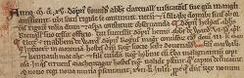
SAINT MAELRUBHA : HIS HISTORY AND CHURCHES. By WILLIAM REEVES, D.D., M.B., Vice-Pres. R.I.A., Hon. Memb. Soc. Antiq. Scotland, and Antiq. Soc. of Zurich.1
Next to St Columcille, there is no ecclesiastic of the ancient Scottish
Church whose commemorations are more numerous in the West of Scotland[72]
In July 1849, the writer of the following paper made a communication to the “Irish Ecclesiastical Journal,” which appeared in the 108th number of that publication (vol. v. p. 299). Previously to that date, nothing had been done towards the identification of St Maelrubha or his church of Apercrossan; and in his note on the passage of the Four Masters at 671, which makes mention of them, the learned Dr O'Donovan declared his inability to ascertain the modern name of the saint's church in Scotland. In the appendix, however, to the second volume (p. 1191), the author refers to the article in the “Irish Ecclesiastical Journal” as affording the desired information. Since that period, the present writer has had opportunity to visit many of the scenes of St Maelrubha's labours, and to extend his acquaintance with Scottish works bearing upon the individual or his age; and the result of all is here collected in a memoir, in the compilation of which accuracy has been principally aimed at. Should this effort to embody in a connected view the disjecta membra of Irish and Scottish reminiscences of the saint be deemed worthy of the notice of the Society of Antiquaries of Scotland, the writer will consider that he has received tenfold remuneration for the time and pains bestowed upon the task.—The Vicarage, Lusk, April 20, 1859.
than St Maelrubha, or whose history is marked with greater exactness
in the main particulars of his life. He was born on the 3d of
January, in the year of our Lord 642, as we learn from the accurate
annalist Tighernach, who, in recording the saint's obit, determines his
age to the very day. On his father's side, he was eighth in descent from
Niall of the Nine Hostages, Sovereign of Ireland, through that branch
of his house called the Cinel Eoghain ;1 subordinately, through the family
styled the Cinel Binnigh,2 which clan early obtained a settlement in,
and gave name to, a district in the south-eastern part of the present
county of Londonderry, where, among his kindred, we may reasonably
presume our saint was born. On his mother's side he was akin to St
Comgall, the great abbot of Bangor in the county of Down, who was of
the Cruithne, or Irish Picts, being of the race of Fiacha Araidhe, the
founder of the Dal-Araidhe of Ulster. His paternal descent is recited
among the pedigrees of the Irish saints preserved in the venerable manuscripts
in the collection of the Royal Irish Academy, called the Book of
Lecan, and the Book of Ballymote.3 It is also found in the more modern
compilation of Duald MacFirbis.4 All these authorities agree in setting
him forth as Maelrubha, son of Elganach, son of Garbh, son of Ollarbach,
son of Cuboirenn, son of Cremthann, son of Binnigh, son of Eoghan (who
died, according to Tigernach, in 465), son of Niall of the Nine Hostages.[108]
The Cinel Eoghain were the descendants of Eoghan, son of Niall, and their territory was called Tir-Eoghain, i,e. Terra Eugenii, subsequently and still known as Tyrone; and Inis Eoghain, i.e. Insula Eugenii, the peninsular portion of the northeast of the county of Donegal, now known as the barony of Inishowen.
The Cinel Binny were the descendants of Eochaidh Binnigh, a son of Eoghan above mentioned. Their territory was a subdivision of Tyrone, extending to Tullaghoge on the south, and comprehending all the modern barony of Loughinsholin on the west of the River Bann, which, though now in the county of Londonderry, was in Tyrone until 1591. It gave name to a rural deanery in the diocese of Derry, called Bynnagh or Bennagh, See Beeves's “Colton's Visitation,” p. 74.
“Book of Lecan,” fol. 87 bc.
“Book of Ballymoto,” fol. 119 ba.
In the tract on the Mothers of the saints of Ireland, preserved in the
manuscripts above mentioned,1 two names are assigned to his mother—
Suibsech mꞇ̇ir Molruḃ mec lgonig, “Suaibsech, mother of
Maolruhha, son of Elgonach;” and again, Subtn ingen Setn siur Chomgill mꞇ̇ir Molruḃ, “Subtan, daughter of Setna, sister of
Comgall, mother of Maolrubha.” With the latter statement agrees the
note on the Feilire of Ængus the Culdee, at the 21st of April; but it is
attended with the chronological difficulty that S. Comgall, Subtan's brother,
died at an advanced age in 602; whereas Maelrubha was not born till 642.
The following table exhibits at a view the double descent of our
saint:—
Niall ix. Hostages
Lughaidh (Cujus atavus flor. a.d. 236.)
Eoghan (ob. 465)
Crimthann
Eochaidh Binnigh (a quo Cinel Binnigh.)
Ernan
Crimthann
Forgo
Cuboirenn
Brian
Ollarbach
Eochaidh
Garbh
Sedna
Elganach
Subtan
Maelrubha.
The name Maelrubha is compounded of Mael “a servant,” and Rubha,
which signifies either “patience”2 or a “promontory;”3 and it is occasionally
met with in Irish records. Maelrubha, of the race of Conall
Gulban, was great-grandfather of St Moabba.4 Two of the name are[109]
“MacFirbis' Genealogical M.S.,” p. 701 b.
Ruba .i. fulng (“patience”). “MacFirbis' Gloss.”
Of frequent occurrence in the topography of Scotland, as a point of land, in words beginning with Ru or Rue.
See the genealogical table in “Reeves's St Columba,” at p. 842; “Book of Lecan,” fol. 41 ba.
found among the descendants of King Laeghaire;1 and the Four Masters,
in their Annals, at the years 715, 771, 823, and 992, record the deaths
of other individuals so called.
Our saint, following the national usage of family association, became
a member of St Comgall's society at Bangor. The Four Masters, led by
the gloss in the Calendar of Marian, state expressly that he was abbot of
that monastery; but for this assertion there is no authority in the earlier
records, and, indeed, there is negative proof to the contrary, as his name
is not found in the catalogue of abbots recited in the Antiphonary of
Bangor.2 His connection with this place seems, however, to have been
kept up even after he fixed his seat in Scotland, and his principal church
in that country was regarded as an affiliation of Bangor; for we find, at
the year 802, mention made of the death of an abbot of Bangor, who took
his designation from Apurcrossan; and it is probable that Failbhe, abbot
of Apurcrossan, who was lost at sea, with twenty-two members of his
fraternity, in 737, was on his way to or from a chapter of his order
in the parent institution.3
In the year 671, Maelrubha, being now twenty-nine years old, withdrew
from his native country to Alba, following in the wake of St
Columba and others of his nation. This we learn from the Annals of
Tighernach and of Ulster, at the years 671 and 670 respectively, in
the entry, Maelruba in Britanniam navigat. Two years expired before
he obtained a permanent settlement; but in 673,4 as Tighernach again
relates, Maelruba fundavit ecclesiam Aporcrosan, The Four Masters, at
the year 671, combine the two entries, omitting any notice of the interval,
and state that in that year Molruḃ bb Bendċir do dul i nlbin go ro foꞇ̇ig eccls porcrosn, “Maelrubha, abbot of Benchar,[110]
“Book of Lecan,” fol. 41 bb; “MacFirbis' Geneal. MS.,” p. 192. “The Annals of Ulster,” at 716, render Maelrubha Filius Rubai; and at 992 by Rubai.
See Muratori Anecd. tom. iv. p. 158; “Opere,” tom, undec. pt. iii. p. 251; “O'Conor, Rer. Hib. Script.” vol. i., Ep. Nuncup., pp. 168, sqq.; Peyron, “Ciceronis Orat. Fragm.,” pp. 224-26 (Stuttgarde, 1824); especially “Ulster Journal of Archæology,” vol. i. pp. 177-79.
See such a case recorded by Adamnan, ii. 45, and the note, p. 178, in Reeves's edition.
“Annal. Ult.” 672; “The Annals of Clonmacnois” have Moyle-Rovaie founded the church of Aporcorossan an. 669.
went to Alba, and founded the church of Aporcrossan.”1 Here he
continued to exercise his abbatial office for fifty-one years, during which
time he founded a church on an island in a lake of Ross-shire, which takes
its name of Loch Maree from him; and he acquired so great a reputation
for sanctity, that he was regarded as the patron saint of this part of Scotland,
whence he extended his influence both in islands and on the mainland.
In 722 he closed his labours; and his obit is thus circumstantially
recorded by Tighernach: Maelruba in Apercrossan, anno lxxx. etatis sue, et tribus mensibus, et xix. diehus peractis, in xi. Kal, Maii tertie ferie die, pausat.
The parallel entry in the Annals of Ulster, at 721, is less explicit:
Maelrubai in Apurcrosson, anno lxxx. etatis sue [obiit]. Tighernach,
indeed, subjects his accuracy to a severe test; for he gives the
year, 722; the day of the month, 21st of April; and the day of the week,
Tuesday. Let us try him on his own telling:
The current letter of April 21 is F; therefore, supposing it to be
Tuesday, as he states, the Sunday-letter will be D. We turn to the
L'Art de Verifier les Dates for a year to answer this note; and 722 exhibits
the desired symbol.
April 21 being established as the day of his death, we refer to the
Irish calendars, where we find the following interesting notices. And
first, the Feilire or Festival-book of Aengus the Culdee,2 a writer who
flourished in the early part of the ninth century:—
“Annals of the Four Masters,” vol. i. p. 282., ed. O'Donovan.
This most venerable, curious, and important poem has never, to the disgrace of Ireland, been printed. Ancient copies exist in MS. in the Bodleian library (Rawl. 505, vell.); the Royal Irish Acad.; and the O'Clery collection in the Burgundian library at Brussels. The finest and best annotated copy known is that in the Leabhar Breac, fol. 28. (Library of the R. Irish Academy.)
Upon which is written the following note by an early hand:1—
.i. do ċenel ogin do, ocus i nlpin t .i. in Conpur Crossn ocus feil eitsecht so. Subtn ingen Setni ocus siur Chomgill Bendchuir mthir ocus in bur Chresen2 t chell.
“i.e., he was of the Cinel Eoghain, and it is in Alba he is, i.e., in Conpur2 Crossan; and this the festival of his death. Subtan, daughter of Setna, and sister of Comgall of Bennchar, was his mother; and in Aburchresen his church is.”
Next in order is the Martyrology of Tamlacht, an ancient calendar,
which simply gives under each day the name of the saint and his principal
church. At the 21st of April it has the commemoration,
Melrubch Benchir,
“Of Maelrubha of Bangor.”
The Calendar of Marian Gorman, compiled about the year 1167, commemorates,
at same day,
Melrub nem,
“Maelruba the holy.”
Upon which is the gloss, bb Benchir, “Abbot of Benchar.”
Lastly, the Calendar of Donegall, collected from ancient authorities,
by the O'Clerys, in the early part of the seventeenth century, thus notices
the saint:—
Melruḃ mc lgniġ do ċenel oġin mic Neill, bb Bennchir gus ro bennigh fos in lbin .i. in pur Crossn, nno Domini 721, octmogt blidn eir n tn ro fid spirt. Suiḃsech inm mꞇ̇ir. No gomb i Suḃꞇ̇in inġen Sedn siur Coṁgill mꞇ̇ir.
“Maelrubha, son of Elganach, of the race of Eoghan, son of Niall, abbot of Benchar; and he blessed also [a place] in Scotland, i.e., in Apur Crossan, a.d. 721. Eighty years was his age when he resigned his spirit. Suaibhsech the name of[112] his mother. Or, it was Subtan, daughter of Sedna, sister of Comgall, was his mother.”
The notes on the Feilire are ascribed by Colgan to Cathal Magnire, a canon of Armagh, who died in 1498. The present gloss is cited in Dr Todd's “Introduction to the Book of Obits of Christ Church,” p. 58.
Conpur seems to be an error for Apur, as the contraction O, which represents con, may easily have been mistaken for a.
Cresen might mean “devout,” or “righteons man.” But it is more likely that Crossan was the ancient name of the Applecross river.
From the above, it may be seen that all the Irish authorities, both
Annals and Calendars, are unanimous in referring his death to the 21st
of April.
The following is a connected summary of the preceding observations:—
St Maelrubha, son of Elgana and Subtan, descended on his father's side
from Niall the Great, through the Cinel Owen race; and by his mother,
from the Dalaradian stock, and, through her, nearly related to St Comgall,
was born on the 3d of January 642. He received his early training at
his kinsman's famous monastery of Bangor, where he rose so much in
esteem that, according to some authorities, he became the abbot, or what
is more probable, was appointed to the subordinate station of prior. In
671, having attained his twenty-ninth year, he left his native country
and withdrew to Scotland. Two years, which were probably spent in
choosing a place of abode, having elapsed, he settled in 673, at Apurcrossan,
on the north-west coast of Scotland, where he founded a church,
which became the nucleus of a conventual establishment, following the
order of Bangor, and for a long period affiliated to that monastery.
After a presidency of fifty-one years, during which time he enjoyed a
character of great sanctity, he died a natural death at Apurcrossan, on
Tuesday, the 21st day of April 722, at the age of eighty years, three
months, and nineteen days.
Such is the Irish statement of his history, and it is too circumstantial
and too well attested to admit of its being called in question. Scottish
authorities, while they agree with the Irish in coupling the name and
memory of the saint with Applecross, as his principal church, differ very
materially from them as to his date, history, and festival. Indeed, it is
difficult to avoid the alternative of supposing that they have confounded
the acts of two saints, or, that a good deal of what is set down to Maelrubha
by them, is gathered from comparatively recent and debased tradition.
I shall adduce these writers in their order of age, premising that
the day which all Scottish calendars and writers, with one exception,
have chosen for the saint's festival, is the 27th of August.[113]
The Breviary of Aberdeen in its calendar, at the vi, kal. Sept., notices
Maelrubii abbatis, medice lectiones de sancto Rupho, novem lectones. In the
Proprium Sanctorum, at same day, we find an office of nine lessons, the
middle three of which are devoted to St Ruffas of the Roman Martyrology.
The compiler of the principal legend of the day evidently was in
the dark as regarded the history of St Malrubius, and records, as will
presently be shown, no more authentic matter in the narrative than a
peasant could at this day collect in the regions where the saint's memory
is preserved.
Lec. i. “Malrubii martyris Christi transitum de mnndo celebraturi
dignis cum laudibus ejus commemoracionem in hymnis psallendo et canticis
transigemus et obDei reverenciam diem presentemdiligenter decorare
studebimus Nee vestras subterfugiat sanctitates hunc quem colimus virum
sub regula et habitu monachali longos vite sue in calamitate et miseria
trivisse dies. Fidei incredulos ac gentilium paganos suis doctrina et predicacione
ad religionem quam profitemur christianam convertendo. Lec. ii.
Sed ne dies predara ilia de qua locuti fuimus absque miraculorum per Dei
virum gestorum narracionis [recte narratione transeat] ea paucis taxando
ubi plurima quam tempus patitur augustia fuerint [recte plurima temporis
non patitur angustia] declarabimus. Nam cum nonnulli malarum cogitacionum
viri de Norvagii regniculo navigio Rossie confinibus applicarent:
beatum audientes Malrubium alienam ab eorum gentilitate fidem predicantem
sanguinolentas in Dei unctum intulerunt manus ac gladios de
vaginis extrahentes funestos beatum Dei virum tanquam agnum mansuetum
et pium pro Christi nomine pacientem crudelius quam enarrari posset
percuBserunt et vulneraverunt: et tanquam mortuum in campis silvestribus
canibus et avibus devorandum reliquerunt. Lec, iii. Beatum itaque corpusculum
per triduum semivivum incognitum populo jacebat Attamen
per angeloB Dei oontinua consolaoione et visitacione a multis visum est
associatum. Locus tamen ubi corpus exanime incubuit fulgore nimio coruscare
pluribus apparuit qui illic venientes beatum Malrubium in agone
laborantem reperierunt sed eo sanguine et corpore Jesu Christi immaculati
agni participati [recte participate] dominum laudando cum sancta
pacientia et senectute bona in fata decessit corpusque ad basilicam que a
vulgo dicitur Appillcroce transferri et ibidem tradi sepulture mandavit.
At ne sanguis beati martyris preoiosus in terram effusus absque veneracione[114]
relinqueretur Illo in loco in honore martyris noBtri sacratissimi ex
inciso robore satis reverenter eztructa est capella que postea in parrochialem
erigitur ecclesiam que in presens Urqubard ab illius terre incolis
vocitatur. (Tres medie Lectiones de sancto Rupho martyre). Lec. vii, Interim
populo alia qiiamplurima contingebant fieri miracula Dani adversus insulanes
bella moventes ad prefatam ecclesiam de Appilcroce navigio terram
illam vi et armis expngnandam et depredandam arripnerunt: verum quia
terre circumvicinei per sena a dicta ecclesia miliaria immunitatis beati viri
meritis gaudet privilegio eandem a quibuscunque minus juste depredari
minime permittit Dani vero de premissis cerciorati Dei vindictam non formidantes
in beati Malrubii contemptum sacerdotibus et aliis ecclesie ministris
in obprobrium datis victualia et animalia cum quibus sese sustentare
deberent yi et palam abstulerunt et rapuerunt atque licet ciborum inedia
astricti fuerant (justo Dei judicio) suis cum rapinis navibus festinarunt
Nam cum tanta prohibuit mora quod illo in territorio manducare nee bibere
potuerantvelisque extensis mare minime agitato ventis sed tranquillo prospero
ut apparuit cursu navigantes videntibus cunctis eosdem mare omnes
simul consumpsit et exsorbuit.[note 1]Lec. viij. Debinc dum prefati insulani
contra Rossenses quosdam veteres excitarent inimicitias cogitayerunt qualiter
in eos vindicarent inito eorum consilio in magna virorum copia congregati
ignorantibus Bossiisqui cum in ecclesia beati Malrubii de Contan
annuam sanctiviri celebrarent solemnitatem insulani clam noctis sub silencio
eosdem insidiarunt atque igne ecclesiam prefatam incenderunt in qua
plusquam centeni cbristiani viri et mulieres ferro et igne extincti sunt quod
facinus Deus ipse gloriosus qui sanguinis innocencium aspersionis est
ultor impunitum non permisit. Nam cum quibusdam illorum occisorum
parentibus beatus vir apparuisset in somnis Bossii in brevi aggregati sunt
numero verum quamquam insulani illis forciores et pociores fuerint
nicbilominus Dei et beati viri freti auxilio Bossii insulanos illos ita compescu[er]unt
et gladio perdomuerunt quod de quincentis armatis triginta
vix viri evaserant qui etiam servi bostium et dediticii efifecti immo
omnes tanquam non videntes stupore formidinis perculsi sunt et a pluribus
adversariis beatus vir baculum gestans manu visus est. Lec. ix.
Sacerdos quidam parrocbialis inter divina celebranda solemnitatem beati
martyris Malrubii suis parrocbianis a servilibus observandam serviciis[115]
See the Gaelic name Comrich, infra; and the Saxon Girth, infra.
precepit parrochiani autem illi quia autumnas instabat grana usque ad
vesperam non obstante metebant pauloque ante singule domus meteucium
sponte igne accense sunt verum quidam devotus diem martyris
solemniter celebrabat in divinis. Ita contigit quod singule domus incendio
consumpte sunt illius devoti yiri dome que aliis domibus contigua fuerat
tantum excepta. Et cum illi messores domesticas suas res de eisdem
domibus adversus ventum extraherent sicut fecerat iste devotus
Ventus yero in aliam versus est regionem: et res ille que premitus
a vento salve fuerint igne adversante similiter exhauste sunt Bebus illius
viri aliis in medio admixtis integre permanentibus.1
The purport of this narrative is, that a body of pagan Norwegians,
landing on the eastern shores of Ross, slew Malrubius, and dragged his
body into the thickets to be devoured by wild beasts. That his martyrdom
occurred at Urquhard, and that on the spot where he suffered, a
wooden chapel was at first constructed, which was subsequently superseded
by the parish church of Urquhart or Ferintosh. That his body
was removed from this place and carried to Applecross, where it was
solemnly interred. That in after-times the lands of Applecross, in a
radius of six miles from the saint's church, enjoyed the rights of sanctuary
and immunity; but the Danes, who invaded the district, despising
the privilege, plundered the priests and ministers of the monastery, and
carried the booty to their ships. Yet the vengeance of Providence overtook
them, for they perished in the tranquil sea. On another occasion
the Islanders surprised the Rossmen who were assembled in St Malrubius's
church of Contan, keeping the saint's festival, and burned the
church with above a hundred men and women in it. But the Rossmen
assembling and suddenly attacking the invaders, overthrew them so
signally, that of five hundred scarcely thirty survived. Lastly, it happened
that one year some people, anxious to anticipate the advancing
autumn, neglected to observe the saint's festival, being busily occupied
in reaping, for which their houses took fire and were consumed, while
one adjoining house, belonging to a man who respected the saint and
kept his holiday, was miraculously left intact.[30]
The next authority is an Aberdeen martyrology preserved in the
University Library of Edinburgh: “vi. Kal. Sept. In Scotia sancti
Malrubii martyris sepultus apud Appilhorss, Rossensis dyocesis. Cujus
tanto sperabatur in partibus illis beatitudo in patria quanto ejusdem
miranda apud illam indomitam gentem comprobatur probitas et
patientia.”1
Adam King's Calendar at the 27th of August has: “S. Malrube
heremeit and mart. be ye daneis at mame in scot. vnder king malcolme 2.
—1024.”
Whom Camerarius follows: Aug. 27. “S. Malrubius Martyr a Noruegis. Celebris habetur in Mernia.”2
Dempster, in his Menologium, has: “Julius xxvii. Marnæ Malrubi
Eremitæ et martyris a Danis interfecti.” And again, “Augustus xxvii.
In Scotia Malrubi Eremitæ.”3 In his larger work he is more explicit:
“S. Malrubus erėmiticam vitam sanctissime professus Danis sub Malcolmo
II. Scotiam ferocissime incursantibus ad Marnam, quam toties
optavit, martyrii palmam tandem recepit. Apices tantum operum invenio
cum ea perierint. scripserat autem—
De imitatione Sanctorum, Lib. i.
De Christiaiia perfectione, Lib. i.
Vixit anno mxxiv. Recolitur ejus memoria die xxvij Augusti.”4
Bishop Keith copies the entry in Adam King, but unhappily turns
Marne into Nairn.5
The Bollandists, following Dempster, notice the saint under the 27th
of July,6 but they refer to the 27th of August for his acts. Under the
latter day they cite the lessons of the Breviary of Aberdeen, but fall into[116]
Proceedings of the Society of Antiqaaries of Scotland, vol, ii. p. 267.
De Scotoram Fortitudine, p. 176 (Paris, 1681).
Tho. Dempsteri Menologii, pp. 18, 21 (Bonon. 1622).
Tho. Dempsteri Hist. Eccles. Gent. Sector.; vol. ii. p. 450* (Repr. 1829.)
Histor. Catal. of Bishops, p. 878 (Edinb. 1824).
Acta Sanctorum, Julii, tom. vi. p. 352 b.
the error of making the place of his martyrdom to be Marnia or Mernis;1
while Patrick Ninian Wemyss, cited by them, fixes it “penes Nairnam
non procul ab Invernesso.” They are again in error in taking exception
to the supposed identity of Malrubius and Rufus:—“Undo censemus,
non satis cum vero consentire, quæ scribit Wemyssius antea allegatus;
Suspicor hunc Malrubium eundem esse cum famoso illo Rossensium eremita,
de quo mira narrantur, quem illi Melrigam vocant: quia narravit
mihi P. Macra noster, eis in oris missionarius, et amicus meus, Rossos
suum eremitam latinè Rufum dicere: jam Malrubius et Rufus non multum discrepant.”2
Alban Butler, in deference to both Scottish and Irish, notices two Malrubii;
the one at April 21, whom he represents as “of Abur-Crossain,
in the county of Ross in Ireland,” who was slain by Norway pirates in
721; having “his festival in Connaught.”3 The other, as leading an
eremitical life in Scotland, and murdered by the Norwegians about the
year 1040. The note adds, that “he is not to be confounded with St
Malrubius who is honoured on the 21st of April.”4 Thus this amiable
writer makes confusion doubly confounded.
The sagacious Thomas Innes, however, was not to be misled by the
conjectural dates of Adam King, nor even by his native calendars:
“About the same time lived among the Picts, S. Maolrubius or Mulruy,
a religious man of great sanctity of life, who being slain by the Danes
or Norwegians in an invasion they made into Ross, a.d. 721, was buried
at Apercross, and his memory celebrated as a Martyr upon 21st of
April.”5 Here it is to be observed that he borrows the day and year
from the Irish authorities, but introduces the Scottish tradition of the
martyrdom, which is not borne out by any ancient record. It is also
open to the serious objection, that the Northmen had not commenced
their recorded ravages of North Britain so early as the year 721.6[117]
Marnia, alias The Mearns, was an old name of Kincardineshire. But may not Marnia have been a name for the district about Urqnhart also ?
Acta Sanctor. Ang., tom. vi. pp. 181, 182.
Lives of the Saints, April 21.
Ibid. Aug. 27.
Civil and Eccles. Hist. of Scotland, p. 819 (Spalding Club). He is styled martyr in the legal records of 1548, 1549, in Appendix infra.
The first inroad of the Danes on England was a.d. 787 (Saxon Chron.); the first in Ireland in 795. In 794 and 798 the island of Britain was ravaged by them; and in 802 and 806 Hy was plundered by them; and these appear to have been the earliest ecclesiastical spoliations. Hence we may pronounce a Danish or Norse descent on Ross in 721 to be a fable.
We can easily suppose this story of S. Malrubha's martyrdom by the
Danes to have been invented, or borrowed from some later ecclesiastic's
history, but it is not so easy to account for the discrepancy regarding
the saint's festival in Ireland, April 21, in Scotland August 27. The
best solution seems to be afforded by the partial coincidence in sound of
the name Mal-rubius with Rufus. St Ruphus or Rufus, of Capua, was a
follower of St Apollinaris, an alleged disciple of St Peter. His day in
the Roman Calendar is August 27th; and he is thence transferred into
the Irish and Scottish Calendars. Marian Gorman has Ruffus at this
day, and the Feilire of Ængus devotes a quatrain to him:
Drong in mrtir glnbi
Ruphin cin combinde
Co rig nel noem ndoe
Luid tre roe rinde.
ʻThe party of that pure martyr,
Ruphin the gentle and sweet:
To the king of the limitless clouds
He went through a field of spears.ʼ
The Scottish calendar in like manner notices him together with Maelrubha,
and inserts his lessons in the body of the other saint's. Therefore
it is possible that the early compilers of the Scottish calendar, finding
Ruphus fixed through Christendom to this day, grafted on the name the
memory of Mael-Rubha: and in support of this hypothesis, it may be
mentioned that an island off Applecross, now called Croulin Beg, was
formerly styled St Ruphus's Island, and that in a native authority our
saint is called “St Rice or Rufus.”1 In the case of three or four other
churches,2 the patron St Rufus seems to be none other than our Maelrubha.
Or, it may be that the observance of the festival of the Translation,[118]
Collectanea de Rebus Albanicis, p. 304.
See the list of churches ifra, under Harris, Keith, Crail. Rafford, in Elgin, was anciently Ecclesia de Ruffus,-0ld Stat. Ac. xvi. 338.
or of some such ceremony, instead of the dies natalis, as has occasionally
happened, may in this case have given rise to the different
usages of the two sister churches. Indeed the gloss on the Feilire of
Ængus already cited, seems to imply another commemoration, when at
the 21st of April it significantly observes, “this is the festival of his
death.” Even Dempster wavers between July 27 and August 27.
One point more deserves to be noticed before I treat in detail of the
churches where St Maelrubha is venerated, namely, the endless variety
under which his name is presented, both simply and in combination.
Preserving the radical letters, we find it in the forms—
Mulruby,
Mulrew,
Malruf,
Malrew,
Malrou,
Mulruy,
Molroy,
Melriga.
Dropping the l from maol, we observe it contracting into—
Marow,
Morew,
Marrow,
Morow,
Maro,
Murruy,
Maroy,
Mareve,
And by a further process becoming—
Măree,
Mărie,
Măry,
Mury,
which is the prevalent pronunciation of the name in Rosshire and
Argyle, and in speaking is sufficiently distinct from Māry the female
name, though on paper it is apt to be confounded with it, and has in
many instances caused the patronage of ancient churches under Celtic
foundation to be transferred to the Virgin Mary1 instead of St Maelrubha,
thereby assigning her a distinction which was very sparingly, if
ever, accorded to her in the early Scotic Church, whose favourite practice
was to adopt the founder's name, and limit the honour to native merit.
Again, another process drops the initial letter of the names in composition, and thus we get—
Arrow,
Erew,
Errew,
Olrou.
A further retrenchment discards the first element of the compound
name, which gives us—
An accomplished Irish antiquary, Charles Haliday, Esq., states that in no case was there an ancient Irish dedication to the Virgin Mary—St Brigid being the female of highest honour; but that the Danes discarded her, adopting Mary instead, and even changing some existing churches to her invocation. A favourite title for St Brigid was “the Mary of the Irish.” See Dr Todd's “Liber Hymnorum,” part i. p. 64.
And, to crown all, by an inverse process, the natives on the east side of
Scotland, less inclined to hurry off the honoured sound, combine both
name and title, running Saint Malrubhe into the euphonistic form of
Summereve, and this again diverging into the local varieties of—
This name in its original form, as supplied by early Irish records, is
manifestly compounded of Apur or Apor,1 the old form of the British
Aber, which signifies “the mouth of a river;” and Crossan the name of
the stream which flows into the bay a little west of the church. This old
name of the river is locally forgotten, and, instead of it, they use the
borrowed designation Abhuin Mareee, i.e. “Maree's River,” or the Applecross[121]
This word is unknown in Ireland, and does not exist among the Irish branch of the Celtic race. Inver is the term commonly employed in Ireland, as it is on the west side of Scotland. Aber prevails on the east side. The existence of an Aber in the eighth century, on the west side of Ross-shire, indicates a Pictish occupation of the district previously to that time. See Adamnan's account of the Pict who was ferried over to Skye to be baptized by St Columba. Vit. i. 88 (p. 62, ed. Reeves).
River, as it is marked on the county maps. In all the Irish authorities
which notice the place, the word is found in its correct form; but
in all existing Scottish records, and in the language of the Gaelic-speaking
natives, it is called Appilcross or Applecross. We have no means of
ascertaining at what period the apur passed into apil, and crossan into
cross, but the change probably arose from a tendency to facilitate the
utterance of the compound.
In the modern etymology of the name, we have a striking example of
the literary loss which a country sustains in the destruction of her primitive
records, and of the childish extravagance into which even men of
sense and education may run, when they have no other guide in etymology
than untutored conjecture. “Applecross,” says the Rev. John
M'Queen, a clergyman who knew Gaelic as well as English, “is a fanciful
designation assumed by one of the proprietors of that part of the parish,
from which it derives its name. In commemoration of this, five apple
trees were planted cross-ways, and have since, in form, been perpetuated
by his successors.”1 This was written in or before the year 1792; but
the derivation seemed too good to be abandoned, and so late as 1836,
the Rev. Roderick M'Rae, impressed with the same idea, states that “the
modern name Applecross was given to the parish by the gentleman who
was proprietor of the Comaraiek estate, at the time of the erection: in
commemoration of which event, five apple trees had been planted crossways
in the proprietor's garden.”2
When the writer of the present paper visited Applecross, in 1854, he
was informed by the then minister that the cross trees which yielded
the name were chesnut instead of apple ! A communication lately
received from the spot suggests a solution by supposing a cross of trees
with a crab-apple in the centre.” Another and more ecclesiastical
version of the etymology is, that every apple which grew in the monks'
garden was marked with the sign of the cross.'
Nay, the tendency which exists in the Celtic mind for quasi and fanciful
etymologies will not allow even the common Gaelic designation of the
sanctuary-land to escape. The Breviary of Aberdeen states, that the[122]
Old Statistical Account of Scotland, vol. iii. p. 869.
New Statistical Account of Scotland, vol. xi7. (Ross-shire), p. 100.
Anderson's Guide Book, p. 481.
privileged territory of this church extended six miles from it in all
directions. This tract was vernacularly called Comrich or Comaraigh,
which is equivalent to Girth or Sanctuary,1 and is rightly interpreted by
the contributors to both Statistical Accounts. Yet local etymology suggests Comchris, “a belly-belt,” because the man who first landed pulled
off his bellyband, and flung it before him on the shore, crying out, Mochomchris ort, “My belly-belt upon you.” The place where he landed is
still marked by four trees on the side of the bay, about a hundred yards
south of the well!
Abbots and Ministers.
Maelrubha the founder, of whom we have already treated, was succeeded
in Apurcrossan by Failbhe, son of Gruaire, who perished at sea in 737, as
is thus recorded by the annalist Tighernach:—Failbe mac Guaire,Maeleirebai eiris [rectè Maelertihai Heres], i. e. Apuorcrosain, in profundo pelagi dimersus est cum suis nautis numero xxii.2[93] Or, as the Annals of
Ulster, at 736, Faelbe filius Guaire Maelrubii, heres Crosain, in profundopelagi dimersus est cum suis nautis numero xxii.3[92] Or, as the Four Masters,
at 732: Filḃe mc Ᵹuipe coṁrb Moileruḃ do ḃꞇ̇d go bfoirinn luinge amaille fris. Dias ar fiċit allion. “Failbhe, son of
Guaire, successor of Maelrubha, was drowned, and the crew of his ship
together with him. Two and twenty their number.”4[91] These twenty-two
were probably brethren of the community of Applecross, who, like
the congregation of Hy, were trained to a seafaring as well as agricultural life.
In the course of the same century, a member of the family of Apurcrossan
became abbot of Bangor in the Ards of Ulster, the institution of
which, as has been already observed, St Maelrubha had originally been a
member. His obit is thus recorded by the Annals of Ulster, a.g. 801:
Mac Oigi Apuirchrosan ab Benchair feliciter vitam in pace finivit,5[95] Of
this MacOigi we hear nothing further; but the writer of this paper is[123]
Styled Refugium lie Girth, in Append., No. viii., infra.
O'Conor, Rer. Hib. Script., vol. ii. p. 241.
Ibid, vol. iv. p. 86.
Vol. i. p. 829 (ed. O'Donovan). Vid. Colgani Acta Sanctor., p. 576 g, n. 8. See Reeves's Columba, p. 885.
O'Conor, Rer. Hib. SS., vol. iv. p. 198. So the Four Masters at 797.
strongly of opinion that he is the individual familiarly known at Applecross
as Ruaidhri mor MacCaoigan, whose tombstone the slab bearing
the incised cross (certainly the monument of an ecclesiastic) is said to be.
MacCaoigan may, without any straining, be traced to MacOigi, the last
letter of the mac being attracted to the following vowel.1
This is the last reference to the place in the Irish Annals, and, it may
be said, in all existing records, until it makes its appearance as “ane
commoun kirk of the bischoprik of Ros.”2[70][note 2] There exists, indeed, a vivid
tradition of an individual styled the Red Priest of Applecross, who is said
to have conveyed to his daughter the rich estates with which this church
was endowed,[106] and which, down to his time, had been enjoyed by his predecessors in office.3[note 3]
It would seem that the office of herenach, or hereditary farmer of
abbey-lands, which was originally, both in Ireland and Scotland, of a
clerico-secular character, was, in the case of this church, early vested in
the family of O'Beollan.4[note 4] They were of Irish extraction, and of the
same stock as St Maelrubha, the founder, although their exact descent
is forgotten. In the present instance, as in the richly-endowed churches
of Dull and Glendochart in Scotland,5 and of Armagh and Bangor in
Ireland, the secular functions of the herenach in process of time gained
upon the clerical; and the transmission of the estates, which was originally
by election in the founder's kin at large, became limited in direct
succession, marriage on the part of the tenants being both allowed and
practised. In this manner the church-lands of Applecross became an
heirloom in one family, which family, namely O'Beollain, furnished the
recipient of the first-created earldom of Ross.[note 5] The legendary history of
the MacDonalds, published by the Iona Club, states that “this surname
Obeolan was the surname of the Earls of Ross, till Farquhar, born in[5]
Thus in Ireland, Mac Artain becomes Mac Carton; Mao Aengusa, Mac Gennis; Loch Oirbsen, Loch Corrib.
Orig. Par. Scot., vol. ii. p. 403.
Old Stat. Account, vol. iii. p. 379.
In Ireland, the O'Beollans were herenachs of St Columba's church of Drumcliff, near Sligo. (See Reeves's Columba, pp. 279, 400.)
See Mr C. Innes's Preface to the Black Book of Taymouth, p. 84; Mr J. Robertson's admirable researches in the Miscellany of the Spalding Club, vol. v. pp. 60, 74 New Stat. Ac, x. p. 765.
Ross, was created earl by King Alexander, and so carried the name of
Ross since, as best answering the English tongue. This Obeolan had
his descent from the ancient tribe of the Menapii;[note 6] of this tribe is also
St Rice or Rufus.”1[12][note 7]
In the early part of the thirteenth century, a member of this family,
commonly known by the epithet Mackentagairt—that is, Mac-an-tsagairt,
“son of the priest”[note 8]—distinguished himself by his military exploits, as is
recorded in the Chronicle of Melrose, at the year 1215:—“Intraverunt in
Moreuiam hostes domini Begis Scotie, scilicet, Dovenaldus Ban filius
MacwiUelmi, et Kennauch mac Art, et filius oujusdam Begis Hibemie,
cum turba malignantium copiosa; in quos irruens Machentagar hostes
regis valide prostravit, quorum capita detruncavit, et novo Begi nova
munera prsesentavit, xvij. Kal. Julii, propter quod dompnus Rex novum
militem ipsum ordinavit.”2[13] In 1235, in a battle between the King of
Scots and Galwegians, the same warrior rendered essential service to the
sovereign: “In principio autem certaminis supervenit Comes Rosensis,
nomine Mackinsagart, et hostes a tergo invadebat.”3[96] This individual
was probably Ferchar O'Beollan, son of the abbot of Applecross, whose
lordship was afterwards known as “Ergadia Borealis (i.e., Northern
Argyle) que est Comitis de Ross.”
The Red Priest was Gilla Patrick O'Beollan,4[note 9] whose daughter was
married or handfasted to Alexander, Lord of the Isles of Lochalsh, and
was mother of Celestine de Insulis,[note 10] in whose charter of 1467 these lands
are included.[note 11] In MacVurrich's Gaelic manuscript he is styled
Giolapadruig Ruaidh, son of Rury, son of the Green Abbot, son of the Earl
of Ross; the original words being—Chlann eile ag Alasdair iodhon tutsudioninghean Ghille Phadrig Ruaidh mic Raighre mic an Aba Uaine mhic Iarla Rois do na Rosachadh a shloinneadh:5 “Alister had other
children, the offspring of the daughter of Gillapatrick Roe, son of Rury,[23]
Collectanea de Rebus Albanicis, p. 304.
Chronica de Mailros, p. 117.
lb. p. 145. So Fordun, Scotichron., ix. 49 (vol. ii. p. 61).
There is also a tradition of a Red Priest at Durness and Farr, in Sutherland. See Orig. Par. Scot., vol. ii. part 2, pp. 702, 703, 708.
For this extract, as well as for the first suggestions regarding the O'Beollans, I am indebted to my learned and ingenious friend, W. F. Skene, Esq.
son of the Green Abbot, son of the Earl of Ross, whose surname was
of the Rosses.[105][129][note 12]
Iarla Rois
|
Abb Uaine
|
Ruaidri
|
Giollapadraig Ruaid.
The story of the Red Priest, as now current in the neighbourhood, is
mixed up with a good deal that is apocryphal. As related to the writer by
his venerated friend the minister of Lochcarron, it is to the following
effect:—The Sagart Ruadh, or Red Priest, was married, and had by his
wife an only child, a female, who was early betrothed to a son of the
laird of Coul. The Priest is supposed to have been a MacDonald. The
girl in process of time grew to maturity, when several neighbouring lairds
strove to win her affections. Among others, Mackenzie of Gairloch, who
attempted abduction, but paid dearly for his desperate experiment. He
came by sea with a band of daring men, whom he landed on the shore
below the manse; and while he remained with a single companion in the
boat, they proceeded under cover of night to execute his orders. It would
seem that the Red Priest had previously obtained some secret information
of their intentions, and was prepared for their reception. So he invited
them into his house, and received them with seeming hospitality; but, in
the middle of the entertainment, a body of men who were lying in wait,
upon a given signal, rushed in and slew all the guests. From the banquet-room
they hastened to the shore, and there finding the laird, with
his attendant, they put them, in like manner, to death. All their bodies
were buried in Applecross churchyard. After this catastrophe a MacDonald
paid his addresses to the damsel, and was accepted, which so
exasperated the Mackenzies of Coul, that they came, demanded the lady
for their chief, and succeeded in scattering the MacDonnells, on whose
withdrawal the lady was surrendered to them, and with her the lands of
Applecross.1 Thus, as the story goes, these lands came into the family
of Mackenzie,[note 13] with whom they remained till the other day, when, by the[26]
In 1662 John M'Keanzie of Aplecroce was served heir male to his grandfather, Alexander M'Keanzie of Coull, in the lands of Aplecroce.[69] (Orig. Par., ii. p. 404.)
gentle process of legal transfer, they became the property of his Grace
the Duke of Leeds.
Another version of the story is: The Red Priest was a MacDonald,
and the last of that family who was proprietor of these lands. He was
married to one of the MacKenzies of Ross-shire, by whom he had a son
called Duncan, the object of his mother's aversion. The Priest was in
the habit of officiating at Gairloch. On one occasion, while there, his
wife sent secret emissaries to incite the Gairloch people to kill him.
This they refused to do while he was on their ground; but while accompanying
him homewards across the Tourbuoy, between Torridon[130] and
Gairloch,[131] three of them followed him, under the semblance of friendship,
farther than the rest, and, while parting with him at a bog on the top of
Tourbuoy, as he turned his back to cross a pool, they stabbed him, and
the wound being mortal, he expired on the spot. The bog is still called
Feith-an-tshagairt, or “the Priest's Bog.” It is not known where he is
buried. His son had children whose descendants are said to be still on
the property. By means of this murder the MacRuries obtained possession
of the estate. But the papers fell into the hands of the Mackenzies,
who excluded Duncan, and eventually established themselves
in possession of the lands. The Red Priest also officiated in a cave in
this parish, at a place called Fearn-na-mor. The sitting-stones are still
in the cave, which is called Ob-na-nughach. The reputed descendants of
the Priest live at Torridon, and they are locally regarded as the rightful
owners of the property. Their burying-ground is pointed out in the
churchyard of Applecross, in a spot which was outside the west end of
the old church.
But to return to St Maelrubha: the local tradition concerning him is,
that he came to Applecross from Iona, and made this the principal
place of his abode during the remainder of his life. He preached in
various parts of the parish; and the spots called Suidhe Maree and
Loch Maree1 are commemorative of his visits. Sometimes he crossed over to
Skye, and at Ashaig, between Eyleakin and Broadford, he founded a
church. He also frequented the island in Loch Maree which bears his
name. He died at Ferintosh, when in the discharge of his sacred calling.
Before he expired, he gave directions that four men should be sent[132]
For their situation, see further on.
for to Applecross, who should convey his body thither. But the Ferintosh
people neglected to fulfil his dying injunctions, for they wished to
retain his remains in their own churchyard. But when his body was
placed on rests outside the chamber where he died, in order to its being
carried to burial, the united efforts of the assembled people were insufficient
for its removal. Perceiving that some unseen agency operated
against them, they sent for four Applecross men, who lifted the coffin at
once, and carried it with such ease that they rested only twice upon the
road—first at Kennlochewe, at a place called Suidhe, and secondly at
Bealach an tsuidhe, between Shieldag and Applecross. On reaching his
last home he was solemnly interred in the churchyard, and the spot
which is supposed to be his grave is marked by a little hillock, called
Claodh Maree. His tombstone, it is said, was sent from Norway by the
king's daughter, and its material was red granite. Some fragments of
it are lying about the churchyard. It was broken when the present
manse was a-building, and, with the debris of the old ruins, was carted
away for the walls of the dwelling-house. But in the midst of the proceeding
the work was suspended, in consequence of a dream which the
master-mason had, wherein he was warned not to touch that stone. Soon
after he was thrown from the scaffolding, and his skull fractured on the
selfsame object of his impiety and dream.
It is believed that a man who takes about his person a little earth
from this churchyard may travel the world round, and that he will safely
return to the neighbouring bay; also, that no one can commit suicide,
or otherwise injure himself, when within view of this spot.
Existing Remains.
Near to the bay, a little north of the place where the stream, locally
known as the Amhain Maree, or Maelrubha's River, falls into the sea,
is the spacious churchyard, which is entered from the south-west, near
the Applecross Manse. The first object which attracts attention is the
upright slab which stands on the sward, facing to the south, and
bearing the figure of a collared cross, which is clear on the top, and
left arm, but lower down is merely incised in outline.1 It is 9[133]
To this Mr Muir refers in the following passage: “Ross-shire is knowm to contain, among many [crosses] of ordinary merit, some very fine specimens; but the only one I have seen is that called the Clach Mhor Mac-Cuagan, in the burying-ground at Applecross. It is a very poor example, 9 feet 4 inches in height, exhibiting a wheel-cross deeply incised on the south face, with its summit above the arms cut out free.” Ecclesiological Notes, &c. (Edinb. 1855), p. 82.
feet 3 inches high, 2 feet 10 inches broad, and 2¾ inches thick. It is
locally called Cloch Ruairidh MacCaoigen, and it is said that it formerly
stood near the mouth of the river, and marked the grave of an
ancient chief, called Buairidh Mor MacCaoigen, who had been proprietor
of Applecross. Concerning this name and its bearer, the writer
has already expressed his opinion.1
South of this, at the opposite side of the road, is a nearly circular
space, about ten yards in diameter, enclosed by a low embankment of
the same form. This is the vestige of some ancient appendage of St
Maelrubha's primitive establishment, although its use is now unknown.
It is said to contain human remains; but no one has been buried within
the precincts in the memory of man. It is at present considered the
special property of the gentry of the place; and so strong is the disinclination
to disturb the invisible owners, that many of the neighbours
would rather face the enemy in the field than meddle with it.
Passing on, the parish church next presents itself. It was built in
1817, partly upon the site of an older church, which was condemned in
1788, but was standing in 1792, and described as “the skeleton of a parish
church, still the only edifice for public worship in the parish.” At the
west end of it, a little north-west of the west gable of the present church,
is a spot which is pointed out as the burial-place of the Red Priest's
family.
Proceeding eastwards past the church, the visitor reaches an old building,
which might be taken for a disused church, but that it stands north
and south. It is roofed and closed, and whatever might have been its
original purpose, it is now the vault of the Applecross family. This is the
building to which the writer in the Old Statistical Account refers, when he
says, “Close by the parish church are the remains of an old religious
house, where the standard and soles of crucifixes are still to be seen.”2[134]
The local tradition concerning Ruaridh Mor MacCaoigen is, that he was slain in battle with the Danes, either in this bay or at Toscaig, where there is a bay called Lochan a Chath, “Battle Bay.”
Vol iii. p. 879.
The present door is in the north end, in which direction the building
formerly extended beyond its present limits.
At a short distance sonth of this is the little elevation called ClaodhMaree, which is supposed to mark the founder's grave.
Beyond this is the eastern boundary of the churchyard, but in the
field outside, at a little distance on the north-east, is a mound which is
said to have been employed as an altar in ancient times.
Near the river, in the meadow below the church, are traces of embankments,
which are reputed to have subserved the abbot's mill, that formerly existed in this place.
Leaving the church, and proceeding about two miles in a south-easterly
direction, the visitor comes to a place called Suidhe Maree, “Maelrubha's
seat,” which is said to have been a resting-place of the saint.
About two miles south-west of the church, near the shore, is a small
sheet of water, about a quarter of a mile long and fifty yards wide, called
Loch Maree.1
South of this, at the hamlet of Camusterrach, on the shore, is a “rude
monolith,” 8 feet 3 inches in height, showing traces of a cross on the
west face.2
South-east of this, in the interior, is a lake called Loch-an-Tagart, or
“Priest's Loch.”
In the strath, about half a mile north-east of Applecross, is Hartfield,
known in Graelic as Caoill Mhourie.
Off the shore, opposite Camusterrach, is an island now called Rugg's
Island, but marked on Thomson's Map I. na nuag, or Saints' Isle. It
contains one grave, but no other ecclesiastical traces.
Lower down, on the south-west, are three islands, now known as CroulinBeg, Croulin Meadhonach, and Croulin Mor that is, Little, Middle,
and Great Croulin. The first of these, which is the most northern, is
marked on Thomson's Map St Rufus' Island, a name now not locally
known, but justified by the ecclesiastical traces which remain on it. It
is about a mile in circumference, and possesses the remains of a church,[135]
About a mile past the school-house. It is laid down on Thomson's Map, but the name is omitted.
Muir's Ecclesiological Notes, p. 82.
Kilvoury, Old Stat. Ac, vol. iii. p. 881.
a portion of the wall of which, about thirty feet long and a foot high, is
still to be seen. There is no cemetery discernible, but there is a green
patch below the site, which is supposed to have been a garden.
APPENDIX.
The following Presentations to the church of Applecross are copied from the Register of Privy Seal, &c. :1—
I. Presentacio domini Alexandri Makcloid directa Episcopo Rossensi
ad conferendum collacionem sibi domino Alexandre super duabus capellaniis
jacentibus et fundatis infra ecclesiam parochialem de Abilcros
infra diocesem Rossensem cum eas vacare contigerit per decessum aut
inhabilitatem domini Murdaci et domini Cristini capellanorum et nunc
possessorum earundem ad presentationem Begis per jus suum patronatus
ac collacionem dicti Episcopi pleno jure spectantibus, etc. Apud Edinburgh
xxiijº Novembris anno Domini et Begis predictis [anno Domini
etc., vcxvto et Regni Regis tercio.]
Per signaturam manu domini Grubematoris subscriptam, etc2[64]
II. Presentacio domini Johannis Donaldsoune super capellania capelle
sancti Mulrubii in Apilcors infra diocesem Rossensem nunc vacante per
decessum quondam domini Alexandri M'clode, etc. Apud Sanctandris
xxviii Maii anno predicto [Anno Domini Mº vc xxxix.
III. Presentacio domini Johannis Donaldsoune super capellania capelle
Sancte Malrubei in Apilcroce infra diocesem Rossensem nunc
vacante per decessum quondam domini Christoferi Johnnesoune ultimi
possessoris ejusdem ad presentacionem domini Begis et collationem
Episcopi Rossensis spectante etc. Apud Sterling xx. Marcii anno prescripto
[Anno Domini jm vº xxxix.]
For these interesting records the writer is indebted to his friend Joseph Robertson, Esq.
Reg. Sec. Sigill., vol. v. fol. 29. MS., General Register House, Edinburgh.
Reg. Sec. Sig., vol. xiij. fol. 26.
Ibid., vol. xiii. fol. 73.
IV. Ane lettre maid to Maister Johnne Cameroune and Schir Johnne
Donaldsonne chaplains thare airis and assignais ane or ma of the gift of
all gudis movable and unmovable quhilkis pertenyt sumtyme to Schir
Christe Johnesone chaplane and now pertennyng to our Souerane Lord
be resoon of eschete throw being of the said Schir Christe borne bastard
and deat bastard, etc. At Stirling the xxix. day of Marche the yer
forsaid [jm vc xlº].
V. Fresentacio magistri Johannis Camroune super capellania Sancti
Malrubii in Apilcroce infra dibcesem Rossensem cum eandem vacare contigerit
per resignacionem aut dimissionem domini Johannis Donaldsoune
ultimi capellani et possessoris ejusdem ad presentacionem domini Begis
et collacionem Episcopi Rossensis spectante, etc. Apud Edinburgh
penultimo Novembris anno predicto [Anno Domini jm vc xlº.]
VI. Presentacio domini Murdoci Johnesoune junioris capellani super
dimedia capellania de Apilcroce infra diocesem Rossensem cum eandem
vacare contigerit per resignacionem cessionem aut dimissionem domini
Murdoci Johnesoune senioris ad presentacionem domini Begis et collationem
Episcopi Rossensis, etc. Apud Falkland xiiij. die mensis Februarii Anno Domini jm vc xlio.
VII. Presentacio Murquhardi Jhonestoune junioris super capellania
sancti Mulrubij martyris de Abilcors fundata in ecclesia parochiali
Rossensi infra diocesem ejusdem nunc vacante aut quum eandem vacare
contigerit per resignacionem aut dimissionem domini Murquhardi Johnestoune
senioris nunc capellani et possessoris ejusdem ad presentacionem
Regine sede Rossensi vacante et collationem ordinariam vicariorum
generalium ejusdem spectante etc. Apud Edinburgh vii° Septembris
anno predicto [jm vº xlviij].
VIII. Presentacio domini Willielmi Monro capellani super capellania
do Apilcroce infra refugium lie Girth ejusdem et diocesem BoBseneem
situata nunc vacante per decessum quondam domini Joannis Donaldsone
ultimi capellani et possessoris ejusdem ad presentacionem domine
Begine pleno jure patronatus et collacionem ordinariam Episcopi Rossensis
spectante, etc. Apud Edinburgh xvijmo Octobris anno, etc., lxiº.
IX. Presentacio domini Johannis Donaldsoune super capellania sancti
Malrwbij martyris in Abilcors infra diocesem Rossensem nunc vacante
aut quum vacare contigerit per resignacionem cessionem seu demissionem
magistri Johannis Gamroune nunc capellani et possessoris ejusdem ad
presentacionem Begine pleno jure patronatus et collationem ordinariam
Yicarii G-eneralis Rossensis sede ejusdem vacante spectante, etc. Apud
Edinburgh xxviij. Maii Anno, etc., quadragesimo nono.
X. Preceptum Carte confirmationis super carta feudifirme facta per
dominum Willielmum Stewart capellanum de Apilcroce infra diocesem
Rossensem cum expressis consensu et assensu Johannis Episcopi Rossensis
ac Decani et Canonicorum cathedralis ecclesie Rossensis capitulariter
congregati Borio Makkangze et heredibus suis masculis de corpore
suo legitime procreatis seu procreandis Quibus deferentibus Eenzeocho
McKangze de Kintaill et heredibus suis masculis quibuscunque
anna et cognomen dicti Eauzeocht gerentibus eorumque assignatis quibuscunque
Omnium et singularum terrarum subscriptarum, viz. dimidietatis
terrarum de Bounadell dimidietatis terrarum de Longoll et Athechork
dimidietatis terrarum de Eippeche dimidietatis terrarum de Satrell
et Drumloy dimidietatis terrarum de Gorlmvir dimidietatis terrarum de
Corchirie dimidietatis terxarum de Coulnakill dimidietatis terrarum de
Ardestaig dimidietatis terrarum de Scheildaig dimidietatis terrarum de
Djbege dimidietatis terrarum de Bischill dimidietatis terrarum de Lestang
jacentium infra comitatum Rossensem et vicecomitatum de Inuerness
dicto domino Willielmo tanquam patrimonium et proprietatem dicte
capellanie spectantium Tenendum de dicto domino Willielmo et suis[137]
Reg. Sec. Sig., vol. xxx. fol. 52, alr. 68.
Ibid., vol. xxiii. fol. x.
successoribus apud Edenburght viceBimo secundo die mensis Aprilis
Anno Domini, etc., lxix.
XI. Ane lettre maid makand mentioun That ane of the chaplanries of
Apilcroce liand in the diocie of Bos and schirefdome of Inuemes yaikig
be the deceis of unquhil Sir Williame Stewart last possessour thairof and
oure Souerane Lord being certefeit that Kenoch McKenze sone to maister
Alexander McKenze of Kilchrist is of conuenient aige to enter in the
studie of grammer and apt and disposit thairfoir As alsua hes promeist
to be subject to discipline and continew thairin Thairfoir gevand grantand
and disponand to the said Eenoche all and haill the said chaiplanrie of
Apilcroce for his sustentatioun at the sculis for the space of seavin yeiris
with power, etc. At Dalkeith the twentie day of Junii the yeir of God
jm vc lxxvi yeiris.
XII. Ane lettre maid to Patrik Dunbar sone to unquhile David Dun
bar of Penik makand mentioun that the chaiplanrie of Apilcroce lyand
in the dyocie of Ross and schirefdome of Inuirnes vaikis be outrunning
of the gift thairof grantit to Eenzeocht McKainzie sone to Mr Alexander
McKainzie of Eilchrist And being certifeit that the said Patrik Dunbar
is of conveinient aige to enter in the studie of philosophie and apt and
disposit thairfore Thairfore gevand grantand and disponand vnto him
the said chaiplanrie of Apilcroce lyand as said is and that for the space
of seven yeiris With power, etc. At Perth the xxix. day of Julij the
yeir of God jm vc fourescoir thre yeiris.
XIII. Jul. 30, 1662. Joannes McKeanzie de Aplecroce, hcerea masculus
Alexandri McKeanzie de Coull avi—in terris de Aplecroce comprehendentibus
villas et terras de Baessolis vulgo vocatis Over and Nether Bassolis,
Besker, Toskag, Barradaill, Longoll, Eeppach, Auchmoir, Sacadaill,
Drumley, Culmoir, Tercherrie, Drumclaughan, Eirktoun de Aplecroce,[138]
Reg. Sec. Sig., vol xxxviii. fol. 119.
Ibid., vol. xliij. fol. 100.
Ibid., vol. xlix. fol. 165.
Killiemoirie, Culduakle, Ardestag, Schildag, Sacrell, Testang, Sadilack,
Auchiechork, et Culnakle, cum advocacione ecdesie de Aplecroce infra
paioohiam de Aplecroce et epiacopatum Rossensem.1[69]
ii. lochcarron.
A parish in the south-west of Ross-shire, adjoining Applecross on the
east.
In reference to its patron saint, it was sometimes designated ChomhrichMulruy that is, “Maelrubha's Sanctuary,” and sometimes ClachanMulruy, “Maelrubha's Hamlet.”2
A small eminence within view of the manse of Lochcarron is called
Suidhe Maree, or “Maelrubha's Seat.”
It is a curious circumstance that the venerable minister of this parish
has two sons ministers of two other of St Maelrubha's churches—namely,
Contin and Urquhart.
iii. gairloch.
A large parish in Ross-shire, next to Applecross, on the north. Its
most remarkable feature is the long narrow lake, extending eighteen
miles in a north-westerly direction, and called after the patron saint,
Loch Maree. In records of the seventeenth century, this name appears
in the forms Lochmaroy, Loch Mairray, Loch Marie.3 It was derived
from the principal island in the lake, called Inis Maree—i.e., “Maelrubha's
Island”—where there formerly existed an oratory of the saint.
Ere the lake received this name, it was called Loch Ewe, and abundant
traces of this earlier appellation exist in the neighbouring district.4[139]
Inquis. ad Capellam Dom. Regis Retorn. Vic. Ross., No. 117.
Orig. Par., vol. ii. pt. 2, p. 898.
Retours of 1688, 1678, 1697, Ross., Nos. 87, 180, 162; Or. Par., ii. 2, p. 407.
1. At the south-east end of the lake is Kinlochew, “Head of Loch Ew.” 2. On the eastern shore, opposite Inis Maree, is Lettir-Ew, “The Holm of Ew,” and Port Lettirew, 3. The stream which runs from the lake into the sea is the Water of Ew (Or. Par., ii. 2, 407). 4. The bay which it enters is now Loch Ew. 5. In the loch is Loch Ew. 6. At its head, opposite the sea, is Poolew. 7. A little north is Inverew.
The island, which is situated about the middle of the loch, has an
ancient cemetery, which the inhabitants on the north side continued to
use till the end of the last century. A modern writer speaks of “the
number of tombstones in the burying-place, with inscriptions and hieroglyphical
figures which few now-a-days can satisfactorily decipher.”
In reference to the name, he writes:1 “About the centre of the loch is
an island called ‘Island Maree,’ on which is a burying-ground supposed
to be dedicated to the Virgin Mary; hence the name of the Island and of
the loch. This is one conjecture”—a false one. “Another is, that some
of the Danish kings were buried in this island, and that the original name
of it was Eilean nan Righ, which came to be pronounced Eilean Maree”—
an absurd one. “As it is a doubtful subject, and likely to remain so, a
third conjecture may be ventured: There lived, a great many years ago, in
this part of the Highlands, a great and good man called Maree, who had
his principal residence on this same island. After his death, his admirers
prefixed Saint to his name. Many of his generous and benevolent
deeds are, to this day, recounted by the people of this and the surrounding
parishes.” An intelligent stranger, who visited the spot in the year
1772, felt no difficulty, however, in arriving at the true derivation.
“Land on that [little isle] called Inch-Maree, the favored isle of the
saint, the patron of all the coast from Applecross to Loch Broom . . . .
In the midst is a circular dike of stones, with a regular narrow entrance:
the inner part has been used for ages as a burial-place, and is still in use.
.... A stump of a tree is shown as an altar, probably the memorial of
one of stone; but the curiosity of the place is the well of the saint;
of power unspeakable in cases of lunacy. The patient is brought into
the sacred island, is made to kneel before the altar, where his attendants
leave an offering in money; he is then brought to the well, and sips
some of thcL holy water: a second offering is made; that done, he is
thrice dipped in the lake; and the same operation is repeated every day
for some weeks: and it often happens, by natural causes, the patient
receives relief, of which the saint receives the credit. I must add, that
the visitants draw from the state of the well an omen of the disposition
of St Maree: if his well is full, they suppose he will be propitious; if
not, they proceed in their operations with fears and doubts: but let the[140]
New Stat. Ac., xiv. 2, p. 91.
event be what it will, he is held in high esteem: the common oath of
the country is by his name: if a traveller passes by any of his resting-places,1
they never neglect to leave an offering; but the saint is so moderate
as not to put him to any expence: a stone, a stick, a bit of rag,
contents him. This is the most beautiful of the isles; the others have
only a few trees sprinkled over their surface.”2
That this veneration was not extinct in 1836, appears from the incumbent's
report: “On the centre of this island is a deep well, consecrated
by the said Saint Maree to the following purpose. To this same well
are dragged, volens, nolens, all who are insane, in this or any of the surrounding
parishes; and after they have been made to drink of it, these
poor victims of superstitious cruelty are towed round the island after a
boat by their tender-hearted attendants. It is considered a hopeful sign,
if the well is full at the time of dragging the patient to the scene. In
justice to the people of this parish, it may be stated, that they have not
such an unbounded belief in the healing virtues of the well, and the
other parts of the transaction, as their most distant neighbours appear to
entertain.”3
What follows is from the “Inverness Courier” of November the 4th,
1852, and crowns the description:—
“About the centre of the celebrated Loch Maree, a splendid sheet of
water nearly twenty miles long, and of proportionable breadth, is situated
an island called 'Island Maree', on which a certain great and good
man is said to have had his principal residence, the appellation of Saint
having been given to him after his death . . . . In the centre of
this island there is a deep well, which is popularly said to have been
consecrated by the Saint for the use of the insane. On Friday last,
confident in the success of the virtuous properties of the fountain, a
woman, accompanied by a young lad and an idiot daughter, were conveyed
down Loch Maree in a boat, in order to put to the test the restorative
powers of the well. . . . We must premise that, in the district,
it has been maintained that the well lost its efficacy on account of
some profane unbeliever having put a mad dog into it; to the sore vexation[141]
These are the Suidhes already spoken of.
Pennant's Tour in Scotland, &c., Pt. ii. p. 880 (Chest. 1774).
New Stat. Ac, xiv. 2, p. 92, note.
of the presiding genie, who forthwith revoked his blessing. On
this occasion, however, the poor idiot was rowed over to the island, the
mother having obtained assistance from several persons. On reaching
the spot, the unfortunate creature was dragged to the well, and having
been compelled to drink of its water, was put through the ceremonial of
ducking, after which she was towed round the island after the boat, and
after midnight bathed in the loch. The result of all this, it is lamentable
to add, has been, that the hitherto quiet imbecile has become a raving
maniac. That persons should have been got to give their countenance
and assistance to such a proceeding is truly sad, and we trust
that the melancholy result of this attempt will act as a warning to the
district, and destroy the belief in so gross a superstition.”
There is another local commemoration of the Saint in this parish in
Suidhe Maree, Maelrubha's Seat, the name of a place between Loch Torridon
and Kinlochew.
iv. contin.
A parish situated eastwards in Ross-shire, on the way to Dingwall. In
the Breviary of Aberdeen it is called Cantan, and its church alluded to
as one where the memory of St Maelrubha was specially observed.1
A fair, called the Feil Maree2 used formerly to be held here on the
last Wednesday of August, o.s., which was familiarly known as
the August Market, Some years ago this fair was removed to Dingwall.
The parish church is pleasingly situated on a space of glebe insulated
by the river Rasay. It is an ancient building, but disguised and disfigured
by modern changes.
In the Mains3 of Coul, about a quarter of a mile from the church, a
little way to the left of the road that leads to Dingwall, is a burying-
ground called Praes Maree, or “Maelrubha's Bush.” Though not[142]
Propr. SS. Temp. Estiv., fol. 70.
Feil, the Irish for a festival, is a modification of the Latin Vigilia. From it comes Feilire, a calendar. A fair held on the Saint's day, or his feil, came itself to be called a feil, like the Irish Pattern, a corruption of Patron [Saint].
Called in the old charters Meyne, Maneye, Mainzie. See Orig. Par., ii. 2, pp. 505, 506. The Applecross Mackenzies are a branch of this Coul family.
employed for interment by any but the family of Coul, it is probably the
re-occupied relict of an ancient cemetery. Sir Greorge Mackenzie, with
his lady, and their son, the late Sir Alexander, were buried here. It is
well enclosed, and kept in very neat order, with shrubs, gravel walks, and
monumental slabs.
v. urquhart.
Called Urquhard in the Breviary of Aberdeen. Here, according to
the legend in that work, St Maelrubha was put to death by Norwegian
invaders.1
The local tradition preserved here is, that St Maree died in this place;
and though this was not his principal church, the parishioners endeavoured
to detain his body; but that it was eventually removed to Applecross,
as already related under that parish.
Urquhart is situate in the peninsular portion of Ross-shire, at its southeastern
extremity between Cromarty and Moray Firth, called the BlackIsle; and is to be distinguished from parishes of the same name in
Inverness and Elgin.
vi. strath.
The territorial name of a parish in the west of Skye, lying to the south
of Applecross. It was formerly called Kilcrist in Askimilruby, Blaeu
marks Askemorruy here, and Macfarlane gives Askemorruy or Morruy.
In all these names we discover the phonetic element of Maelrubha, denoting
his connection with the district.
In this parish there are the remains of a cell at Kilmarie, not as has
hitherto been explained “St Mary's Church,” but “Marie's,” or “Malrubha's
Church.”2 It is marked as Kilmore3 on Thomson's map, and is
on the west shore of Loch Slapin, in the Aird of Strath, that is, in the
south-western part of the parish. In Black's County Atlas it is iQore
correctly written Kilmaree.[143]
Propr. SS., Temp. Estiv., fol. 70.
New Stat. Ac, xiv. 1, 805; Or. Par., ii. 1, 844.
Kilmori in Old Stat. Ac, vol. xvi. p. 226.
There is also a cemetery at Ashig,1 on the north-east coast, halfway
between Broadford and Kyleakin. Near it is Tobar-Ashig, a beautiful
spring. This name, with Maelrubha, is evidently the origin of the compound
Asi-milruby above mentioned.
The tradition is, that St Maree used to preach here, and that he hung
a bell in a tree, where it remained for centuries. It was dumb all the
week till sunrise on Sunday morning, when it rang of its own accord till
sunset. It was subsequently removed to the old church of Strath, where
it ever afterwards remained dumb; and the tree on which it had so long
hung soon after withered away.
vii. brackadale.
Also in Skye. At the head of Loch Eynort, Blaeu marks Kilmolruy,
in that part of the parish called Minginish.
St Assint was the patron saint of Brackadale proper.
The annual tryst is in September, probably the early part, new style,
or the close of August, old style—that is, about St Maree's day.
viii. portree.
The principal church on the bay of Portree, in former times owned S.
Columba as patron;2 but the old church of Ceiltarraglan, situate to the
north of Loch Portree, may have been St Malrubha's.3 He certainly had
a commemoration in the neighbourhood; for, according to a respectable
authority, there was held in September “Samarive's fair at Keith; and
at Portree, within the Isle of Sky, first Tuesday.”4
ix. arasaig,
A parish in Inverness-shire, lying to the north of, and united to Ardnamurchan.
The church was formerly styled Kilmolroy in Arisik, or Kilmaroy,
or Kilvorie.5 “Kilmaria, the walls of which remain at Keppoch
in Arasaig, dedicated to the Virgin Mary.”6 Which error concerning
the patron saint is continued in a later publication. “At Ardnafuaran[144]
Called Aisk in Old Stat. Ac., xvi. 226.
See Reeves's Adamnan, p. 189.
New Stat. Ac., vol. xiv. 1, p. 219.
Aberdeen Prognostication for 1708.
Or. Par., ii. 1, p. 200.
Old Stat. Ac., vol. xx. p. 287.
in Arasaig, the church of Eilmaria, dedicated to the Virgin Mary.”1
Nor is it abandoned in the latest: “The church, dedicated to the Virgin
Mary, stood at Keppach or Ardnafuaran in Arasaig, where its ruins may
still be seen.”2
x. harris.
On the west side of the entrance of Loch Seaforth, which is on the
east side of Harris, the map in the “Origines Parochiales” marks, on
earlier authority, Malrube.
The church of St Rufus is mentioned as on the mainland by Martin,3
and Old Statistical Account.4
xi. muckairn.
On the west side of this parish is Kilvary, situated north-east of
Oban, near the road to Loch Etive.
Among the lands of this parish, in 1532, are mentioned the pennylands
of Kilmohrowe,5 and in 1601 those of Kilmolruy.
The derivation of this name is misunderstood. “Near the western
boundary of the parish we have Kilvarie, that is, the burial-ground or
church of Marie, or the Virgin Mary.”6
In 1518, Sir John Campbell of Calder received the services of the clan
MacDuinlaves and others, who were sworn upon the “mess buik and the
relic callit the Arwachyll at the iil of Kilmolrue.7 This relic, which,
as the name imports, was a crozier, may have been kept by the officials
who gave name to Ballindore—that is, Baile-an-deoraidh, “town of the
religious stranger”—situated at the south-west of Kilespicerrill old
church.8
There is Kilvarie Loch, and on its west side Killarie, marked on
Thomson's map; but there is a difficulty in fixing the situation of the
isle above mentioned.[145]
New Stat. Ac, vii. 2, p. 147.
Or. Par., ii. 1, p. 200.
Western Isles, pp. 47, 49.
Vol. x. p. 877.
Erroneously written Kilmokowe. Or. Par. ii. 1, 188; ib. p. 184.
New Stat. Ac, vii 2, p. 617.
Written Kilmolmolrue in the copy. See “The Book of the Thanes of Cawdor,” p. 129 (Spalding Club, 1869).
Or. Par., ii. 1, 188.
xii. craignish,
A parish about the middle of the west coast of Argyllshire, marked by
Blaeu Kilmolrou, and called in the Retours Kilmalrew and Kilmolrew,
sometimes Kilmorie.1
It is stated, but incorrectly, to have been dedicated to the Virgin
Mary.2
The true explanation is Cill-Maelrubha, Maelrubha's church.
It stood between the castle of Craignish and the extremity of the
peninsula Ardcraignish.
xiii. kilarrow,
A parish of Islay, the church of which was near the centre of the island.
The name passed through the following forms in arriving at its present
disguised shape :3—
In Keith's catalogue it is called Kilru and interpreted Cella Ruvii.4
The ambiguity between St Mary and St Malrube is removed in the Appendix to part ii. of the second volume of the “Origines Parochiales.”5
xiv. strathlachlan,
A parish united to Strachur, on the east side of Loch Fyne, south of
Inverary. In 1593 it was called Kilmorie, and in 1663 Kilmoir; but
in 1680, Kilmary; which last form, coupled with the consideration that
ancient dedications to the Virgin Mary are very rare, if anywhere to be
found, in the Highlands, renders it likely that Maree is the patron
saint.
xv. kilmarow,
On the west shore of Cantyre, in the union of Killean and Kilchenzie;
and though styled “Ecclesia Sancte Marie” before 1251, yet to be rather[146]
Or. Par., ii. 1, p. 99.
New Stat. Ac., vii. 2, p. 45; Or. Par., ii. 1, p. 96.
Or. Par., ii. 1, p. 260.
Or. Par., ii. 1, p. 261.
Vol. ii. 2, pp. 402, 833.
referred for its patronage and derivation to St Malrube, as the following
forms clearly indicate:—
Killolrow (1600; Blaeu), Killorow (1695).1
Kilmarow (1697),
Kilmaro (1631),
The error concerning the patron saint is rectified in the Appendix to
the third volume of the “Origines Parochiales.”2
xvi. forres,
A parish in the north of Elgin or Morayshire. Here the saint's festival,
under the compounded name of Samarevis's Day, used to he commemorated
by a fair held on the 27th of August.3
Paterson's “Geographical Description of Scotland”4 (1685) mentions
“Samarvis day in Forres, 27th day” of August; and the old almanacs,
called the “Edinhurgh Prognostications,” notice the same observance as
Samarevis' Day5 or Smarevis' Day.6
xvii. fordyce,
A parish in the shire of Banff. The annual fair of Kirktown of
Fordyce was held on the feast of St Tallerican or Tarkin, October 30;7
but besides this, there was a fair held “at the hill end of Fordyce upon
the last Tuesday of August,"8 which in an old Aberdeen almanac is
described as “New Summaruff's Fair at Fordyce on last Tuesday” of
August.9
xviii. keith,
A parish in the shire of Banff. The first time that the parish name appears
on record is in a charter of King Alexander II. (a.d. 1214-1224),10
where it is called Kethmalruf, that is, “Keth of Malruve.” In subsequent
documents the qualifying name is dropped, but the memory of the
saint has been locally preserved to modern times. A writer, treating of[147]
Or Par., ii. 1, p. 21.
Vol. ii. 2, p. 821.
Collections on Aberdeen and Banff, vol. ii. p. 240
Page 20.
Years 1686, 1687, 1618, 1688, 1689, 1690, 1696.
Ib. 1706, 1709.
Collections in Aberdeen, vol. i. p. 644; ii. p. 94.
Edinburgh Prognostication, 1705, 1706, 1709.
Aberdeen Prognostication, 1708.
Carta Alexandri II. de terra Kethmalruf. Terra apud Innernaven apud Kethmalruf. Reg. Episcop. Moray, p. 18, No. 25 (Edinb. 1887).
the parish about the year 1726, says :—“The parish of Keith has for its
tutelar Saint Summarius or Samarive, whose fair is held here on the
first Tuesday in September. I find one of Saint Colm's disciples called
Summarius,1 in Jonas's Life of Saint Colm quoted in the “Scottish
Historical Library,” p. 233.2 Mr Thomas Innes takes it to be Saint
Malrubius the Hermit (quhose feast is on the twenty-seventh of August)
called in Irish Sa-Maruve. On Samarevis day (the twenty-seventh of
August) there is a fair at Forres.”3 Another description, written about
1742, says:—“In this town is a weekly market, held upon Fridays; and
about a quarter of a mile southward from it, near a small moss, is held a
great fair upon the first Tuesday of September yearly, called Summer
Eves Fair, which is said to be the greatest of its kind in Scotland.”4
Concerning which we find it stated at a later date:—An annual fair “in
September, of very old standing, and which some sixty or seventy years
ago was the general mart for merchant goods from Aberdeen to Kirkwall;
it is still the best frequented market in the north for black cattle
and horses.”5 So great was the concourse of people there, that “there
was not accommodation for them, and they occupied the barns and outhouses
in the country for many miles round.”4
In the old Edinburgh Almanacs of 1685, 1687, 1692, 1696, 1705,7
among the fairs of September is “Samarevis in Keith, the first Tuesday;"—
called Samervis in those of 1686, 1689; Smarivis in that of
1690; and Samarvis in Paterson's Geographical Description.8
xix. kinnell,
A parish in Forfarshire. In a charter dated June 2, 1509, Master[148]
See Jonas's Life of S. Columbanus, cap. x., in Messingham's Florilegium, p. 224, b; and in that very rare work, Fleming's Collectanea, p. 224, a. In the former the name is printed Soniarius, in the latter Sognicharius—some MSS. reading Soniarius and Somarius. But it evidently has no connection whatever with the name in question.
Bp. Nicolson's Scottish Historical Library, p. 65 (ed. Lend. 1776), where the author ignorantly confounds Colnmbanus of Bobio with St Columba, and indeed makes a disgraceful mess of the whole subject.
Historical Collections on Aberdeen, &c., vol. ii. p. 240.
Ib. p. 241.
Old Stat. Ac., vol. v. p. 421.
New Stat. Ac., xiii. p. 390.
New Edinburgh Prognostications.
Edinburgh, 1685.
George Sterling of Esterbrekky and Patrick Sterling, his brotber-german,
with consent of Lord Ogilvy of Airlie, and of David Sterling, son and
heir-apparent of Mr George Sterling, give to St Mary the Virgin, to St
Peter and Paul the Apostles, and to S. Malrubius the Confessor, and to a
chaplain serving in the parish church of Kynnell at the altar of the
blessed Virgin, an annual rent of L.IO from the lands of Esterbrekky.
Charter confirmed by James IV. 12 Mar. 1512-13.1
xx. crail,
A parish in the eastern extremity of Fife. “It is generally believed
that Crail was at one time the seat of a priory, &c., dedicated to St
Bufus.”2
There was also a chapel within the castle of Crail dedicated to St
Rufus, which had teinds belonging to it, both parsonage and vicarage.3
xxi. lairg.
To the above may possibly be added Lairg, a parish in the mid-south
of Sutherlandshire. Here, in Loch Shin, is Island Murie, and on the land
St Murie's Fair.4[149]
Gen. Hutton's MSS, Advoc. Libr., from the orig. chart.
Property "Has citation sort" (as page type) with input value "Laing|John|1862" contains invalid characters or is incomplete and therefore can cause unexpected results during a query or annotation process.
Timeline
Below is a list of events that are evidenced by this source. They should appear in the 'Timeline' section of articles about people and places involved in the events.
14 June 1859 - William Reeves presented to the Society of Antiquaries of Scotland his research on the location of St Maelrubha's church at Apercrossan in the west of Scotland. In it, he states that, "the church-lands of Applecross became an heirloom in one family, which family, namely O'Beollain, furnished the recipient of the first-created earldom of Ross." This was the beginning of the story that Fearchar Mac an t-Sagairt, Earl of Ross, was of a family of lay-abbots of Applecross.[72] <ref name="Proceedings vol. 3 p. 258" />
Reeves weaves the questionable tale that, early on, a family named O'Beollan were hereditary farmers of these abbey-lands. He connects these O'Beollans back to the Irish family Ó Beólláin who were hereditary farmers of the abbey-lands of St Columba's church of Drumcliff. In this tale, these O'Beollans were of the ‘same stock’ as Maelrubha and the first Earl of Ross, Mac-an-tsagairt, “son of the priest”, was of this O'Beollan family. He then finds in several sources a Red Priest, or Sagart Ruadh, who he believes to be the last of this line of hereditary farmers of these abbey-lands of Applecross.
Reeves himself was both an antiquarian and Bishop of the Church of Ireland. His primary interest was the life of the Irish Saint Maelrubha and the churches he founded.[2] This paper was an expansion of an earlier paper that focused on his search for the location of the monastery originally called by the name porcrosn or puor crosn founded in Scotland by Maelrubha.
The original paper made no mention of an O'Beollan family, a Red Priest, or the Earls of Ross. These names all appear in a section of the subsequent paper titled Abbots and Ministers. It's small part of a much larger paper that concentrates on the life and ancestry of Maelrubha and identifiable locations of his missionary works on the west coast of Scotland. Again, as a Bishop of the Church of Ireland, his primary interest was the life and works of the Irish Saint Maelrubha. He goes so far as to say in the earlier paper that, “it must prove gratifying to every lover of his country to find another missionary treading in the steps of St. Columba.” Maelrubha, not the Earls of Ross, were the primary focus of his research.
This section discussing the abbots and ministers of Applecross appears to be a story he just pieced together from details he encountered in his attempt to locate the remains of the original monastery at Applecross and work being doing concurrently by Scottish historian William F. Skene. As a member of the Society of Antiquaries of Scotland, Reeves would have had opportunity to interact with the likes of William Skene and, in fact, in a footnote, Reeves does credit Skene for several suggestions.
Skene was the source of the excerpt from the Red Book of Clanranald, written circa 1700, that includes the genealogy “Patrick the Red, son of Rury, son of the Green Abbot, son of the Earl of Ross”. This excerpt comes from a passage dedicated to Alexander Macdonald, a descendant of Fearchar Mac an t-Sagairt who became both Lord of the Isles and Earl of Ross. It states that Alexander had a son by a daughter of this Patrick the Red.
Reeves also mentions the legendary history of the MacDonalds, written in the late 17th century, but not published until 1847. It also includes a section dedicated to Alexander Macdonald, Lord of the Isles and Earl of Ross. It states that, “First, he took to him the concubine, daughter to Patrick Obeolan, surnamed the Red, who was a very, beautiful woman. This surname Obeolan was the surnames of the Earls of Ross, till Farquar, born in Ross, was created earl by King Alexander, and so carried the name of Ross since, as best answering the English tongue. This Obeolan had its descent of the ancient tribe of the Manapii; of this tribe is also St Rice or Rufus.”[3] Rufus being another name for Maelrubha.
Reeves thanks Skene for what he calls “the first suggestions regarding the O'Beollans”. He is not specific about the details of this suggestion, but we do know that Skene's The Highlanders of Scotland, first published in 1836, states that, “the oldest authorities concur in asserting the patronymic or Gaelic name of the earls of Ross to be O'Beolan, or descendants of Beolan.” Skene does not name these ‘oldest authorities’, but it's possible that he considered this “legendary history of the MacDonalds” one of those authorities. No other evidence is found to corroborate this connection.
We know that Reeves had access to the Statistical Accounts of Scotland. He mentions them in the opening paragraph of his original article and cites them again in this article. From the Applecross Parish entry published in the Statistical Account of 1792, he finds mention of a Red Priest of Applecross. This entry states that the parish church was richly endowed with landed property which was conveyed by the last Popish missionary to his daughter.[4]
The last piece of the puzzle is the story told to Reeves by his friend the minister of Lochcarron. The story of the Sagart Ruadh, or Red Priest, who had a daughter. Legend has it that it was through her that Mackenzies of Coul came to hold the lands of Applecross.
Reeves, therefore, had this legend of a Red Priest whose daughter had the lands of Applecross. He finds in these two Macdonalds manuscripts the concubine of Alexander, the daughter of Patrick the Red, or Patrick Obeolan, surnamed the Red. The Macdonald history states that the surname Obeolan was the surnames of the Earls of Ross and connects Patrick Obeolan to the tribe of Rufus, or Maelrubha. The Book of Clanranald provided a genealogy actually connecting Patrick the Red to an unnamed son of the Earl of Ross.
In this way, Reeves drew a tenuous connection between the Fearchar, Earl of Ross, and the lands of Applecross. He then took it one step further by drawing a connection even further back to the Irish Ó Beólláin family who were herenachs of St Columba's church of Drumcliff.
Reeves begins by saying,
“There exists, indeed, a vivid tradition of an individual styled the Red Priest of Applecross, who is said to have conveyed to his daughter the rich estates with which this church was endowed, and which, down to his time, had been enjoyed by his predecessors in office.”[5]
Of these predecessors, he says specifically,
“It would seem that the office of herenach, or hereditary farmer of abbey-lands, which was originally, both in Ireland and Scotland, of a clerico-secular character, was, in the case of this church, early vested in the family of O'Beollan. They were of Irish extraction, and of the same stock as St Maelrubha, the founder, although their exact descent is forgotten.”[5]
And,
“... In this manner the church-lands of Applecross became an heirloom in one family, which family, namely O'Beollain, furnished the recipient of the first-created earldom of Ross.”[5]
This was not a story that had come down through the ages or that was discovered by reviewing ancient documents. This was a theory that came to Reeves during his research into the work of Maelrubha.
He gives us his source for these connections when he says,
“The legendary history of the MacDonalds, published by the Iona Club, states that “this surname Obeolan was the surname of the Earls of Ross, till Farquhar, born in Ross, was created earl by King Alexander, and so carried the name of Ross since, as best answering the English tongue. This Obeolan had his descent from the ancient tribe of the Menapii; of this tribe is also St Rice or Rufus.””[3]
Reeves's entire theory hinges on this passage from a manuscript written in the 17th century and another brief passage from what he calls ‘MacVurrich's Gaelic manuscript’, written just a few decades later.
Reeves translated the second passage to read,
“Alister had other children, the offspring of the daughter of Gillapatrick Roe, son of Rury, son of the Green Abbot, son of the Earl of Ross, whose surname was of the Rosses.”[6]
Here Reeves finds mention of what he considered a Red Priest, here actually called Gillapatrick Roe, or Patrick the Red. In a footnote, Reeves says of this passage, “For this extract, as well as for the first suggestions regarding the O'Beollans, I am indebted to my learned and ingenious friend, W. F. Skene, Esq.”
Of this, Rev. Archibald Scott says, “Dr. Reeves was unintentionally misled by information supplied by Dr. Skene. He was also further misled by some folk-gossip collected and supplied to him by the minister of Lochcarron.”[7]
As an antiquarian and Bishop of the Church of Ireland, Reeves's primary interest was the life of the Irish Saint Maelrubha and the churches he founded.[2] And, as a member of the Society of Antiquaries of Scotland, he had the opportunity to interact with the likes of William Skene.
As an antiquarian and Bishop of the Church of Ireland, Reeves was also in a position to be familiar with the Irish Ó Beólláin family who were herenachs of St Columba's church of Drumcliff, near Sligo.[8] In fact, he cites several times his paper on St. Columba and mentions that St Comgall, an associate, or possibly disciple, of Columba, was closely related to Maelrubha through his mother.[9]
William Skene was one of the founders of the Iona Club. When they published this ‘Fragment of a Manuscript History of the Macdonalds’ in 1847, he furnished the endnotes. We know that Skene was also familiar with this ‘MacVurrich's Gaelic manuscript’ because Reeves thanks him for the extract. It's entirely possible that it was Skene who first imagined a connection between the Earls of Ross and Applecross. He may have simply mentioned these sources to Reeves when he learned of his research into Maelrubha.
It's interesting, though, that Skene did not caution Reeve regarding the contents of this manuscript.
Skene himself says in the endnotes,
“The genealogical accounts of the various families contained in these MSS. is, however, frequently full of errors, principally intentional, and arising from the prejudices and active partizanship of the Sennachy, who being always devoted to one particular family, shared his patron's animosity against the Clans with whom he was at feud, and his jealousy of the other families of his own Clan, between whom there existed a rivalry. The Sennachy seldom scrupled to subserve his patron's jealousies, by perverting the history of their families, and this he, in general, accomplished either by actually perverting the genealogy, or by an extensive bastardising of the heads of the family, probably proceeding upon a principle not unknown to the present day, that a fact, however notoriously false, if perseveringly asserted for a certain length of time, will at length be received as true.”[10]
Reeves quotes from this manuscript one the passage that says,
“This surname Obeolan was the surnames of the Earls of Ross, till Farquar, born in Ross, was created earl by King Alexander, and so carried the name of Ross since, as best answering the English tongue. This Obeolan had its descent of the ancient tribe of the Manapii; of this tribe is also St Rice or Rufus.”[12]
In these two sentences, Reeves finds a connection between the surname Obeolan, Fearchar Mac an t-Sagairt, first Earl of Ross of his line, and ‘St Rice or Rufus’, who he equates with Maelrubha.
Farquar, or Fearchar, was the first earl of the family of earls who later adopted the surname Ross. As Reeves points out, he appears in an entry recorded in the Chronicle of Melrose in 1215, referred to only as Mac-an-tsagairt.[13] The last of his male to hold the title Earl of Ross was William, 5th Earl of Ross who died in 1372.[14] The title then fell into the female line.
There is no evidence of a surname found in original documents of this time.
“Of this Farqr discendit fyve erlis, being Ross of surname, viȝt Farqr the first, Williame the second, Williame the third, Hew the fourt, and William the fift;”[15]
“the laird of Balnagown his surname should not be Rosse, seing ther wes never any Earle of Rosse of that surname; bot the Earles of Rosse wer first of the surname of Builton,”[16]
And then we have, sometime between 1660 and 1688, this Macdonald seanchaí writing,
“This surname Obeolan was the surnames of the Earls of Ross, till Farquar, born in Ross, was created earl by King Alexander, and so carried the name of Ross since, as best answering the English tongue.”
How is it known that “this surname Obeolan was the surnames of the Earls of Ross”? Was this common knowledge that was just never recorded? Is it true, as has been said, that the surname of Builton is the Anglicized version of Obeolan? If this is the case, why is there no other mention of it? And why would the Balnagown manuscript make a point to say that “of this Farqr descended five earls, being Ross of surname”?
The Macdonald seanchaí says also,
“This Obeolan had its descent of the ancient tribe of the Manapii; of this tribe is also St Rice or Rufus.”
Reeves goes into great detail in this paper about the confusion between St. Maelrubha and the Roman St. Rufus of Capua. In this instance, though, he seems to equate ‘St. Rufus’ with Maelrubha. He says elsewhere in the paper, “it may be mentioned that an island off Applecross, now called Croulin Beg, was formerly styled St Ruphus's Island, and that in a native authority our saint is called “St Rice or Rufus.” In the case of three or four other churches, the patron St Rufus seems to be none other than our Maelrubha.”
Could the Macdonald manuscript be the “native authority” he is referring to?
We also see here mention of the Manapii, as it is spelled in the original publishing of the Macdonald manuscript by the Iona Club. The name of the tribe in Reeves's paper, as it is printed by the Society of Antiquaries of Scotland, is spelled Menapii. The Menapii were a Belgic tribe from mainland Europe. The Manapii were an Irish tribe thought, potentially, to be descended from the Menapii.
It is from this statement that Reeves gets the idea that “the family of O'Beollan were of Irish extraction and of the same stock as St Maelrubha.”
Again, we have to ask ourselves, though, what is the basis for this claim that this Obeolan had its descent of the ancient tribe of the Manapii?
Ronald Black, in his in-depth analysis of the 1467 manuscript, says, “In a vague and stuttering way, Hugh MacDonald is pointing us towards Applecross, though once again Applecross is not mentioned.”[17]
Was there a benefit to the Macdonalds to be connected to Applecross?
Was there motive, at this point, then, for these families, the Rosses and the Macdonalds, to assert their relationship with the original earls? Why is it that no mention of a surname is found before the early 17th century?
Rev. Scott has a similar take, saying,
“Dr. Reeves identified Sagart Ruadh with a certain Gilla-Patrick the Red, a reputed ancestor of certain Ross-shire lairds. These Ross-shire lairds, however, claimed descent not only from Gilla-Patrick the Red, but from Maolrubha or Sagart Ruadh himself. This claim we can quite understand and explain when we remember that those who made it held Maolrubha's lands of Applecross, to which they had to profess some sort of title.”[7]
He says of these ‘Ross-shire lairds’,
“I understand that two of the families concerned did not thank Dr. Reeves for his laboured attempt to identify the Sagart Ruadh with Gilla-Patrick the Red. If Dr. Reeves had been correct the origin of these families would have been put about 500 years later than is reputed.”[7]
He goes on to say,
“A Sutherland family also claimed descent from Maolrubha. While the Ross-shire lairds claim through a daughter, the Sutherland laird claimed through a son. Needless to add, the Sutherland laird also held land belonging to a church of Maolrubha.”[7]
As we will see, this Gilla-Patrick the Red also comes from this, and another, Macdonald manuscript.
Do we have reason, then, to question claims made by the Macdonalds, and maybe even the Sutherlands, regarding the surname of the Earls and any ancestry that connects to them or to Maelrubha?
Even if we could prove that they were both descendants of this tribe, the connection is in no way an indication of a familial or patrilineal relationship between Maelrubha and Patrick Obeolan. The Manapii were first mentioned by Greek geographer Ptolemy in the 2nd century AD. In the 500 years between Ptolemy and Maelrubha there could be many, many descendants of this tribe. And in the 700 years between Maelrubha and Patrick the Red, there could be many, many more descendants of this tribe.
We see that Reeves seems to have interpreted this passage from the Macdonald manuscript as, “This Obeolan had its descent of the ancient Irish tribe; of this tribe is also Maelrubha.” And from this, he found a connection to Applecross, gleaning from it, somehow, confirmation that the surname of the Earls of Ross was once Obeolan and that they could trace their lineage back to Applecross.
These manuscripts, both apparently commissioned by the Macdonalds, contain genealogies of Macdonald branches, including the branch that once held the title of Earl of Ross. Both were also written during a time that the title of Earl of Ross was vacant, Charles I of England being that last to hold it. Both attempt to draw a connection from the Macdonalds back to the ancient Earls of Ross, which may be to their benefit if they were attempting to reclaim that title.
Reeves chooses to include very short quotes from each of these manuscripts, but, if we we look at the larger context, from the Macdonald manuscript, thought to have been written first, we have,
“Alexander his son succeeded to his father's estate, and was proclaimed Earl of Ross and Lord of the Isles after the accustomed manner, a man born to much trouble all his lifetime. First, he took to him the concubine, daughter to Patrick Obeolan, surnamed the Red, who was a very, beautiful woman. This surname Obeolan was the surnames of the Earls of Ross, till Farquar, born in Ross, was created earl by King Alexander, and so carried the name of Ross since, as best answering the English tongue. This Obeolan had its descent of the ancient tribe of the Manapii; of this tribe is also St Rice or Rufus. Patrick was an abbot, and had Carlebay in the Lewis, and the church lands in that country, with 18 merks lands in Lochbroom.”[12]
“Alexander had other children, viz., Hugh, by a daughter of Gilpatrick Roy, son of Rory, son of the Green Abbot, son of the Earl of Ross, whose surname was of the Rosses. He had for patrimony the third part of Lewis, and other lands upon the mainland. It is he that was killed in the parts of Garioch when along with Mac Donald, viz., Donald of Isla. For there were four that went out of the army before any part of the main force went with them, viz., Norman Macleod and Torquill his brother, Lochluinn mac Gillemhaoil and Gilpatrick mac Rory. Gilpatrick mac Rory and Lochluinn mac Gillemhaoil were killed, but Norman and Torquill escaped safe from the pursuit.”[18]
MacMhuirich is also speaking here of Alexander Macdonald, Earl of Ross and Lord of the Isles, Gilpatrick Roy being the same man as Patrick Obeolan, surnamed the Red.
Neither of these manuscripts mention Applecross specifically. The Macdonald manuscript does, however, say that, “This Obeolan had its descent of the ancient tribe of the Manapii; of this tribe is also St Rice or Rufus.”
What Reeves neglects to include in his quoting of the Macdonald seanchaí is the statement that,
“Patrick was an abbot, and had Carlebay in the Lewis, and the church lands in that country, with 18 merks lands in Lochbroom.”
MacVurrich's repeats this by saying,
“He had for patrimony the third part of Lewis, and other lands upon the mainland.”
We also see in the MacVurrich's Red Book the pedigree that led Reeves back to an Earl of Ross, ‘Gilpatrick Roy, son of Rory, son of the Green Abbot, son of the Earl of Ross’.
We have, in the 1467 manuscript, a pedigree for a Green Abbot. In his in-depth analysis of this pedigree, Ronald Black concludes that the Green Abbot’s kindred were the Morrisons of Ness, that their origins were at Aberuthven in Strathearn.[19]
map
He also concludes that Patrick the Red, or Gilpatrick Roy, was probably abbot of Bragar, on the west coast of Lewis, seven miles from Carloway, or Carlebay.[20]
Black says of the Earl of Ross connection,
“It may be that the fall of the Nicolsons meant the rise of the Green Abbot, for MacMhuirich tells us that Patrick was ‘son of Ruairi, son of the Green Abbot, son of the earl of Ross’ and that ‘his pedigree was from the men of Ross’, while MacDonald gives Patrick’s surname as Obeolan, which was also, he says, the surname of the earls of Ross. It is difficult to know what to make of this, but if MacDonald’s account came first (which appears to be the case) he seems to be saying that Patrick and the earl shared a common surname, and MacMhuirich deduces from this, quite wrongly, that the Green Abbot was a son of the earl of Ross. There is no Beollán in our pedigree, and the Green Abbot was certainly not a son of the earl of Ross, so all that we can say is that by Patrick’s time a myth appears to have grown up in Lewis that the Green Abbot and the old earls of Ross were of the same stock.”[21]
Reeves did not originally set out to investigate the Earls of Ross. He was curious, instead, to know the location of the church of Apor Crosán founded by Maelrubha in 673.
In 1849, he wrote a letter to the Irish Ecclesiastical Journal that begins, “Dear Sir, There is a parish in Scotland with the early history of which the statistical writers of that country seem to have been hitherto unacquainted.” He then presents his conclusion that the remains of an old religious house near the parish church in Applecross were those of Máel Ruba's monastery.[22]
Rev. John McQueen of Applecross Parish was one of these these “statistical writers”. In his entry for Applecross published in the Statistical Account of 1792, McQueen wrote,
“Close by the parish church, are the remains of an old religious house, where the standard and soles of crucifixes are still to be seen. It was richly endowed with landed property, which tradition relates to have been conveyed, by the last Popish missionary, in the place known by the designation of the Red Priest of Applecross, to his daughter.”[4]
It was these ‘remains of an old religious house’ in Applecross Parish that Reeves determined to be the site of Maelrubha's monastery. It is this Red Priest of Applecross .
His initial letter was well-received and, ten years later, Reeves presented this, much expanded, paper to the Society of Antiquaries of Scotland. It includes, in the section dedicated to Applecross Parish, a subsection called “Abbots and Ministers”. It is here that he presents what he calls “a vivid tradition of an individual styled the Red Priest of Applecross”. Fortunately, he also provides us with all of the facts and stories that led him to the conclusion that the “office of hereditary farmer of abbey-lands was, in the case of this church, early vested in the family of O'Beollan.” And that “the church-lands of Applecross became an heirloom in one family, which family, namely O'Beollain, furnished the recipient of the first-created earldom of Ross.”
As expected, Reeves focused the bulk of his research on Maelrubha. He presents in the first half of the paper the story of Maelrubha and his ancestry along with a detailed explanation of the confusion between St. Maelrubha of Applecross and St. Ruffus of the Roman Martyrology. The second half of the paper is dedicated to the ways in which St. Maelrubha was commemorated in each of the parishes. Applecross is the only parish in which he includes an Abbots and Ministers section. It appears to be an attempt to simply round out the contents of the paper as a whole and provide an additional bit of historical context. And, unlike the well-researched majority of the paper, it appears to be just a quick side note based on information obtained from other people.
Reeves begins by saying,
“There exists, indeed, a vivid tradition of an individual styled the Red Priest of Applecross, who is said to have conveyed to his daughter the rich estates with which this church was endowed, and which, down to his time, had been enjoyed by his predecessors in office.”[5]
It seems that McQueen's passage in the Statistical Accounts may have been the inspiration for parts of this statement.
He then says that,
“The Red Priest was Gilla Patrick O'Beollan, whose daughter was married or handfasted to Alexander, Lord of the Isles of Lochalsh, and was mother of Celestine de Insulis, in whose charter of 1467 these lands are included.”[23]
In a footnote, Reeves thanks notable Scottish historian William Forbes Skene “for the first suggestions regarding the O'Beollans”.[23]
Of this, Rev. Archibald Scott says, “Dr. Reeves was unintentionally misled by information supplied by Dr. Skene. He was also further misled by some folk-gossip collected and supplied to him by the minister of Lochcarron.”[7]
According to Rev. Scott, the Saint known as Maolrubha was also known as Sagart Ruadh and both of these names mean the Red Priest.[24][25] Rev. Scott says specifically, “Dr. Reeves, at the outset of his inquiries, prevented himself from recognising that ‘Sagart Ruadh’ is the later Gaelic-speaking people's variant of the Saint's name.”[7] He also says, “The two names misled some of the Roman Catholic writers, and even so great an authority as Dr. Reeves, into supposing that Maolrubha and Sagart Ruadh were different persons.”[24]
And, indeed, we see that, instead of reading McQueen's passage as “the place that was once known to be Maelrubha's monastery”, Reeves assumed the Red Priest of Applecross to be a separate person, the last of the Popish missionaries (Catholics) who conveyed to his daughter the rich estates with which this church was endowed. He then equated this separate Red Priest of Applecross with both Gilla Patrick O'Beollan and the Sagart Ruadh, or Red Priest, of Lochcarron's ‘folk-gossip’.
Reeves also thanks William Skene for a passage he shared.
Chlann eile ag Alasdair iodhon tutsudion
inghean Ghille Phadrig Ruaidh mic Raighre mic an Aba Uaine
mhic Iarla Rois do na Rosachadh a shloinneadh:
This passage is found in what Reeves calls ‘MacVurrich's Gaelic manuscript’, or the Red Book. This is the passage he uses to draw a connection between this particular 'Red Priest' and the Earls of Ross, saying,
“In MacVurrich's Gaelic manuscript he is styled Giolapadruig Ruaidh, son of Rury, son of the Green Abbot, son of the Earl of Ross”[23]
This manuscript was written sometime in the early 18th century, so some 4 centuries after the death of the last Earls of Ross. Niall MacMhuirich was a member of the MacMhuirich bardic family. The family was, at first, chiefly employed by the Macdonald Lords of the Isles, but, after the fall of the Lordship of the Isles in the 15th century, came to be in the employ of the chiefs of the MacDonalds of Clanranald. The Red Book is comprised mainly of an account of the history of Clan Donald.
Reeves's conclusion was that McQueen's Red Priest of Applecross was the last Popish missionary who conveyed to his daughter the rich estates with which the church was endowed. He also concluded that this Red Priest was Gilla Patrick O'Beollan. We've already seen, though, that Rev. Scott's opinion was that, when McQueen mentioned the Red Priest of Applecross, he was referring to Maelrubha himself. And now we have Ronald Black's opinion that Gilla Patrick Roy, or Patrick the Red, was probably abbot of Bragar, on the west coast of Lewis, seven miles from Carloway, or Carlebay.
If it is the case that ‘Giolapadruig Ruaidh, son of Rury, son of the Green Abbot,’ or Patrick the Red, was abbot of Bragar, not abbot of Applecross, and if the Green Abbot’s kindred were the Morrisons of Ness, not the Earls of Ross, why is it that the Macdonald seanchaí called him ‘Patrick Obeolan, surnamed the Red’? And why would he say that, “This surname Obeolan was the surnames of the Earls of Ross, till Farquar, born in Ross, was created earl by King Alexander, and so carried the name of Ross since, as best answering the English tongue. This Obeolan had its descent of the ancient tribe of the Manapii; of this tribe is also St Rice or Rufus.”
Returning to the Macdonald manuscript, we next have the line, “This Obeolan had its descent of the ancient tribe of the Manapii; of this tribe is also St Rice or Rufus.”
Reeves then supplies this ‘vivid tradition’ as conveyed to him by the minister of Lochcarron.
“The Sagart Ruadh, or Red Priest, was married, and had by his wife an only child, a female, who was early betrothed to a son of the laird of Coul. The Priest is supposed to have been a MacDonald. The girl in process of time grew to maturity, when several neighbouring lairds strove to win her affections. Among others, Mackenzie of Gairloch, who attempted abduction, but paid dearly for his desperate experiment. He came by sea with a band of daring men, whom he landed on the shore below the manse; and while he remained with a single companion in the boat, they proceeded under cover of night to execute his orders. It would seem that the Red Priest had previously obtained some secret information of their intentions, and was prepared for their reception. So he invited them into his house, and received them with seeming hospitality; but, in the middle of the entertainment, a body of men who were lying in wait, upon a given signal, rushed in and slew all the guests. From the banquet-room they hastened to the shore, and there finding the laird, with his attendant, they put them, in like manner, to death. All their bodies were buried in Applecross churchyard. After this catastrophe a MacDonald paid his addresses to the damsel, and was accepted, which so exasperated the Mackenzies of Coul, that they came, demanded the lady for their chief, and succeeded in scattering the MacDonnells, on whose withdrawal the lady was surrendered to them, and with her the lands of Applecross.”[26]
Reeves then provides what the calls ‘another version of the story’, also involving a Red Priest who was a MacDonald and the last of the family who was proprietor of these lands.
Reeves believed that this Red Priest of Lochcarron's legend was the Red Priest of Applecross, the end of a long line of predecessors who enjoyed the rich estates with which this church was endowed.
And, as he adds, “Thus, as the story goes, these lands came into the family of Mackenzie, with whom they remained till the other day.”
From these few pieces of information then, Reeves has a story of a Red Priest, a MacDonald, in possession of the lands of Applecross. And the daughter of this Red Priest, through whom the lands of Applecross came to be in the possession of the Mackenzies.
We do know that these lands did come to be in the hands of the Mackenzies.
Cosmo Innes states in Origines parochiales that, “in 1569 the same Kenzeoch was heir in remainder to the chapel lands of Apilcroce, then granted by Sir William Stewart the chaplain to Rory Makkangze and his heirs male.”[27] He cites Reg. Sec. Sig., vol. xxxviii. fol. 119. He says later, “In 1569 King James VI. confirmed a grant made by Sir William Stewart chaplain of Apilcroce, with the consent of John bishop of Ross, the dean, and the canons, to Rory Makkangze and his heirs male, with remainder to Kenzeoch M'Kangze of Kintaill and his male heirs whomsoever bearing his arms and surname, of half of the lands of Bonnadell, Longoll and Achechork, Kippech, Satrell and Drumloy, Cowlmoir, Corchirie, Coulnakill, Ardestang, Scheildag, Dybege, Rischill, and Lestang, in the earldom of Ross and sheriffdom of Innernes, which belonged to Sir William as the patrimony of the chaplainry.”[28] And again cites Reg. Sec. Sig., vol. xxxviii. fol. 119.
Reeves also includes the text of this document in the 'Appendix' section of this paper.
Precept of the Charter of Confirmation on the charter of fief made by Mr. William Stewart, chaplain of Apilcroce, under the diocese of Ross, with the express consent and assent of John, Bishop of Ross, and the Dean and Canons of the cathedral church of Ross, capitularly gathered to Rorio Makkangze and his male heirs, legitimately begotten or to be begotten of his body. to the conveyance of Kenzeoch McKangze of Kintaill and his heirs male to whomever bear the arms and surname of the said Kanzeocht and to their assigns to whomsoever of all and singular lands underwritten, viz. half the lands of Bounadell half the lands of Longoll and Athechork half the lands of Kippeche half the lands of Satrell and Drumloy half the lands of Corlmvir half the lands of Corchirie half the lands of Coulnakill half the lands of Ardestaig half the lands of Scheildaig half the lands of Dybege half the lands of Rischill half the lands of Lestang, lying in the county of Rossense and the sheriffdom of Inuerness to the said lord William as the patrimony and property of the said chaplaincy To be held of the said lord William and his successors at Edenburght on the twenty-second day of the month of April in the year of the Lord, etc., lxix.[29]
The chapel lands of Apilcroce circa 1569.
Loading map...
So, the lands of Applecross, at this point, included Bonnadell, Longoll and Achechork, Kippech, Satrell and Drumloy, Cowlmoir, Corchirie, Coulnakill, Ardestang, Scheildag, Dybege, Rischill, and Lestang. And one of the two chaplains of Applecross, with consent of the church, transferred to the Mackenzies his half of these lands.
The locations of some of these lands are lost to history. From what we do know, we can see that this was a very large area, covering the entire peninsula. This agrees with Reeves's statement, “That in after-times the lands of Applecross, in a radius of six miles from the saint's church, enjoyed the rights of sanctuary and immunity.”[30]
This transaction is an example of the diminishing power of the church prior to the Scottish Reformation which led to the transfer of church property into the hands of powerful nobles.[32]
This also places Lochcarron's legend sometime around the year 1569. It, however, does not conform to the narrative of Lochcarron's legend. Mr. William Stewart, as far as we know, was not a Red Priest of Applecross. He was also not a MacDonald. In the second version of the story that Reeves includes, the MacRuries were first to obtain the estate, but the papers fell into the hands of the Mackenzies, but that his clearly not the case.
In the first version of the legend, Loccharron mentions Mackenzie of Gairloch, who “paid dearly” for attempting to abduct the Red Priest's daughter. It is then the Mackenzies of Coul who demand the lady for their chief and, with her, the lands of Applecross.
According to historian Alexander Mackenzie, the Mackenzies obtained the Barony of Gairloch in the late 15th century.[33] About the time of Lochcarron's legend, the lands changed hands several times between the sons of John Glassich Mackenzie. Hector Mackenzie of Gairloch died in 1566. Alexander died a few weeks after he succeeded his brother.[34] Mackenzie takes from an old family manuscript that the brothers were killed probably in the same manner as their father and uncles, by the Mackenzies of Kintail.[35]
The Mackenzies of Coul, however, were not contemporary with these brothers. Alexander Mackenzie of Applecross and 1st of Coul was the grandson of Roderick Mackenzie, 2nd of Davochmaluag, and Kenneth Mackenzie, 10th of Kintail, the men actually named in the Precept of the Charter of Confirmation of 1569.
Either way, there may be some truth to Lochcarron's claim that the first Mackenzie to possess the lands of Apilcroce was married to the daughter of a Macdonald. This Macdonald, however, was not the Sagart Ruadh, or Red Priest. He was, instead, chief of Clan Macdonald of Sleat.
Regardless, this mention of a Macdonald appears to be the clue that led Reeves to what he calls the “legendary history of the MacDonalds, published by the Iona Club”. Or maybe this was the ‘suggestion regarding the O'Beollans’ that was made by William Skene.
This Macdonald manuscript was written by a Highlandsennachie sometime during the reigns of Charles II and James II of England, so between 1660 and 1688[40], so a century after the transfer of the lands of Applecross by the church to the Mackenzies. The Iona Club published a transcription of a 'fragment' of a copy of the document for the first time in 1847, just before Reeves sent his letter to the Irish Ecclesiastical Journal.
“Alexander his son succeeded to his father's estate, and was proclaimed Earl of Ross and Lord of the Isles after the accustomed manner, a man born to much trouble all his lifetime. First, he took to him the concubine, daughter to Patrick Obeolan, surnamed the Red, who was a very, beautiful woman. This surname Obeolan was the surnames of the Earls of Ross, till Farquar, born in Ross, was created earl by King Alexander, and so carried the name of Ross since, as best answering the English tongue. This Obeolan had its descent of the ancient tribe of the Manapii; of this tribe is also St Rice or Rufus. Patrick was an abbot, and had Carlebay in the Lewis, and the church lands in that country, with 18 merks lands in Lochbroom.”[12]
Reeves finds here an abbot named Patrick the Red. The daughter of this Patrick the Red is said here to have been a concubine of Alexander Macdonald, Earl of Ross and Lord of the Isles. This Alexander is known to have died in 1449. This places Patrick the Red in the early 15th century, a century before the transfer of the lands of Applecross by the church to the Mackenzies. Nevertheless, Reeves equates this Patrick the Red with the Red Priest of Applecross of the Statistical Accounts and Lochcarron's legend.
He says,
“The Red Priest was Gilla Patrick O'Beollan, whose daughter was married or handfasted to Alexander, Lord of the Isles of Lochalsh, and was mother of Celestine de Insulis, in whose charter of 1467 these lands are included.”
There are several issues with this sentence.
First, according to this manuscript, the only known source to suggest this relationship between Alexander and the daughter of Patrick Obeolan, Alexander was Earl of Ross and Lord of the Isles. Reeves calls him here ‘Alexander, Lord of the Isles of Lochalsh’. Alexander of the Isles of Lochalsh, also called Alexander of the Isles, lord of Lochalsh, was actually the grandson of Alexander, Earl of Ross and Lord of the Isles.[41][42]
Family tree of Alexander, Earl of Ross and Lord of the Isles, from Acts of the lords of the Isles.
Celestine de Insulis was the son of Alexander, Earl of Ross and Lord of the Isles, and father of Alexander, Lord of the Isles of Lochalsh. Reeves claims that the daughter of Patrick the Red was the mother of Celestine de Insulis. This same manuscript, however, claims that the daughter of Patrick the Red was the mother of Celestine's brother Hugh, 1st of Sleat.
According to MacPhail, Celestine is misplaced by the sennachie and listed as the son of Alexander's son John and MacDuffee of Colonsay's daughter.[43]
In what Reeves calls MacVurrich's Gaelic manuscript, also known as the Books of Clanrananld, we find Celestine, called here Gillespie.
“Gillespie, son of Alexander of Isla, whose mother was daughter of Mac Phee of Lochaber, and Alexander, son of Gillespie, who obtained possession of the earldom of Ross, and Donald, his son, died without issue.”[18]
Skene agrees that Celestine was the son of a daughter of Mac Dubhshithe or Macphee, of Lochaber.
Reeves is the only one to name Celestine as the son of the daughter of Patrick the Red. This appears to be another misinterpretation of the information provided him by Skene. Additionally, there is evidence that suggests that Celestine was also a legitimate son, not the son of an unnamed concubine.[44][45][46]
Unfortunately, unlike all of the other documents referenced in this paper, Reeves does not provide a citation for this Celestine de Insulis charter of 1467 in which “these lands are included”.
We find, dated April 25, 1467, a charter by John, earl of Ross and lord of the Isles, with the consent of his council to his brother Celestine of the Isles of Lochalsh, sheriff of Inverness, of the lands of Strathhalladale in the earldom of Caithness, sheriffdom of Inverness.[47]
This is the only charter that has been located pertaining to Celestine de Insulis and dated 1467. This document does not include the lands of Applecross. It is speaking instead of the lands of Strath Halladale in Caithness, or Sutherland; Sutherland being on the opposite coast of Scotland.
There are several other charters found involving Celestine.
February 2, 1463 - Charter by John, earl of Ross and lord of the Isles, with the consent of his council to Celestine his brother and his heirs by Finvola, daughter of Lachlan MacLean of Duart, whom failing to any lawful heirs of Celestine by any other wife, of the lands of Lochbroom, Lochalsh, Lochcarron, Torridon and Kishorn, in the earldom of Ross and sheriffdom of Inverness.[48]
November 8, 1463 - Charter by John, earl of Ross and lord of the Isles, with the consent of his council to Celestine of the Isles his natural brother and his heirs male by Finvola, daughter of Lachlan MacLean of Duart, whom failing to heirs male of Celestine by any other wife, of the lands of Sleat in the lordship of the Isles.[49]
January 10, 1464 - Charter by John, earl of Ross and lord of the Isles, with the consent of his council to Celestine his natural brother and his heirs by Finvola daughter of Lachlan MacLean of Duart, whom failing to the heirs of Celestine by any other wife of the lands of Ferincoskry, namely Creich, Spinningdale, Acharry, Fload, and Pulrossie in the earldom of Sutherland and sheriffdom of Inverness.[50]
November 7, 1464 - Note of a charter by John, earl of Ross, to Celestine of the lands of Glenloy, Strone (?), and Locharkaig.[51]
Loading map...
This charter of February 2, 1463, includes the lands of Lochbroom, Lochalsh, Lochcarron, Torridon and Kishorn. Lochalsh and Lochcarron, “and others”, were the lands that Skene claims Alexander, Earl of Ross, obtained from Patrick the Red's daughter. If Reeves got his information from Skene, this must have been the transaction that Skene informed him of.
If we look at the map of parish boundaries prior to 1891, Lochbroom Parish was to the northeast of Applecross Parish, just on the other side of Gairloch Parish. Lochcarron Parish was just to the southeast of Applecross Parish. Lochalsh Parish was just to the south of Applecross Peninsula and Lochcarron Parish. Loch Torridon was between the Applecross Peninsula and Lochbroom Parish and Loch Kishorn was between Applecross Peninsula and Lochcarron Parish. Origines parochiales, published in 1854, says of Applecross, “This parish, chiefly mountainous, lies between the salt-water lochs named Loch Kishorn and Loch Torridon, and includes three districts, Kishorn, Applecross, and Lochs.”[52]
It appears that this charter includes the lands surrounding the area that was once Maelrubha's monastery, but not the lands that would be considered Apilcroce. As Reeves states, legend has it that the sanctuary of Maelrubha's monastery extended 6 miles in all directions.[53] The monastery itself was at the mouth of the river Crossan. A 6-mile radius would encompass most of the peninsula. This would include what became the Applecross district. These lands do not appear to be included in the charter.
In fact, in 1546, when Angus Yla, son of Alexander Macdonald 6th of Glengarry,[54] granted the lands of Ernsay to Robert Munro of Fowlis, he was lord of half the lands of Lochalsh, Lochcarron, and Lochbroom, and patron of the chaiplainry of Obsdale.[55]
Again, the charter of 1569 made by the chaplain of Apilcroce, William Stewart, to Roderick Mackenzie indicates that the lands of Apilcroce were church lands at that point. Not in the possession of the Macdonalds.
Skene may have said it more accurately in his Celtic Scotland, published several decades later.
“By the daughter of Giollapadraig, the last of the lay abbots of Applecross, and known to tradition as the Red Priest, with whom he obtained the lands of Lochalsh, Lochcarron, and others, he had a son Hugh, to whom he gave the lands of Sleat in Skye ; and by a daughter of Mac Dubhshithe or Macphee, of Lochaber, he had Celestine or Gilleaspic, to whom he gave the lands of Lochalsh.”[56]
Skene is speaking here of the only Alexander Macdonald to be earl of Ross. This is the same Alexander that the Macdonald history says “took to him the concubine, daughter to Patrick Obeolan, surnamed the Red”, Giollapadraig being the Gaelic form of Patrick the Red.
Reeves, however, confuses him with Alexander, Lord of the Isles of Lochalsh. These were two different men. Alexander, Lord of the Isles and Earl of Ross, was the father of Celestine de Insulis. And Celestine was the father of Alexander, Lord of the Isles of Lochalsh, therefore, was the grandson of Alexander, Earl of Ross.
who was of a surname that had its descent from the tribe of St. Rufus.
Reeves goes into great detail in this paper about the confusion between St. Maelrubha and the Roman St. Rufus of Capua. In this instance, though, he equates St. Rufus with Maelrubha. It's interesting that he chose to do so. The name of the tribe in Reeves's paper, as it is printed by the Society of Antiquaries of Scotland, is Menapii. The name in Macdonald's manuscript, as it is printed by the Iona Club, is Manapii. The Menapii were a Belgic tribe from mainland Europe. The Manapii were an Irish tribe thought, potentially, to be descended from the Menapii. If Reeves understood this word to mean the Irish tribe, we see why he could've associated this St. Rufus with Ireland. But we don't know that he did.
There is also this idea that the Manapii were first mentioned by Greek geographer Ptolemy in the 2nd century AD. In the 500 years between Ptolemy and Maelrubha there could be many, many descendants of this tribe. And in the 700 years between Maelrubha and Patrick the Red, there could be many, many more descendants of this tribe. This connection is in no way an indication of a familial or patrilineal relationship between Maelrubha and Patrick the Red.
Additionally, there is the question of the basis for the claim that this Obeolan had its descent of the ancient tribe of the Manapii. On whose authority does he have this information? Is there any possible ulterior motive for making this claim? Or the claim that Patrick's name was Obeolan? Or that this surname Obeolan was the surname of the Earls of Ross?
In his first note found at the end of the transcription of the fragment, William Skene states:
“The genealogical accounts of the various families contained in these MSS. is, however, frequently full of errors, principally intentional, and arising from the prejudices and active partizanship of the Sennachy, who being always devoted to one particular family, shared his patron's animosity against the Clans with whom he was at feud, and his jealousy of the other families of his own Clan, between whom there existed a rivalry. The Sennachy seldom scrupled to subserve his patron's jealousies, by perverting the history of their families, and this he, in general, accomplished either by actually perverting the genealogy, or by an extensive bastardising of the heads of the family, probably proceeding upon a principle not unknown to the present day, that a fact, however notoriously false, if perseveringly asserted for a certain length of time, will at length be received as true.”[10]
He points out that the writer of this particular manuscript was a staunch adherent of the Sleat family. According to this manuscript, Hugh, the 1st of the Sleat family, “who was called Austin, or, as others say, Augustine,” was the son that Patrick the Red's daughter bore to Alexander, Lord of the Isles and Earl of Ross.[57] The use here of Austin for Uisdean or Hugh is one of many instances in which classical names are utilized to represent Gaelic names of a somewhat similar sound.[58]
This family later professed themselves to be rightful heirs to both the Lordship of the Isles and the Earldom of Ross once possessed by this Alexander.[37] Is it possible, then, that this sennachie saw a benefit in claiming a connection between this family of Sleat and the original Earls of Ross?
If Hugh Macdonald, 1st of Sleat, was the son of Alexander, Lord of the Isles and Earl of Ross, and a daughter of Patrick Obeolan, whose surname was that of the Earls of Ross, could he then claim rights to the Earldom through both of his parents?
Rev. Scott also points out that Gilla-Patrick the Red was a “reputed ancestor of certain Ross-shire lairds”. He says, “These Ross-shire lairds, however, claimed descent not only from Gilla-Patrick the Red, but from Maolrubha or Sagart Ruadh himself. This claim we can quite understand and explain when we remember that those who made it held Maolrubha's lands of Applecross, to which they had to profess some sort of title.”[7]
No evidence is found in contemporary documents that would suggest this maternal relationship between the first Macdonalds of Sleat and a descendant of the Mac an t-Sagairt Earls of Ross. In fact, in a later printing of the manuscript, next to the sentence claiming that Patrick the Red's daughter bore a son to Alexander, is a margin note that states, “That this is false can be proven from a charter granted by his father to Austin [Hugh], wherein is mentioned that the Earl of Huntly's daughter was her [sic] mother, who was likewise married to Alexander.”[58]
The details of this charter are not shared, but later researchers have supplied us with evidence that suggests that Hugh was a legitimate son, not the child of a concubine.[45][46][42]
MacPhail, editor of this second printing, points out that the sennachie, called by him Hugh Macdonald, confuses Alexander's wife with that of his son.[59] After telling us that Patrick's daughter was twice brought before the king, the sennachie says that Alexander was persuaded to marry Margaret Livingston, daughter to Sir Alexander Livingston.[57] Other sources claim that Alexander's wife's name was Elizabeth and that she was most likely the daughter of Alexander Seton, lord of Gordon and Huntly.[60] Her name also may have been Haliburton.[61] It was his son, John, who married Elizabeth, eldest daughter of Lord Livingstone.[62] Is it possible, then, that he was also confused about Hugh being the son of the daughter of Patrick the Red?
Regardless of the credibility of the claims made in the manuscript, Reeves finds in Patrick the Red the Sagart Ruadh he was looking for.
He goes so far as to say,
“The Red Priest was Gilla Patrick O'Beollan, whose daughter was married or handfasted to Alexander, Lord of the Isles of Lochalsh, and was mother of Celestine de Insulis, in whose charter of 1467 these lands are included.”
This connection was either supported or suggested by Skene as Reeves thanks him in a footnote.[63]
It does seem that Reeves may have received information from someone else and gotten a few of the details confused.
The earliest mention of Apilcroce in post-Viking times is found on November 23, 1515. It is the presentation of Mr. Alexander Maccloid, directed to the bishop of Ross, to grant him the collation of Mr. Alexander over two chaplaincies lying and founded below the parish church of Abilcros under the diocese of Ross, when they happen to be vacant by the death or incapacity of Mr. Murdac and Mr. Cristini, the chaplains and now possessors of the same.[64] We can see from this that there were two chaplaincies founded below the parish church of Abilcros. They were at this point already in the possession of Mr. Murdac and Mr. Cristini indicating that these chaplaincies were established prior to 1515.
We then have, between the years 1515 and 1561, a series of presentations to the chaplaincy of Apilcroce. Reeves also incudes transcriptions of many of these documents in his appendix.
The chapel lands of Apilcroce circa 1569
In 1569, this chaplaincy was in possession of what Innes calls the “chapel lands of Apilcroce”, Bonnadell, Longoll and Achechork, Kippech, Satrell and Drumloy, Cowlmoir, Corchirie, Coulnakill, Ardestang, Scheildag, Dybege, Rischill, and Lestang. Only two of them, Ardheslaig and Shieldaig, are found listed in Applecross Parish in Place-Names of Ross and Cromarty,[65] but several can be found on a map drawn in 1826.[66] The chapel lands of Apilcroce appear to have encompassed the entirety of the peninsula.
The first document we find cataloged by the National Records of Scotland is a charter by David [Lindsay], bishop of Ross, to Kenneth McKenzie of Kintaill of the kirklands of Cullicudden, Farnes Wester, Culboll, Wodheid, and many other subjects; with the patronage of the parish churches and parishes of Kintaill, Lochaillche, Lochcarrone, Apilcroce, Garloch, Lochbrume, and Assint; also the office of heritable constable of the castle of Ross, dated August 15, 1607.[67]
The next document we find cataloged is an Instrument of Sasine in favour of Agnes Fraser, second daughter of Hugh Fraser of Belladrome, and spouse of John McKenzie, apparent of Applecroce, of lands and towns of Kylburrie, Calnakill, Ardteaschlack, Schealdack, and the scheilling of Scammadill, in barony of Applecroce and sheriffdom of Innernes, in liferent, following on charter by said John McKenzie and Alexander McKenzie of Coull, his grandfather, dated 6th February 1649.[68]
In the History of the Mackenzies, Alexander Mackenzie claims that Alexander Mackenzie of Coul had “sasine of half the lands of Applecross and others, as a “natural son of Colin Mackenzie of Kintail,” dated 10th of March, 1582.”[36] This Alexander was grandson of both Rory of Davochmaluag and Kenneth of Kintail.
So, the story told by the documents of how the lands came to be in the family of Mackenzie begins with this grant by Mr. William Stewart, chaplain of Apilcroce, in 1569. We have afterwards a chain of ownership from Roderick Mackenzie, 2nd of Davochmaluag to his great-great-grandson John Mackenzie, 2nd of Applecross. This, therefore, would date the minister of Lochcarron's legend to around 1569.
Agnes Fraser daughter of Hugh Fraser of Belladrome
According to the minister of Lochcarron, the Sagart Ruadh, or Red Priest, was supposed to have been a MacDonald and the lands of Applecross went with his daughter to the Mackenzies of Coul.
We see that it was actually Mr. William Stewart, chaplain of Apilcroce, who transferred the lands of Apilcroce to Roderick Mackenzie, 2nd of Davochmaluag. This family didn't carry the name of Coul until several generations later.
As Reeves himself states, though, the obit of Mac Oige of Aporcrosan in 801 “is the last reference to the place in the Irish Annals, and, it may be said, in all existing records, until it makes its appearance as “ane commoun kirk of the bischoprik of Ros.””[5]
This reference that Reeves makes to “ane commoun kirk of the bischoprik of Ros” comes from the Presentation of Murdoch Johnnestoun to the parsonage and vicarage of Apilcroce, a common kirk of the bishopric of Ross, in the sheriffdom of Inverness, dated August 4, 1575.[70] But we know, based on documents that he includes in this paper, prior to being a common kirk, or church, it was a chaplaincy.
These chaplaincies were founded under the parish church of Apilcroce in the diocese of Ross. This would've been a Catholic diocese. During the Scottish Reformation, Scotland broke with the Papacy and developed the Church of Scotland. It would probably have been after the Scottish Reformation Parliament of 1560 that the chaplaincy in the diocese of Ross became, or began to be referred to as, “ane commoun kirk of the bischoprik of Ros”. Would this mean, then, that Mr. William Stewart, chaplain of Apilcroce, who granted to Roderick Mackenzie half the lands of Apilcroce in 1569, was the “last of the Popish missionaries” mentioned by Rev. McQueen in the Old Statistical Account? We see in the letter dated 1576, after his death, Sir William Stewart is called “the last possessor thereof”. Kenneth Mackenzie, son of Alexander Mackenzie of Kilchrist, is then disponed the chaplainry of Apilcroce.[71]
It's interesting that, when Reeves wrote his original letter in 1849, it was met with the response that, “Previously to that date, nothing had been done towards the identification of St Maelrubha or his church of Apercrossan; and in his note on the passage of the Four Masters at 671, which makes mention of them, the learned Dr O'Donovan declared his inability to ascertain the modern name of the saint's church in Scotland.”[72]
In these 16th-century documents that Reeves includes, there is mention specifically of the chaplaincy of the chapel of Saint Malrube in Apilcroce. This would indicate that knowledge of Maelrubha's association with the area had been handed down, even during the time of Viking occupation.[73][74][75] Why it was not known to scholars in the 19th century is unclear.
15th century chapel, Applecross
There are, standing today, near what is thought to be the original location of Maelrubha's monastery, the remnants of a chapel said to have been founded in the 15th century.[76] Could this be “the remains of an old religious houſe” mentioned by Rev. McQueen in the Old Statistical Account? Could it be that this is the chapel of the chaplaincy called specifically the chaplaincy of the chapel of Saint Malrube in Apilcroce? Could this have been the point at which these chaplaincies were established following a long period of Norse occupation and then several centuries of recovery? There are no documents in existence today that tell the story.
If the lands were in the possession of the Macdonalds in 1467, we have no way of knowing how this happened or how they then came to be property of the church 100 years later.
What we can say is that this idea that Celestine Macdonald was the grandson of Patrick the Red and that he inherited the lands of Apilcroce in or around 1467 diverges greatly from Lochcarron's legend. The legend tells us that the lands came into the hands of the Mackenzies through the daughter of the Red Priest. While there doesn't seem to have been a Red Priest involved, we do have existing documents proving that the Mackenzies did actually obtain the lands from the chaplaincy in 1569.
In both versions of Lochcarron's legend, “The Priest is supposed to have been a MacDonald.” If we take the story as told by the documents, the Macdonald would be Donald Macdonald of Sleat who died in 1539.[77] He was, however, not a priest or an abbot. And we know that during his lifetime, the lands of Apilcroce belonged to the chaplaincy of Apilcroce.
In the story told in this paper by Reeves, the Red Priest was a Patrick O'Beollan, also called Patrick the Red, not a Macdonald. The Macdonald manuscript says that, “This surname Obeolan was the surnames of the Earls of Ross, till Farquar, born in Ross, was created earl by King Alexander, and so carried the name of Ross since, as best answering the English tongue.”[12]
Reeves then finds in MacVurrich's Gaelic manuscript, written not long after the Macdonald manuscript, a pedigree for this Patrick the Red, or called here, Gilpatrick Roy.
“Alexander had other children, viz., Hugh, by a daughter of Gilpatrick Roy, son of Rory, son of the Green Abbot, son of the Earl of Ross, whose surname was of the Rosses.”[18]
As Reeves diagrams in the paper:
Iarla Rois
Earl of Ross
Abb Uaine
the Green Abbot
Ruaidri
Rory
Giollapadraig Ruaid
Gilpatrick Roy or Patrick the Red
Because, in his mind, Patrick the Red, or O'Beollan, was “the laſt Popiſh miſsionary, in the place known by the deſignation of the Red Prieſt of Applecroſs,” Reeves was now able to draw a connection between Maelrubha's monastery at Aporcrosan and the Earls of Ross, who he thought to also be O'Beollans.
He then draws a connection further back to the Irish Ó Beólláin family who were herenachs of St Columba's church of Drumcliff, near Sligo.[78] The fact that Columba was known to have been a mentor or associate of Maelrubha's great-uncle Comgall[9] seemed to further reinforce for Reeves the idea of a connection between the Ó Beólláins of Columba's church in Ireland and an Obeolan of Maelrubha's church in Scotland.
This would lead him to state that, “It would seem that the office of herenach, or hereditary farmer of abbey-lands, which was originally, both in Ireland and Scotland, of a clerico-secular character, was, in the case of this church, early vested in
the family of O'Beollan.”[5]
What both of the Macdonald manuscript and the MacVurrich manuscript say, though, is that Patrick had land in Lewis.
The Macdonald manuscript says specifically,
“Patrick was an abbot, and had Carlebay in the Lewis, and the church lands in that country, with 18 merks lands in Lochbroom.”[12]
The MacVurrich manuscript says, in less detail,
“His pedigree was from the men of Ross, and he had a third of Lewis and other properties on the mainland for his livelihood.”[17]
Celestine's charter of 1463 included the lands of Lochbroom. Could this be another detail that convinced Reeves, or possibly Skene, that the lands of Applecross, or more accurately, according to the charter, the lands of Lochbroom, Lochalsh, Lochcarron, Torridon and Kishorn, came to Celestine from Patrick the Red?
Patrick had 18 merks lands in Lochbroom. If a merk was ⅔ of a pound Scots, then 18 merks land would be valued at 12 pounds.[79]
Ronald Black, in his analysis of the Green Abbot pedigree found in the 1467 manuscript, makes a very detailed argument that Patrick the Red was abbot of Bragar, on the west coast of Lewis, seven miles from Carloway, or Carlebay.[20] Black also concludes, based on this 1467 manuscript, that the Green Abbot’s kindred were the Morrisons of Ness, and that their origins were at Aberuthven in Strathearn.[19]
Black says of the Earl of Ross connection,
“It may be that the fall of the Nicolsons meant the rise of the Green Abbot, for MacMhuirich tells us that Patrick was ‘son of Ruairi, son of the Green Abbot, son of the earl of Ross’ and that ‘his pedigree was from the men of Ross’, while MacDonald gives Patrick’s surname as Obeolan, which was also, he says, the surname of the earls of Ross. It is difficult to know what to make of this, but if MacDonald’s account came first (which appears to be the case) he seems to be saying that Patrick and the earl shared a common surname, and MacMhuirich deduces from this, quite wrongly, that the Green Abbot was a son of the earl of Ross. There is no Beollán in our pedigree, and the Green Abbot was certainly not a son of the earl of Ross, so all that we can say is that by Patrick’s time a myth appears to have grown up in Lewis that the Green Abbot and the old earls of Ross were of the same stock.”[21]
MacVurrich's manuscript goes on to say,
“And he was slain in the Garioch(?) in the retinue of MacDonald, namely Donald of Islay, for four men got separated from the army leading a detachment or party of the host which accompanied them, namely Norman MacLeod and Torquil his brother, Lachlan MacMillan and Gille Pádraig son of Ruairi. Gille Pádraig son of Ruairi and Lachlan MacMillan were slain, while Norman and Torquil survived the attack unscathed.”[17]
It is thought that this passage is describing the Battle of Harlaw and that Patrick the Red was slain there in 1411.
So, we have the entries in the Irish annals pertaining to Aporcrosan, as Reeves mentions. They end with the death of Mac Oige of Aporcrosan, abbot of Bennchor, in 801. As Reeves himself says, “This is the last reference to the place in the Irish Annals, and, it may be said, in all existing records, until it makes its appearance as “ane commoun kirk of the bischoprik of Ros.”” This identification of Applecross as “ane commoun kirk of the bischoprik of Ros” isn't found until 1575. But we do have mention of it 60 years earlier as “two chaplaincies lying and founded below the parish church of Abilcros under the diocese of Ross”. We know that Reeves was aware of this fact because he includes this document in his 'Appendix' section.
The important point to make here, though, is that there are no records of Maelrubha's monastery at Aporcrosan or of the parish church of Abilcros between the years 801 and 1515. There is not evidence of what became of it. We just know that it disappears from history shortly after Maelrubha's death and reappears 7 centuries later as a parish church.
Scotland in the 12th century
This disappearance of the monastery from records after 801 has been attributed to increased activity in the area by Viking invaders.[31][80] And Reeves does include in this paper the Scottish version of the story “that a body of pagan Norwegians, landing on the eastern shores of Ross, slew Malrubius, and dragged his body into the thickets to be devoured by wild beasts.”[30]
For quite a long period of time, the west coast of Scotland was under Norse control. It wasn't until 1263 that the Battle of Largs was fought, leading to the end of Viking influence over Scotland. It does seem, though, that during this time, the association of this place both with its name Aporcrosan, and with the Sagart Ruadh, the Red Priest St. Maelrubha, endured, appearing again in 1539 as “the chaplaincy of the chapel of Saint Mulrubi in Apilcors”.
And this leads us back to Lockcharron's legend, a story that describes how the Mackenzies came to be in possession of the lands of Applecross.
We can now revisit Reeves's statement made in the section of the paper in which attempts to provide a history of Maelrubha's monastery at Applecross.
“In this manner the church-lands of Applecross became an heirloom in one family, which family, namely O'Beollain, furnished the recipient of the first-created earldom of Ross.”
And we can see the steps he took to get there.
He finds in the Old Statistical Account makes mention of a place thought to be the “remains of an old religious house,” that once was “richly endowed with landed property, which tradition relates to have been conveyed, by the last Popish missionary, in the place known by the designation of the Red Priest of Applecross, to his daughter.”
The minister of Lochcarron then tells the story that the Mackenzies of Coul came to be in possession of the lands of Applecross through marriage to a daughter of the Sagart Ruadh, or Red Priest, who is supposed to have been a MacDonald.
Skene makes, at some point, the first suggestions regarding the O'Beollans.
He finds in the Macdonald manuscript, originally written in the time of the last Earl of Ross, Charles I, a time when the Macdonald's might have been motivated to situate themselves to reclaim the Earldom, mention of a concubine of Alexander, Lord of the Isles, who was daughter of Patrick Obeolan, surnamed the Red, an abbot. This document also claimed that, “This surname Obeolan was the surnames of the Earls of Ross.”
Skene shares with him, at some point, a later manuscript, potentially based, and possibly expanding on, the Macdonald manuscript, containing a lineage from Patrick the Red through his father Rory through his father the Green Abbot to his father, an Earl of Ross.
From this, and additional information, potentially gathered by him, or provided by Skene, Reeves concludes that,
“The Red Priest was Gilla Patrick O'Beollan, whose daughter was married or handfasted to Alexander, Lord of the Isles of Lochalsh, and was mother of Celestine de Insulis, in whose charter of 1467 these lands are included.”
By “these lands,” he is meaning the lands of Applecross. From the genealogical information provided by the manuscripts, he concludes that Patrick O'Beollan's ancestors where the Earls of Ross.
As an antiquarian and Bishop of the Church of Ireland, Reeves was already aware of the Irish Ó Beólláin family who were herenachs of St Columba's church of Drumcliff. He also knew of the connection between St Columba and Maelrubha. From this, based solely on the name O'Beollan, he drew an additional connection from Applecross back to Ireland.
What we have from the documents is:
Saint Maelrubha, the Red Priest or Sagart Ruadh, who founded the monastery at Aporcrosan and died in 721.
The Green Abbot who’s kindred were the Morrisons of Ness.
Celestine de Insulis, son of Alexander Macdonald, Earl of Ross, who was granted on February 2, 1463, not 1467, by his brother, John, earl of Ross and lord of the Isles, the lands of Lochbroom, Lochalsh, Lochcarron, Torridon and Kishorn, in the earldom of Ross and sheriffdom of Inverness. Lochbroom, Lochalsh, and Lochcarron parishes were later large areas to the north and south of Applecross peninsula. These were not the lands of Applecross. Loch Torridon bounds Applecross peninsula to the north and Loch Kishorn bounds Applecross peninsula to the south. In the Statistical Account of 1792, the minister of Applecross stated that the parish was divided into three districts, Lochs and Tirdon, Kishorn, and Applecros. In 1463, Torridon and Kishorn may have been considered 'lands of Applecross'.[81] In the feudal system, Celestine may have had rule over these lands, but they would've been inhabited by other groups.
Alexander of the Isles, lord of Lochalsh, son of Celestine de Insulis.
Roderick Mackenzie who married a daughter of Donald Gorm Macdonald and was granted by Mr. William Stewart, chaplain of Apilcroce, in 1569, half the lands of Bounadell, half the lands of Longoll and Athechork, half the lands of Kippeche, half the lands of Satrell and Drumloy, half the lands of Corlmvir, half the lands of Corchirie, half the lands of Coulnakill, half the lands of Ardestaig, half the lands of Scheildaig, half the lands of Dybege, half the lands of Rischill, half the lands of Lestang, lying in the county of Ross and the sherrifdom of Inverness as the patrimony and property of the said chaplaincy.
There is nothing here that would indicate a long line of lay-abbots of Aporcrosan descended from the Earls of Ross.
References to Maelrubha's church of Aporcrosan disappear from records in 801. We next see, in 1515, two chaplaincies lying and founded below the parish church of Abilcros under the diocese of Ross. The church relinquishes ownership to the Mackenzies in 1569.
Rev. Scott was questioning Reeves's conclusion that Patrick the Red was the same man as the Red Priest of Applecross as early as 1909.[82] Although, in a footnote he does say, “Evidently when the Vikings made Applecross untenable as a religious centre the O'Beollans, the ancestors of the Rosses, usurped the rights and powers the Ab.”[7] It's not clear, then, whether or not Scott looked deeply enough to question Reeve's O'Beollan connection to Applecross.
Alexander Grant said, in 2000, though, that the earl of Ross, Farquhar MacTaggart,
“is usually believed to have been a west-coast potentate, who was hereditary lay abbot of the secularised monastery of Applecross, originally founded by St Mael Rubha. But if so, then his surname ought to have been MacNab (mac an Aba, son of the abbot) rather than MacTaggart. In fact, the idea of Earl Farquhar's connection with Applecross originated no earlier than the mid nineteenth-century speculation of W. F. Skene and W. Reeves. Admittedly, speculation is essential when dealing with the early history of Ross (as this essay makes only too clear), but in that case it is distinctly unsound.”[83]
Yet, we still have, everywhere on the internet, this story that Fearchar Mac an t-Sagairt, Earl of Ross, was of the family of lay-abbots of Applecross. As Skene said, “a fact, however notoriously false, if perseveringly asserted for a certain length of time, will at length be received as true.”
It doesn't appear that Reeves had reason to contrive this story. There was no ulterior motive. He was a Bishop of the Church of Ireland and his interest was primarily the life of the Irish Saint Maelrubha. He just seems to have been looking for a way to 'round out' this paper that dealt mostly with place names and Saint's festivals. The fact that he was also an antiquarian, and a member of organizations that would connect him with other antiquarians, provided him the opportunity to correspond with the likes of William Skene who had already published several books on the history of Scotland. As a side note to his paper, Reeves pieced together a few ideas that were circling in the day never imagining that it would take on the life that it has.
Genetic genealogy requires us, though, to have solid trees, or solid history, against which to compare DNA results.
There are two large groups of Y-DNA matches in the Ross Surname Project. One contains descendants of Hugh Rose, 1st of Kilravock. History suggests that this Hugh was descended, along with other English Ros families, from the men of Normandy who came to the British Isles with William the Conqueror. Y-DNA does tell us that the ancestors of this group were in the Normandy area as long as 4,500 years ago.[84]
Nothing found in the documented genealogies of these Ros and Rose families that would indicate a patrilineal relationship between Hugh of Kilravock and Fearchar, Earl of Ross.
Preliminary Y-DNA results from the other large group of matches show they descend from a man who came from Norway to the west of Scotland during the time of the Viking invasions. Without results from confirmed descendants of Fearchar, Earl of Ross, though, we can't say whether they are a match to this group of not.
If we continue to believe stories about the origins of these families simply because they have been told over and over again, we will not have accurate trees against which to compare our DNA results. We are fortunate to have a large group of participants in our Y-DNA project. But it is asking us to take a look again at the old stories with fresh eyes.
Timeline of documents
Below is a list of events and documents that Reeves references in this paper, along with any others found to be pertinent to the discussion.
The first 11 items in this list are 4 different events recorded variously in 3 different Irish annals. Reeves himself points out that the obit of MacOigi in 801 is, “the last reference to the place in the Irish Annals, and, it may be said, in all existing records, until it makes its appearance as “ane commoun kirk of the bischoprik of Ros.””
721 - St. Maelrubha, Abbot of Beannchair, after having gone to Alba, died in his own church at Apurcrosan, on the 21st of April; eighty years, three months, and nine days, was the length of his life.[88]
722 - Maolruba in Apurchrosan in the 80th year of his life 3 months and 29 days , on the 11th of the Kalends of Mai, the third day, rested.[90]
732 - Failbhe, son of Guaire, successor of Maelrubha, was drowned, and the crew of his ship along with him; they were twenty two in number.[91]
736 - Failbe son of Guaire, i.e. successor of Máel Ruba of Apor Crosán, was drowned in the depth of the sea together with his sailors, twenty-two in number.[92]
737 - Failbe son of Guaire, i.e. the heir of Mael RubaiApuircrosan, was drowned in a deep open sea with his sailors to the number of 22.[93]
797 - and Macoige, of Aporcrosain, Abbot of Beannchair, died.[94]
801 - Mac Oige of Aporcrosan, abbot of Bennchor, Muiredach son of Óchobor, abbot of Cluain Ferta Brénainn, Coscrach grandson of Fraech, abbot of Lugmad, Clemens of Tír dá Glas—all ended their lives happily and in peace.[95]
Chronicle of Melrose15 June 1215 - The lord king of Scotland's enemies entered Moray—namely Donald Ban, the son of Mac-William ; and Kenneth Macheth ; and the son of a certain king of Ireland—, with a numerous band of malignants. Maccintsacairt attacked them, and mightily overthrew the king's enemies ; and he cut off their heads, and presented them as new gifts to the new king. And because of this, the lord king appointed him a new knight.[13]
15 July 1235 - On the first Sunday before the festival of the blessed Mary Magdalene, after collecting his army, the lord king entered Galloway. And he came to a place sufficiently fair to the eye; where, since the day was now spent, he proposed to fix his tents. But the Galwegians, knowing better the site of the place, after lurking the whole day in the mountains, now on the contrary gave battle to the king. The aforesaid place had given them great confidence; because it was full of marshes, covered over everywhere with grass and flowers; and in these the king's army for the greater part had sunk. But in the beginning of the contest, the earl of Ross, named Maccintsacairt, arrived, and attacked the enemy in the rear; and after the enemy was aware of this, he turned his back, and made for the mountains and woods. But the aforesaid earl, and many others besides, pursued them, making a great slaughter, and harassing them until dark. On the following day, the king, with his accustomed piety, granted peace to all who came to him. Therefore the Galwegians who had survived came to the king's peace, with ropes put round their necks.[96]
10 January 1464 - Charter by John de Ile, Earl of Ross and Lord of the Isles, with consent of his whole council, giving granting and confirming to his natural brother Celestine de Isles the lands of Fernacostrech, eg, Auchnes, Spanegydill, Devachcarry, Plodd and Pulrossy, with pertinents, in the Earldom of Sutherland, within the sheriffdom of Innernys; to be held of the granter and his heirs by said Celestine and the heirs lawfully procreated or to be procreated betwixt him and Fynvola, daughter of Lachlan McGillean of Doward, whom failing the lawful heirs of said Celestine and any other wife in fee and heritage forever, by all their right marches, in woods, plains, meadows, moors, marshes, grazings and pastures, etc, with 'wrak' and 'waith', mills, etc, courts and their issues, herezelds, bloodwites, etc; rendering therefor to said earl and his successors 6 pennies Scots in name of blench-farm yearly if asked; with clause of warrandice. Sealed at the castle of Dingvale.[98]
23 November 1515 - At Edinburgh, By the presentation of Mr. ALEXANDER MACCLOID, directed to the bishop of Ross, to grant him the collation of Mr. Alexander over two chaplaincies lying and founded below the parish church of Abilcros under the diocese of Ross, when they happen to be vacant by the death or incapacity of Mr. Murdac and Mr. Cristini, the chaplains and now possessors of the same,— to the presentation of the king by his right of patronage and ordinary contribution to the said bishop, with full rights, etc. By Signature [etc., as above]. Sol. as above.[64]
28 May 1539 - At Sanctandrois, Presentation of D. JOHANNIS DONALDSOUN-over the chaplaincy of the chapel of Saint Mulrubi in Apilcors, under the diocese of Ross, now vacant by the death of the late D. Alexander McClode, etc. By Signature.[100]
20 March 1540 - At Stirling, Presentation of D. JOHN DONALDSOUN-over the chaplaincy of the chapel of Saint Malrube in Apilcroce, under the diocese of Ross, now vacant by the death of the late Mr. Christopher Johnesoun, the last owner of the same, regarding the presentation of the Lord King and the collation of the Bishop of Ross, etc. By Signature.[73]
29 March 1540 - At Stirling, ane lettre maid to M. JOHNE CAMEROUN and SCHIR JOHNE DONALDSOUN, chaplains, thare airis and assignais ane or ma,—of the gift of all gudis movable and unmovable quhilkis pertenit sumtyme to Schir Christe Johnesone, chaplane, and now pertenyng to oure soverane lord be resoun of eschete, throw being of the said Schir Christe borne bastard and deit bastard, etc. Per Signaturam.[101]
29 November 1540 - At Edinburgh, the Presentation of M. JOHN CAMROUN - over the chaplaincy of St. Malrubius in Apilcroce, under the diocese of Ross, when the same happened to be vacant by the resignation or dismissal of Mr. John Donaldsoun, the last chaplain and possessor of the same, regarding the presentation of the lord the king and the collation of the bishop of Ross, etc. By Signature.[74]
14 February 1542 - At Falkland, the presentation of Mr. MURDOCI JOHNESOUN, junior, chaplain, over half the chaplaincy of Apilcroce in the diocese of Ross, when the same happened to be vacant by the resignation, cession, or dismissal of Mr. MURDOCI JOHNESOUN, senior, to the presentation of the lord the king and the collation of the bishop of Ross, etc. By Signature.[102]
7 September 1548 - At Edinburg, The presentation of Murquhardi Johnestoune the younger over the chaplaincy of St. Mulrubi the martyr of Abilcors founded in the parish church of Ross below the same diocese now vacant or when the same happens to be vacant by the resignation or dismissal of Mr. Murquhard Johnestoune the senior now chaplain and owner of the same to the presentation of the Queen in the vacant seat of Ross and the ordinary contribution of the vicars general looking at the same etc.[103]
28 May 1549 - At Edinburgh, The presentation of Mr. John Donaldsoune over the chaplaincy of St. Malrwbij the martyr in Abilcors below the diocese of Ross now vacant or when it happens to be vacant by the resignation or resignation of master John Camroune now the chaplain and owner of the same to the presentation of the Queen with full right of patronage and the ordinary collation of the Vicar General of Ross in the vacant seat of the same, etc.[75]
between 1561 and 1566 - The united value of the chaplainries of Saint Monanis (in Kiltearn) and Apilcorce, held by Sir William Stewart vicar of Dingwall, was stated by him at 36 marks.[28]
17 October 1561 - At Edinburgh, Presentation of Mr. William Monro chaplain over the chaplaincy of Apilcroce below the refuge lie Girth of the same and the diocese of Ross now vacant by the death of the late Mr. John Donaldson the last chaplain and possessor of the same to the presentation of the Lord Queen in full right of patronage and with regard to the ordinary collation of the Bishop of Ross, etc.[75]
22 April 1569 - Precept of the Charter of Confirmation on the charter of fief made by Mr. William Stewart, chaplain of Apilcroce, under the diocese of Ross, with the express consent and assent of John, Bishop of Ross, and the Dean and Canons of the cathedral church of Ross, capitularly gathered to Rorio Makkangze and his male heirs, legitimately begotten or to be begotten of his body. to the conveyance of Kenzeoch McKangze of Kintaill and his heirs male to whomever bear the arms and surname of the said Kanzeocht and to their assigns to whomsoever of all and singular lands underwritten, viz. half the lands of Bounadell half the lands of Longoll and Athechork half the lands of Kippeche half the lands of Satrell and Drumloy half the lands of Corlmvir half the lands of Corchirie half the lands of Coulnakill half the lands of Ardestaig half the lands of Scheildaig half the lands of Dybege half the lands of Rischill half the lands of Lestang, lying in the county of Ross and the vicecounty of Inuerness to the said lord William as the patrimony and property of the said chaplaincy To be held of the said lord William and his successors[104]
4 August 1575 - Dalkeith. Presentation of Murdoch Johnnestoun to the parsonage and vicarage of Apilcroce, a common kirk of the bishopric of Ross, in the sheriffdom of Inverness; directing the bishop or commissioner of Ross to examine the said Murdoch and admit him if found qualified to serve as a minister.[70]
20 June 1576 - At Dalkeith, Ane lettre maid makand mentioun That ane of the chaplanries of Apilcroce liand in the diocie of Ros and schirefdome of Inuernes vaikis be the deceis of unquhil Sir Williame Stewart last possessour thairof and oure Souerane Lord being certefeit that Kenoch McKenze sone to maister Alexander McKenze of Kilchrist is of conuenient aige to enter in the studie of grammer and apt and disposit thairfoir As alsua hes promeist to be subject to discipline and continew thairin Thairfoir gevand grantand and disponand to the said Kenoche all and haill the said chaiplanrie of Apilcroce for his sustentatioun at the sculis for the space of seavin yeiris with power, etc.[71]
29 July 1583 - At Perth, Ane lettre maid to Patrik Dunbar sone to unquhile David Dunbar of Penik makand mentioun that the chaiplanrie of Apilcroce lyand in the dyocie of Ross and schirefdome of Inuirnes vaikis be outrunning of the gift thairof grantit to Kenzeocht McKainzie sone to Mr Alexander McKainzie of Kilchrist And being certifeit that the said Patrik Dunbar is of conveinient aige to enter in the studie of philosophie and apt and disposit thairfore Thairfore gevand grantand and disponand vnto him the said chaiplanrie of Apilcroce lyand as said is and that for the space of seven yeiris With power, etc.[71]
15 August 1607 - Charter by David [Lindsay], bishop of Ross, with consent of the dean, canons and chapter of the cathedral church of Ross, to Kenneth McKenzie of Kintaill of the kirklands of Cullicudden, Farnes Wester, Culboll, Wodheid, and many other subjects; with the patronage of the parish churches and parishes of Kintaill, Lochaillche, Lochcarrone, Apilcroce, Garloch, Lochbrume, and Assint; also the office of heritable constable of the castle of Ross. Dated at Leith, 15th August and at Cromartie 27th October 1607. [Two seals appended.][67]
circa 1615 - The unknown author of the Cronicle of the Earlis of Ross manuscript stated that, "Of this Farqr discendit fyve erlis, being Ross of surname, viȝt Farqr the first, Williame the second, Williame the third, Hew the fourt, and William the fift ; but the sixt erle was namit Walter Ross, utherwayis Leslie, quha maryit the said fift erle of Ross his dochter, callit Euphame Ross."[15]
From this second sone of the Earle of Rosse, the lairds of Balnagown ar descended; and had by inheritance the lands of Rariechies and Coulleigh; wher yow may observe, that the laird of Balnagown his surname should not be Rosse, seing ther wes never any Earle of Rosse of that surname; bot the Earles of Rosse wer first of the surname of Builton, then they were Leslies, and last of all that earldom fell by inheritance to the Lords of the Yles, who resigned the sam into King James the Third his hands, the yeir of God 1477 : So I doe think that the lairds of Balnagowne, perceaveing the Earles of Rosse decayed, and that earldom fallen into the Lord of the Yles his hands, they called themselves Rosses, therby to testifie ther descent from the Earles of Rosse. Besyds, all the Rosses in that province ar vnto this day called in the Irish language, Clan-Leamdreis, which race, by ther owne tradition, is sprung from another stock. Bot I leave this, as litle apperteyning to my purposse.[16]
6 February 1649 - Instrument of Sasine in favour of Agnes Fraser, second daughter of Hugh Fraser of Belladrome, and spouse of John McKenzie, apparent of Applecroce, of lands and towns of Kylburrie, Calnakill, Ardteaschlack, Schealdack, and the scheilling of Scammadill, in barony of Applecroce and sheriffdom of Innernes, in liferent, following on charter by said John McKenzie and Alexander McKenzie of Coull, his grandfather, dated 6th February 1649. Registered P.R.S. Inverness, 31st July 1649, i. July 26 28 & 30[68]
“Alexander his son succeeded to his father's estate, and was proclaimed Earl of Ross and Lord of the Isles after the accustomed manner, a man born to much trouble all his lifetime. First, he took to him the concubine, daughter to Patrick Obeolan, surnamed the Red, who was a very, beautiful woman. This surname Obeolan was the surnames of the Earls of Ross, till Farquar, born in Ross, was created earl by King Alexander, and so carried the name of Ross since, as best answering the English tongue. This Obeolan had its descent of the ancient tribe of the Manapii; of this tribe is also St Rice or Rufus. Patrick was an abbot, and had Carlebay in the Lewis, and the church lands in that country, with 18 merks lands in Lochbroom.”[12]
30 July 1662 - JOHN M'KEANZIE of Aplecroce, male heir of Alexander M'Keanzie de Coull, grandfather,—in lands of Aplecroce, comprising the villages and lands of Rassollis commonly called Over and Nether Rassollis, Resker, Toskag, Barradaill, Longoll, Keppach, Auchmoir, Sacadaill, Drumley, Culmoir, Tercherrie, Drumclaughan, Kirktoun de Aplecroce, Killiemoirie, Culdnakle, Ardestag, Schildag, Sacrell, Testang, Sadilack, Auchiechork, and Culnakle, with the advocacy of the church of Aplecroce, within the parish of Aplecroce and the bishopric of Ross.—E. 48m. et Ss. 4d. in augmentation, "fiefdom"[69]
“Alexander had other children, viz., Hugh, by a daughter of Gilpatrick Roy, son of Rory, son of the Green Abbot, son of the Earl of Ross, whose surname was of the Rosses. He had for patrimony the third part of Lewis, and other lands upon the mainland.”[105]
“Close by the parish church, are the remains of an old religious house, where the standard and soles of crucifixes are still to be seen. It was richly endowed with landed property, which tradition relates to have been conveyed, by the last Popish missionary, in the place known by the designation of the Red Priest of Applecross, to his daughter.”[106]
dates indicate time period as Earl or Countess of Ross
Notes:
Suo jure is Latin for "in her own right". It is used following the title of a noblewoman to specify that she holds the title independently of her husband. De jure uxoris is Latin for "by right of his wife". It denotes a title of nobility that is used by a man because his wife holds the office or title suo jure.
Cawley, Charles, ed. (20 May 2021). "Scotland, Earls Created 1162-1398". Foundation for Medieval Genealogy. B. EARLS of ROSS (FERQUHARD MacTAGGART). Retrieved 22 Sep 2021.
Cawley, Charles, ed. (20 May 2021). "Scotland, Earls Created 1162-1398". Foundation for Medieval Genealogy. C. EARLS of ROSS (LESLIE). Retrieved 22 Sep 2021.
Cawley, Charles, ed. (20 May 2021). "Scotland, Earls Created 1162-1398". Foundation for Medieval Genealogy. D. EARLS of ROSS (MACDONALD). Retrieved 22 Sep 2021.
Cawley, Charles, ed. (20 May 2021). "Scotland, Kings". Foundation for Medieval Genealogy. B. KINGS of SCOTLAND 1371-1603. Retrieved 22 Sep 2021.
Cawley, Charles, ed. (20 May 2021). "Scotland, Earls Created 1162-1398". Foundation for Medieval Genealogy. B. EARLS of LENNOX 1488-1571 (STEWART). Retrieved 22 Sep 2021.
Cawley, Charles, ed. (22 Feb 2021). "England, Kings 1066-1837". Foundation for Medieval Genealogy. Chapter 5. KINGS of ENGLAND and SCOTLAND 1603-1714 (STUART). Retrieved 22 Sep 2021.
Each of the timeline events displayed above is followed by the reference code for that particular timeline event. This code is not displayed when the timeline event is included in the 'Timeline' section of an article. If an event is discussed within the body of an article, this reference code can be used to cite the source of the timeline event.
This source also needs to be included in the 'Sources' section of an article by adding the following:
↑ 17.017.117.2Black Nov 2019, pp. 2. sfn error: no target: CITEREFBlack_Nov_2019 (help)Cite error: Invalid <ref> tag; name "FOOTNOTEBlack Nov 2019[httpswww1467manuscriptcoukGreenAbbottBlack20BLACKforWEBpdfpage2 2]" defined multiple times with different content
Adomnán, Saint (1857) [c. 700]. Reeves, William (ed.). The life of St. Columba, founder of Hy. Dublin: University Press. OCLC3775323.
Airt, Seán Mac; Niocaill, Gearóid Mac (1983). The Annals of Ulster (xv + 2 plates) (1st ed.). School of Celtic Studies (Dublin Institute for Advanced Studies) – via Corpus of Electronic Texts.